
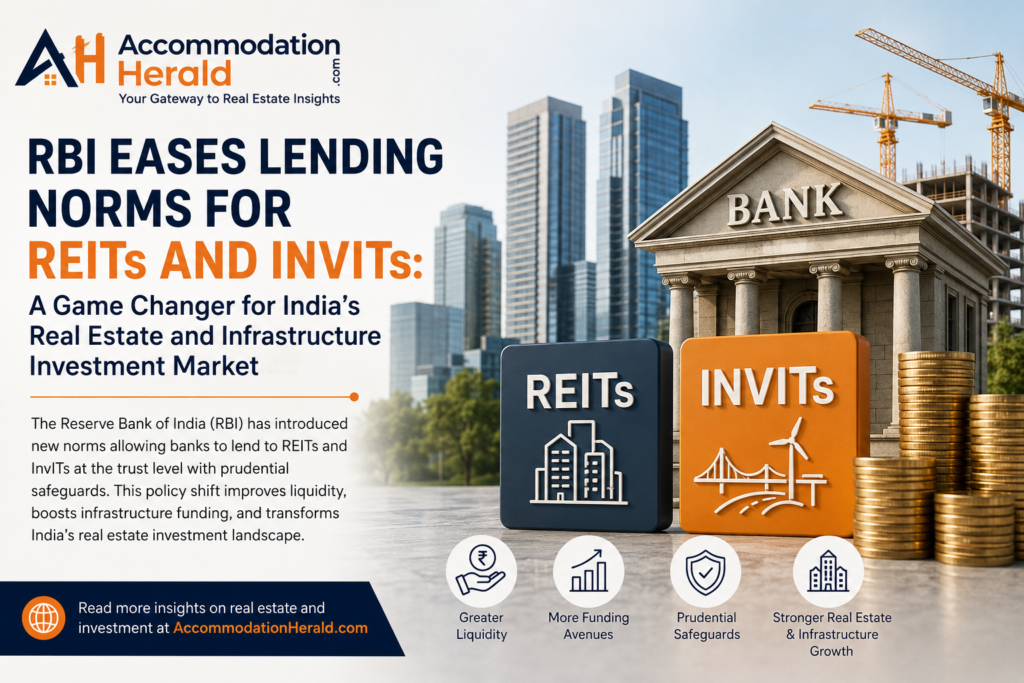
RBI Eases Lending Norms for REITs and InvITs: What the New Policy Means for India’s Real Estate and Infrastructure Investment Market.
The Reserve Bank of India (RBI) has introduced new norms allowing banks to lend to REITs and InvITs at the trust level with prudential safeguards. Explore how this policy shift improves liquidity, boosts infrastructure funding, and transforms India’s real estate investment landscape.
RBI’s Landmark Move: Allowing Bank Lending to REITs and InvITs – A Game Changer for India’s Investment Landscape
The Reserve Bank of India (RBI) has taken a significant and pragmatic step in strengthening India’s financial and infrastructure ecosystem by allowing commercial banks to extend lending support to Real Estate Investment Trusts (REITs) and Infrastructure Investment Trusts (InvITs) at the trust level.
This policy update marks a structural shift in how institutional capital flows into India’s real estate and infrastructure sectors. By enabling regulated bank financing—under strict prudential safeguards—the RBI aims to deepen liquidity, enhance capital efficiency, and expand funding avenues for large-scale asset development.
This article breaks down what the new policy means, why it matters, and how it could reshape India’s investment environment in the coming years.
Understanding REITs and InvITs in Simple Terms
Before diving into the RBI policy change, it is important to understand the two key instruments involved:
What are REITs?
Real Estate Investment Trusts (REITs) are investment vehicles that pool capital from multiple investors and invest in income-generating real estate assets such as:
- Commercial office spaces
- Shopping malls
- Rental housing projects
- Warehousing infrastructure
Investors earn returns through rental income and capital appreciation without directly owning property.
What are InvITs?
Infrastructure Investment Trusts (InvITs) are similar structures, but they focus on infrastructure assets such as:
- Roads and highways
- Power transmission lines
- Renewable energy projects
- Telecom towers
- Pipelines and logistics infrastructure
They provide retail and institutional investors exposure to long-term infrastructure cash flows.
The RBI Policy Update: What Has Changed?
The latest directive from the RBI allows commercial banks to lend to REITs and InvITs at the trust level, which was previously either restricted or not clearly defined under regulatory guidelines.
Earlier, units of REITs and InvITs were considered quasi-debt instruments with limited clarity on bank lending exposure. As a result, banks largely avoided providing direct financing against them.
Key Highlights of the New Guidelines:
- Banks can now lend directly to REITs and InvITs
- Lending is permitted at the trust level (not just SPV level exposure)
- Strong prudential safeguards are mandatory
- Exposure limits and risk management rules apply
- Restrictions remain on land acquisition financing
- Asset quality and repayment structures will be closely monitored
This is not a blanket relaxation but a controlled liberalisation with safeguards.
Why This Policy Change Matters
The RBI’s move is not just a regulatory adjustment—it is a structural reform that has implications for capital markets, real estate financing, and infrastructure development.
1. Unlocking Liquidity in Illiquid Assets
One of the biggest challenges with REITs and InvITs has been liquidity constraints. While they are listed instruments, their underlying assets are long-term and illiquid.
Bank lending introduces:
- Easier refinancing options
- Improved cash flow flexibility
- Reduced dependency on equity markets
- Better asset monetisation capabilities
This helps trusts manage capital more efficiently.
2. Expanding Funding Channels for Asset Creation
The Indian infrastructure and real estate sectors require massive capital investment. Traditional funding sources include:
- Equity markets
- Institutional investors
- NBFCs
- Foreign capital
Now, banks entering this ecosystem adds a new and stable funding pillar, enabling REITs and InvITs to:
- Acquire new assets
- Refinance existing projects
- Improve portfolio quality
- Scale faster without excessive dilution
3. Strengthening India’s Infrastructure Growth Model
India’s development pipeline—roads, energy networks, urban real estate, and logistics—requires long-term, patient capital.
InvITs, supported by bank credit, can now:
- Accelerate project completion
- Reduce funding bottlenecks
- Improve infrastructure monetisation cycles
This aligns with India’s broader economic growth strategy.
4. Institutional Confidence and Market Maturity
By allowing regulated bank participation, RBI is effectively signalling:
- Increased confidence in REIT and InvIT structures
- Greater maturity of India’s financial markets
- Stronger governance and transparency standards
This move is likely to increase both domestic and foreign institutional participation.
Prudential Safeguards: Ensuring Financial Stability
While the policy is liberal in spirit, it is tightly controlled in execution. The RBI has incorporated multiple safeguards to ensure financial stability.
Key Risk Controls Include:
1. Exposure Limits
Banks cannot overexpose themselves to REITs or InvITs beyond prescribed thresholds.
2. Asset Quality Requirements
Only high-quality, income-generating assets are expected to qualify for financing.
3. Structured Repayment Conditions
Loans must follow disciplined repayment structures aligned with cash flows.
4. Restrictions on Land Acquisition Financing
Banks are explicitly restricted from financing speculative land acquisition activities.
5. Risk Weighting and Monitoring
Enhanced supervision ensures risks are properly weighted and tracked.
These safeguards ensure that while liquidity improves, systemic risk remains contained.
Impact on Real Estate Sector
The Indian real estate sector stands to benefit significantly from this policy shift.
1. Improved Capital Recycling
Developers and asset owners can now monetize completed projects via REITs and reinvest capital into new developments.
2. Lower Cost of Capital
With banks entering the lending ecosystem, borrowing costs may become more competitive.
3. Increased Institutional Participation
More structured financing options will attract pension funds, sovereign wealth funds, and insurance companies.
4. Enhanced Transparency
Bank involvement demands higher compliance standards, improving overall sector governance.
Impact on Infrastructure Development
InvITs are central to India’s infrastructure financing strategy.
With bank lending support:
- Highway operators can refinance debt more efficiently
- Renewable energy projects can scale faster
- Telecom infrastructure expansion becomes easier
- Logistics and warehousing networks can grow rapidly
This creates a multiplier effect on economic development.
What This Means for Investors
For retail and institutional investors, this policy introduces both opportunities and indirect benefits:
Positive Impacts:
- More stable REIT and InvIT structures
- Better dividend consistency
- Improved asset backing
- Reduced financial stress on trusts
Potential Risks:
- Increased leverage in some structures
- Dependence on bank credit cycles
- Need for stronger regulatory monitoring
Overall, the direction is positive but requires careful risk management.
Long-Term Outlook: A Structural Evolution in Capital Markets
This RBI policy shift is not an isolated event—it is part of a broader evolution of India’s capital markets.
Over the next decade, we may see:
- REITs becoming mainstream retail investment products
- InvITs powering national infrastructure expansion
- Banks playing a larger role in structured real estate finance
- Greater integration between capital markets and credit markets
India is gradually moving toward a hybrid financing ecosystem, where equity, debt, and trust-based instruments work together seamlessly.
Conclusion
The RBI’s decision to allow banks to lend to REITs and InvITs represents a carefully balanced reform that enhances liquidity while maintaining financial discipline.
By opening new funding channels, the central bank is not only supporting real estate and infrastructure growth but also strengthening India’s long-term economic foundation.
For developers, investors, and financial institutions, this policy marks the beginning of a more dynamic, liquid, and structured investment environment.
As implementation unfolds, its true impact will be measured by how effectively it unlocks capital for India’s next phase of urban and infrastructure development.
Intellex Strategic Consulting Pvt Ltd
More Featured Articles:
Revenue-Based Finance in India 2026: The Ultimate Founder’s Guide to Non-Dilutive Growth Capital
Strategic Finance Options for Medical and Hospital Businesses in India (2026)
Personal Finance Red Flags Related To Savings & Emergency Planning
Personal Finance Red Flags Related To — Debt & Borrowing