
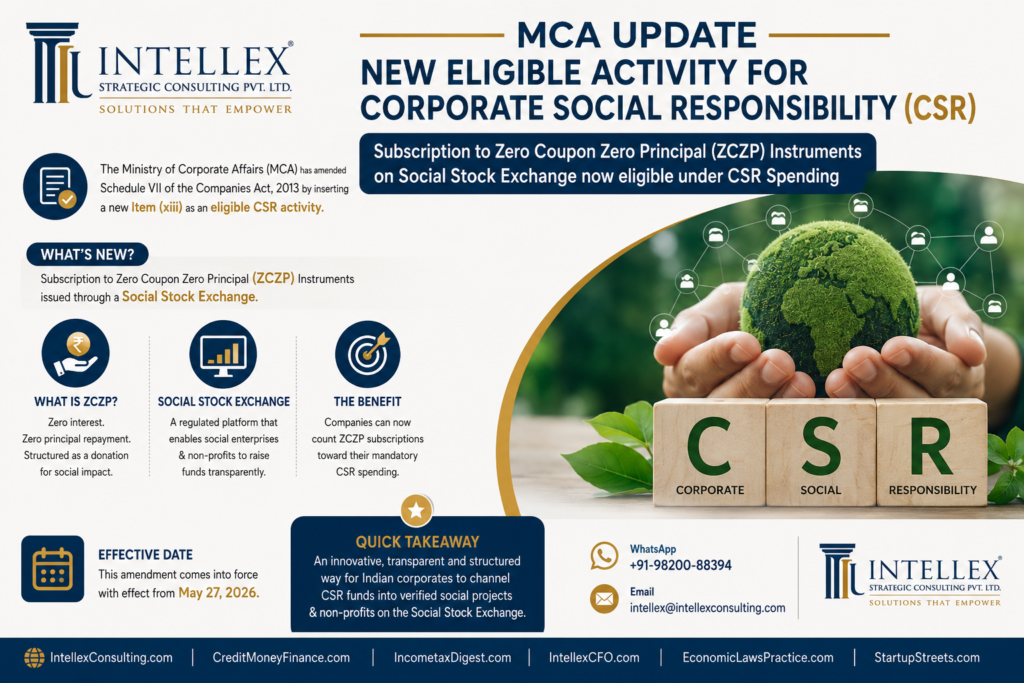
MCA Introduces New CSR Investment Route: Subscription to Zero Coupon Zero Principal (ZCZP) Instruments on Social Stock Exchange Now Eligible Under CSR Spending.
The Ministry of Corporate Affairs (MCA) has amended Schedule VII of the Companies Act, 2013, allowing CSR spending through subscription to Zero Coupon Zero Principal (ZCZP) instruments listed on the Social Stock Exchange. Learn the implications, benefits, compliance requirements, and opportunities for corporates.
The amendment introduces a new avenue through which companies can deploy their CSR funds by subscribing to Zero Coupon Zero Principal (ZCZP) Instruments issued through the Social Stock Exchange (SSE).
This reform is expected to improve transparency, accountability, and efficiency in the deployment of CSR funds while enabling social enterprises and non-profit organizations to access structured funding from the corporate sector.
Background: CSR Obligations under the Companies Act, 2013
Corporate Social Responsibility (CSR) is a mandatory compliance requirement under Section 135 of the Companies Act, 2013 for eligible companies.
A company is required to spend at least 2% of its average net profits of the preceding three financial years on CSR activities if it meets any of the following thresholds:
- Net worth of ₹500 crore or more
- Turnover of ₹1,000 crore or more
- Net profit of ₹5 crore or more
The permissible CSR activities are specified under Schedule VII of the Companies Act, 2013.
Over the years, Schedule VII has been expanded to accommodate evolving social priorities such as education, healthcare, environmental sustainability, rural development, gender equality, disaster relief, and contributions to government funds.
What Has Changed?
The MCA has inserted a new Item (xiii) in Schedule VII immediately after Item (xii).
Newly Added CSR Activity
Subscription to Zero Coupon Zero Principal Instruments issued through a Social Stock Exchange.
As a result, corporates can now treat investments made in eligible ZCZP instruments as qualifying CSR expenditure.
This amendment became effective immediately from May 27, 2026.
Understanding the Social Stock Exchange (SSE)
The Social Stock Exchange is an innovative platform established under the regulatory framework of the Securities and Exchange Board of India.
The objective of the SSE is to facilitate fundraising by:
- Non-Profit Organizations (NPOs)
- Social Enterprises
- Impact-driven institutions
- Development organizations
The platform brings greater transparency, governance, disclosure standards, and accountability to social impact financing.
The Social Stock Exchange operates through recognized stock exchanges and provides a regulated mechanism through which social organizations can raise funds from corporates, institutions, and individual contributors.
What are Zero Coupon Zero Principal (ZCZP) Instruments?
Zero Coupon Zero Principal Instruments are unique securities specifically designed for non-profit organizations.
Key Features
1. No Interest Component
The instrument does not provide any coupon or periodic interest payment to the subscriber.
2. No Principal Repayment
Unlike bonds or debentures, the investor does not receive the original amount invested upon maturity.
3. Social Impact Focus
The funds raised are entirely used for social and developmental projects undertaken by eligible organizations.
4. Structured Donation Mechanism
Although legally structured as a financial instrument, economically it functions like a donation intended to support social causes.
5. Enhanced Transparency
Since these instruments are issued through the Social Stock Exchange, corporates gain access to better reporting, disclosures, utilization tracking, and impact measurement.
Why Has the Government Introduced This Amendment?
The amendment aligns with India’s broader objective of creating innovative financing mechanisms for social development.
Some of the key policy objectives include:
Strengthening Social Enterprises
Many non-profit organizations struggle to access sustainable funding. The new provision provides them with a regulated fundraising avenue.
Better Utilization of CSR Funds
Companies often face challenges in identifying credible projects for CSR implementation. SSE-listed entities undergo regulatory scrutiny, making them more reliable recipients of CSR funds.
Increased Transparency
Funds raised through the SSE are subject to disclosure requirements and reporting standards, reducing concerns regarding misuse or inefficiency.
Encouraging Impact Investing
The framework encourages corporates to participate in measurable social impact initiatives.
Deepening India’s Social Capital Market
The amendment supports the government’s vision of creating a robust ecosystem where capital markets can contribute directly to social development.
Practical Implications for Companies
New CSR Spending Channel
Companies now have an additional option to fulfill CSR obligations beyond traditional implementation methods.
Reduced Execution Challenges
Instead of independently identifying and monitoring CSR projects, corporates can support verified social initiatives through SSE-listed entities.
Enhanced Governance
The SSE framework provides stronger governance and reporting standards compared to many conventional CSR deployment structures.
Better Documentation
Companies may find compliance reporting easier due to standardized disclosures available through the SSE ecosystem.
Portfolio-Based Social Impact
Corporates may diversify their CSR initiatives by supporting multiple social enterprises through various ZCZP instruments.
Benefits for Non-Profit Organizations
The amendment is equally beneficial for the social sector.
Access to Corporate CSR Capital
NPOs can now attract CSR funding through a recognized market platform.
Improved Visibility
Listing on the Social Stock Exchange increases visibility among corporate donors and institutional contributors.
Credibility Enhancement
The due diligence and disclosure framework associated with SSE listing enhances stakeholder confidence.
Sustainable Fundraising
Organizations gain access to a broader funding base rather than relying solely on grants and donations.
Compliance Considerations for Companies
Before treating ZCZP subscriptions as CSR expenditure, companies should ensure:
- The issuing entity is eligible under Social Stock Exchange regulations.
- The instrument qualifies as a valid ZCZP instrument.
- CSR Committee approvals are appropriately obtained.
- Board resolutions and CSR policies are updated where necessary.
- Proper documentation and reporting are maintained for annual CSR disclosures.
- Expenditure is aligned with applicable CSR Rules and MCA guidelines.
Companies should also monitor future clarifications from MCA and SEBI regarding operational aspects of implementation and reporting.
Impact on India’s CSR Landscape
India already has one of the world’s largest mandatory CSR regimes.
The inclusion of ZCZP instruments under Schedule VII represents a significant evolution in CSR regulation because it:
- Integrates capital market mechanisms with social development.
- Creates new funding opportunities for non-profits.
- Enhances transparency and accountability.
- Improves measurement of social outcomes.
- Encourages innovation in social finance.
This move could substantially increase the flow of corporate funds into impactful and scalable social projects across education, healthcare, environment, livelihood generation, women empowerment, rural development, and other priority sectors.
Expert Perspective
The MCA’s latest amendment reflects a progressive approach toward modernizing CSR implementation in India. By recognizing subscriptions to ZCZP instruments as an eligible CSR activity, the Government has created a bridge between corporate philanthropy and regulated social financing.
The amendment is expected to encourage greater participation from corporates in the Social Stock Exchange ecosystem while ensuring that CSR funds are deployed through transparent, accountable, and measurable channels.
As awareness and adoption grow, this mechanism could emerge as one of the most effective ways for companies to meet their CSR obligations while creating lasting social impact.
Conclusion
The MCA Notification dated May 27, 2026 marks a landmark development in India’s CSR framework. The inclusion of subscriptions to Zero Coupon Zero Principal (ZCZP) Instruments on the Social Stock Exchange as an eligible CSR activity broadens the avenues available to companies for fulfilling their CSR obligations.
The amendment promotes transparency, accountability, innovation, and impact-driven funding while strengthening India’s social enterprise ecosystem. Corporates should evaluate this new opportunity as part of their CSR strategy and governance framework going forward.
Professional Assistance for CSR Compliance, CSR Structuring & Corporate Advisory
Intellex Strategic Consulting Pvt. Ltd.
Our team assists corporates, listed entities, startups, NGOs, social enterprises, and business groups in matters relating to:
- CSR Compliance & Advisory
- CSR Policy Drafting
- CSR Committee Governance
- Social Stock Exchange Advisory
- Corporate Law Compliance
- Companies Act Compliance
- ROC Filings
- ESG & Sustainability Advisory
- Governance Frameworks
- Business Structuring & Strategic Consulting
WhatsApp: +91-98200-88394
Email: intellex@intellexconsulting.com
Websites:
- IntellexConsulting.com
- CreditMoneyFinance.com
- IncometaxDigest.com
- IntellexCFO.com
- EconomicLawsPractice.com
- StartupStreets.com
For professional guidance on CSR implementation, Social Stock Exchange participation, and corporate compliance matters, connect with Intellex Strategic Consulting Pvt. Ltd.