
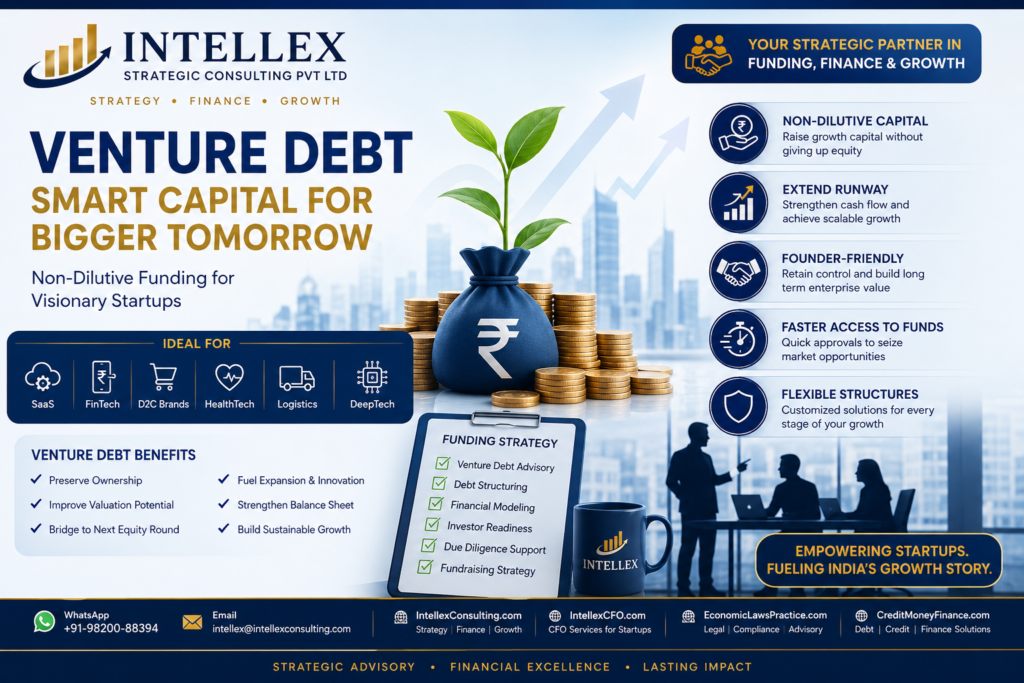
Venture Debt in India: The Complete 2026 Guide for Startups, Founders, CFOs & Growth Companies.
Venture Debt in India 2026: Complete Guide for Startups, Founders, Eligibility, Lenders, Terms, Risks & Funding Strategies
Discover everything Indian startups need to know about Venture Debt in 2026. Learn how venture debt works, eligibility criteria, lender terms, repayment structures, risks, benefits, and the complete list of venture debt lenders in India. Expert advisory by Intellex Strategic Consulting Pvt Ltd.
Introduction: The Rise of Venture Debt in India
India’s startup ecosystem has matured significantly over the last decade. What was once a predominantly equity-driven fundraising environment has now evolved into a sophisticated capital market offering multiple financing instruments for startups and growth-stage companies.
Among these financing instruments, Venture Debt has emerged as one of the most important and founder-friendly sources of capital.
Indian startups today are increasingly looking beyond pure equity funding because repeated equity dilution can reduce founder ownership, affect investor control, and significantly dilute long-term wealth creation. Venture debt solves this challenge by providing growth capital without excessive dilution.
The Indian venture debt ecosystem has witnessed tremendous growth due to:
- Increasing maturity of startup ecosystems
- Larger VC-backed startup universe
- Growing confidence among institutional lenders
- Better startup governance standards
- Rise of SaaS, fintech, D2C and recurring revenue businesses
- Increased demand for non-dilutive growth capital
According to leading industry participants like Alteria Capital and emerging debt platforms such as Recur Club, venture debt adoption among Indian startups has accelerated substantially in recent years.
Today, venture debt is no longer viewed as “alternative financing.” Instead, it has become a mainstream strategic financing tool for Indian startups.
What is Venture Debt?
Venture debt is a form of non-dilutive debt financing provided primarily to venture capital-backed startups and high-growth businesses.
Unlike traditional bank loans, venture debt lenders focus less on profitability or hard collateral and more on:
- Quality of venture capital investors
- Revenue growth trajectory
- Unit economics
- Founder quality
- Scalability potential
- Future fundraising capability
In simple terms:
Venture debt helps startups raise capital without giving away additional equity ownership.
How Venture Debt Works
Typically, a startup raises venture debt after completing a venture capital equity round.
Example:
- Startup raises ₹50 Crores equity funding
- Venture debt lender offers additional ₹10–20 Crores debt facility
- Startup uses debt capital for growth
- Founders preserve ownership dilution
This creates a balanced capital structure.
Why Indian Startups Prefer Venture Debt
1. Reduced Equity Dilution
This is the biggest advantage.
Instead of raising 100% equity capital, founders use debt to reduce dilution.
For example:
- Equity raise: ₹100 Cr
- Alternative structure:
- ₹70 Cr equity
- ₹30 Cr venture debt
This preserves founder ownership significantly.
2. Extending Cash Runway
Startups use venture debt to:
- Extend runway by 12–24 months
- Delay next fundraising round
- Achieve better valuation before next equity raise
3. Growth Capital Without Loss of Control
Debt financing avoids:
- Excessive investor rights
- Board control dilution
- Additional liquidation preferences
- Strategic interference
4. Faster Access to Capital
Compared to VC rounds, venture debt can often be raised faster.
Some lenders now claim approvals within days.
5. Suitable for Asset-Light Startups
Traditional banks usually hesitate to fund startups lacking:
- Tangible collateral
- Profits
- Long operating history
Venture debt lenders specialize in precisely such businesses.
Types of Venture Debt in India
1. Growth Venture Debt
Used for:
- Expansion
- Hiring
- Product scaling
- Market expansion
2. Working Capital Debt
Used for:
- Inventory financing
- Vendor payments
- Receivable cycles
Popular among D2C and ecommerce startups.
3. Equipment Financing
Used for:
- Machinery
- Tech infrastructure
- Manufacturing equipment
4. Revenue-Based Financing
Repayments linked to monthly revenues.
Very useful for SaaS startups.
5. Acquisition Financing
Used for mergers, acquisitions or strategic buys.
Venture Debt vs Venture Capital
| Parameter | Venture Debt | Venture Capital |
|---|---|---|
| Ownership Dilution | Minimal | High |
| Repayment Required | Yes | No |
| Interest Cost | Yes | No |
| Equity Warrants | Sometimes | Full Equity |
| Founder Control | Higher | Lower |
| Speed | Faster | Slower |
| Ideal Stage | Post traction | Early/Growth |
Typical Venture Debt Structure in India
Most Indian venture debt deals include:
Loan Size
Usually:
- 20%–40% of last equity raise
Interest Rates
Typically:
- 12%–18% annually
Depends on:
- Startup risk
- Revenue
- Investors
- Burn rate
- Sector
Tenure
Usually:
- 12–48 months
Moratorium
Initial repayment holiday:
- 3–12 months
Warrants
Some lenders seek small equity upside:
- 0.1%–2% equity warrants
Eligibility Criteria for Venture Debt in India
Most lenders evaluate the following:
1. VC Backing
Strong institutional investors improve approval chances dramatically.
Alteria Capital specifically highlights institutional backing as a major criterion.
2. Revenue Visibility
Startups with predictable revenues are preferred.
Especially:
- SaaS
- Fintech
- B2B platforms
- D2C brands
- Logistics tech
3. Growth Metrics
Lenders assess:
- ARR/MRR growth
- CAC/LTV
- Burn multiple
- Gross margins
- Retention
4. Governance Standards
Important factors include:
- Audited financials
- Proper compliances
- Board governance
- MIS systems
5. Future Fundraising Potential
Lenders want confidence that:
- Startup can raise future equity
- Debt can eventually be refinanced or repaid
Startups Most Suitable for Venture Debt
Ideal Sectors
SaaS Companies
Strong recurring revenues.
Fintech Startups
Large scalable markets.
D2C Brands
Inventory-heavy but high-growth businesses.
Healthtech
Growing investor interest.
Logistics & Supply Chain
Asset-light scaling potential.
EV & Climate Tech
Rapidly emerging category.
When Should Startups Raise Venture Debt?
Best Timing
Immediately After Equity Raise
This is the most common timing.
Reason:
- Balance sheet strongest
- Investor confidence highest
- Cash runway longest
Before Major Expansion
Useful for:
- Geographic expansion
- Marketing growth
- Hiring
To Avoid Down Round
Debt helps avoid raising low-valuation equity.
Key Risks of Venture Debt
While venture debt is powerful, it is not risk-free.
1. Fixed Repayment Obligations
Unlike equity, debt requires repayments.
Poor cash flows can create pressure.
2. Default Risk
Failure to repay may lead to:
- Legal action
- Security enforcement
- Investor pressure
3. Financial Covenants
Lenders may impose:
- Minimum cash balance
- Revenue milestones
- Reporting obligations
4. Higher Cost Than Traditional Loans
Interest rates are higher because startups are riskier.
Important Financial Metrics Lenders Track
ARR/MRR
Annual or Monthly Recurring Revenue.
Burn Rate
Monthly cash consumption.
Runway
Months before cash exhaustion.
Gross Margins
Important for sustainability.
Customer Retention
Strong retention reduces lender risk.
Complete List of Venture Debt Lenders in India (2026)
1. Alteria Capital
One of India’s leading dedicated venture debt funds. Focuses on VC-backed startups across sectors. Has funded 200+ companies and multiple unicorns.
Typical Features
- Growth debt
- Structured debt
- Flexible financing
- Startup-focused underwriting
2. Trifecta Capital
Among the earliest large-scale venture debt platforms in India.
Focus Areas
- Technology startups
- Growth-stage companies
- Venture-backed businesses
Typical Ticket Size
₹5 Cr to ₹100 Cr+
3. Stride Ventures
One of India’s fastest-growing venture debt firms.
Popular Among
- Growth startups
- Consumer brands
- Tech companies
4. InnoVen Capital
Strong presence across India and Southeast Asia.
Key Features
- Venture lending
- Revenue financing
- Flexible structures
5. Recur Club
AI-powered non-dilutive financing marketplace with 100+ lending partners.
Suitable For
- Revenue-generating startups
- SMEs
- SaaS companies
Claimed Benefits
- Fast approvals
- Multiple lender access
- Non-dilutive structures
6. BlackSoil
Provides structured debt and venture financing solutions.
Popular Among
- D2C startups
- Growth-stage companies
- NBFCs
7. Nuvama Private Credit
Focused on structured credit and growth financing.
8. Alteria Short Duration Scheme
Specialized financing structures for short-duration startup needs.
9. UC Inclusive Credit
Works with startups and emerging businesses.
10. Oxyzo
Popular among manufacturing and B2B businesses.
11. GetVantage
Revenue-based financing alternative.
Ideal for:
- Ecommerce
- D2C
- SaaS
12. Velocity
Provides growth capital linked to revenues.
13. Titan Capital Debt
Emerging startup financing participant.
14. SIDBI
Government-backed development finance institution supporting startups and MSMEs.
15. Traditional Banks Entering Startup Lending
Several banks are now building startup-focused financing verticals.
Examples include:
- HDFC Bank
- ICICI Bank
- Kotak Mahindra Bank
- Axis Bank
Venture Debt Documentation Requirements
Typical documents include:
- Pitch deck
- Cap table
- Financial projections
- Audited financials
- GST returns
- Bank statements
- Shareholder agreements
- Board resolutions
- MIS reports
- Revenue analytics
How Startups Should Prepare Before Applying
1. Clean Financial Reporting
Invest in strong finance systems.
2. Improve Unit Economics
Focus on sustainable growth.
3. Build Institutional Governance
Professional boards and compliance improve lender confidence.
4. Prepare Investor References
Lenders often speak to VCs.
How Investors View Venture Debt
Most sophisticated VCs support venture debt because:
- It improves capital efficiency
- Extends runway
- Delays dilution
- Enhances valuation potential
However, excessive leverage may concern investors.
Balance is critical.
Venture Debt Trends in India (2026)
India’s venture debt market is evolving rapidly.
Current trends include:
1. Rise of AI-Based Credit Assessment
Platforms like Recur Club use AI-based underwriting models.
2. More Structured Credit Products
Customized debt structures are increasing.
3. Revenue-Based Financing Growth
Popular among SaaS and D2C startups.
4. Expansion Beyond Metro Cities
Tier-2 startup ecosystems now attracting debt funding.
5. Increased Institutional Participation
Private credit funds and NBFCs are entering startup financing aggressively.
Common Mistakes Startups Make
Overleveraging
Taking excessive debt without repayment visibility.
Poor Cash Flow Planning
Ignoring repayment schedules.
Raising Debt Too Early
Pre-revenue startups may struggle with debt obligations.
Weak Compliance Systems
Poor governance reduces lender trust.
How Intellex Strategic Consulting Pvt Ltd Can Help Startups
Raising venture debt requires:
- Financial structuring
- Investor readiness
- Due diligence preparation
- Documentation
- Financial modelling
- Negotiation expertise
This is where professional advisory becomes critical.
Our Services Include
- Venture debt advisory
- Startup fundraising strategy
- Financial modelling
- Investor documentation
- Due diligence preparation
- Pitch deck support
- Debt structuring
- Capital raise strategy
- CFO advisory
- Compliance and governance support
About Intellex Strategic Consulting Pvt Ltd
Intellex Strategic Consulting Pvt Ltd is a specialized advisory and consulting platform supporting startups, SMEs, growth companies, investors and entrepreneurs across India.
Contact Details
- WhatsApp: +91-98200-88394
- Email: intellex@intellexconsulting.com
Websites
Final Thoughts
Venture debt has become one of the most important financing instruments in the Indian startup ecosystem.
As startup founders become more financially sophisticated, the preference for balanced capital structures is increasing rapidly.
The future belongs to founders who understand how to strategically combine:
- Equity
- Venture debt
- Revenue financing
- Structured credit
- Working capital instruments
The Indian startup ecosystem is entering a phase where financial strategy will become as important as product innovation.
For founders seeking growth without excessive dilution, venture debt can become a transformational financing tool — provided it is structured properly with the right advisory support.
India’s startup financing landscape is only getting bigger, deeper and more sophisticated — and venture debt is now firmly at the center of that evolution.
Intellex Strategic Consulting Pvt Ltd
More Featured Finance Posts:
Debt Funding for Businesses in India: Raise ₹30 Lakhs to ₹200 Crore with the Right Capital Partners.
Looking for Strategic Acquisition Opportunities in Listed NBFCs in India:
Infrastructure Finance in India: Concept, Evolution, Key Players, and the Road Ahead.
Kotak Mahindra Bank – SME & Wholesale Lending Solutions (₹7–200 Cr)
SIDBI – Powering India’s MSME Growth: Funding, Schemes & Business Support
Breaking the Ceiling: 10 IPO Myths Holding SME Promoters Back.