
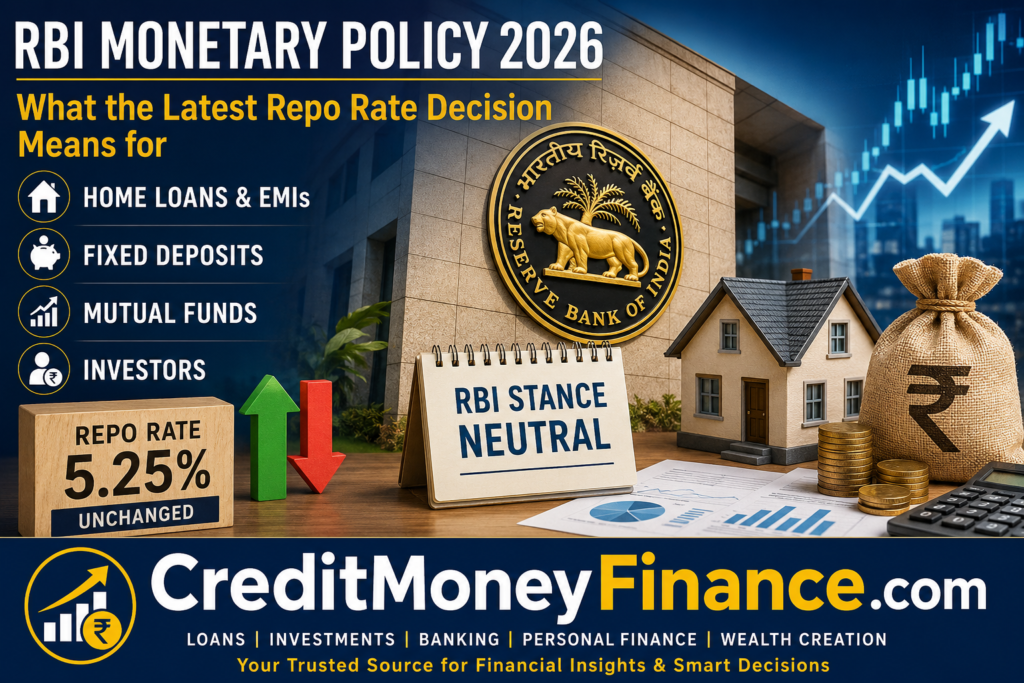
RBI Monetary Policy 2026 Explained: What the Latest Repo Rate Decision Means for Home Loans, EMIs, Fixed Deposits, Mutual Funds and Investors.
The RBI has kept the repo rate unchanged at 5.25% in its latest Monetary Policy Committee meeting. Discover what this means for home loans, EMIs, fixed deposits, stock markets, mutual funds, and Indian investors in 2026.
RBI Monetary Policy 2026 Explained: What the Latest Repo Rate Decision Means for Home Loans, EMIs, Fixed Deposits, Mutual Funds and Investors
The Reserve Bank of India (RBI) plays a critical role in shaping the country’s economic landscape through its monetary policy decisions. Every change—or even the decision to maintain the status quo—in the repo rate affects millions of borrowers, depositors, businesses, and investors across India.
In its latest Monetary Policy Committee (MPC) meeting held in June 2026, the RBI decided to keep the benchmark repo rate unchanged at 5.25% while maintaining a neutral policy stance. The central bank cited concerns regarding global geopolitical tensions, rising energy prices, inflationary risks, and uncertainty in international markets as key reasons for adopting a cautious approach. The RBI also revised its FY2026-27 GDP growth forecast downward to 6.6% and raised its inflation forecast to 5.1%.
For ordinary Indians, the big question remains:
How does this RBI decision affect home loans, EMIs, fixed deposits, mutual funds, stock markets, and personal finances?
Let’s examine the implications in detail.
Understanding the Repo Rate
The repo rate is the interest rate at which commercial banks borrow money from the RBI against government securities.
When the RBI:
- Raises the repo rate, borrowing becomes costlier.
- Cuts the repo rate, borrowing becomes cheaper.
- Keeps the repo rate unchanged, lending and deposit rates generally remain stable in the short term.
The repo rate currently stands at 5.25%, and the RBI has retained a neutral stance, indicating that future actions will depend on inflation and economic developments.
Why Did RBI Keep Rates Unchanged?
Several factors influenced the RBI’s decision:
1. Inflation Risks Remain Elevated
While retail inflation has remained within the RBI’s target range, rising fuel prices and geopolitical tensions continue to pose inflationary threats. The RBI has increased its inflation projection for FY2026-27 to 5.1%.
2. Global Uncertainty
Conflicts in West Asia, volatile crude oil prices, and supply chain disruptions have increased uncertainty in global markets.
3. Growth Needs Protection
India’s economic growth remains strong compared to many major economies, but the RBI has slightly lowered its GDP growth forecast to 6.6%, indicating a need to support growth while managing inflation.
4. Wait-and-Watch Approach
The MPC emphasized that premature rate changes could be risky given the uncertain global environment, preferring to monitor incoming data before taking further action.
Impact on Home Loans and EMIs
For millions of homeowners and prospective borrowers, the RBI’s decision comes as welcome news.
Existing Home Loan Borrowers
If your loan is linked to an External Benchmark Lending Rate (EBLR), particularly the repo rate, your EMI is unlikely to change immediately because the repo rate remains unchanged.
What This Means
- No immediate increase in EMI burden.
- No reduction in monthly installments.
- Borrowers continue enjoying the benefit of the rate cuts seen during 2025.
For example:
A borrower with a ₹50 lakh home loan at 8% interest will likely continue paying the same EMI unless banks independently adjust lending rates.
New Home Loan Applicants
Those planning to purchase homes in 2026 continue to benefit from a relatively favorable interest rate environment compared to the high-rate cycle experienced globally over the last few years.
Competition among banks and housing finance companies may still result in attractive offers despite the unchanged repo rate.
What Does It Mean for Fixed Deposit Investors?
Fixed Deposit (FD) investors form one of the largest groups of savers in India.
The unchanged repo rate suggests that banks are unlikely to significantly increase FD rates in the immediate future.
Good News for Existing FD Holders
Those who locked in higher FD rates during the rate-cutting cycle of 2025 may continue enjoying attractive returns.
For New Investors
Banks may maintain current FD rates for some time, but substantial hikes appear unlikely unless inflation rises sharply and forces the RBI to tighten policy.
FD Strategy for 2026
Investors may consider:
- Laddering FD investments.
- Splitting deposits across different maturities.
- Locking longer-tenure FDs if attractive rates are available.
Impact on Personal Loans and Auto Loans
Most floating-rate personal loans and vehicle loans are also influenced by repo-linked lending rates.
Since the repo rate remains stable:
- Personal loan rates are expected to remain largely unchanged.
- Auto loan rates should stay steady.
- Consumer financing costs are unlikely to rise in the near term.
This stability supports consumer spending and demand across sectors.
What Does It Mean for Stock Market Investors?
Stock markets closely monitor every RBI policy announcement.
Positive Signals
The RBI’s decision indicates confidence in the resilience of India’s economy despite global challenges.
Sectoral Impact
Banking Sector
Banks benefit from:
- Stable borrowing costs.
- Predictable lending margins.
- Strong credit growth prospects.
Real Estate Sector
Unchanged home loan rates support housing demand and real estate activity.
Automobile Sector
Stable financing costs encourage vehicle purchases.
Infrastructure and Capital Goods
Lower uncertainty helps long-term investment planning.
Impact on Mutual Fund Investors
Debt Mutual Funds
Debt fund investors should closely watch interest rate trends.
With the RBI holding rates steady:
- Short-duration debt funds may continue delivering stable returns.
- Medium-duration funds could benefit if future rate cuts emerge.
- Long-duration funds may remain sensitive to inflation developments.
Equity Mutual Funds
A stable interest rate environment generally supports:
- Corporate earnings growth.
- Economic expansion.
- Investor confidence.
Sectors such as banking, financial services, infrastructure, and consumer discretionary may continue attracting investor interest.
What Should Retail Investors Do Now?
The current RBI policy environment calls for balance rather than aggressive positioning.
For Conservative Investors
Focus on:
- Fixed deposits
- Debt funds
- Government securities
- Senior citizen savings schemes
For Growth-Oriented Investors
Continue systematic investments through:
- SIPs in diversified equity funds
- Index funds
- Flexi-cap funds
- Large-cap mutual funds
For Home Buyers
Current rates remain attractive by historical standards. Those planning genuine home purchases may not need to delay decisions solely in anticipation of lower rates.
Key Risks Investors Must Monitor
Several developments could influence future RBI decisions:
Crude Oil Prices
India remains heavily dependent on imported energy. Rising oil prices can fuel inflation.
Global Geopolitical Events
Conflicts and trade disruptions can impact growth and inflation.
Monsoon Performance
Agriculture continues to influence food inflation and rural demand.
Currency Movements
The rupee’s performance against the US dollar remains an important factor in inflation management.
Outlook: What Could RBI Do Next?
The RBI’s neutral stance indicates flexibility rather than commitment to a specific direction.
Possible scenarios include:
Scenario 1: Inflation Remains Under Control
The RBI could maintain rates or even consider accommodative measures to support growth.
Scenario 2: Inflation Accelerates
The central bank may be compelled to raise rates to protect price stability.
Scenario 3: Growth Slows Sharply
Further monetary support could emerge through rate cuts or liquidity measures.
For now, most analysts expect the RBI to remain cautious and data-dependent over the coming quarters.
Final Thoughts
The RBI’s latest monetary policy decision reflects a delicate balancing act between controlling inflation and sustaining economic growth. By keeping the repo rate unchanged at 5.25%, the central bank has provided stability to borrowers, depositors, businesses, and investors while preserving flexibility for future action.
For Indian households, the immediate takeaway is clear:
- Home loan EMIs remain stable.
- Fixed deposit returns are likely to hold steady.
- Borrowing costs remain manageable.
- Equity and debt investors can continue investing with a long-term perspective.
As always, successful investing depends not on predicting every RBI move but on maintaining discipline, diversification, and a long-term financial strategy.
Published by CreditMoneyFinance.com – Your Trusted Source for Personal Finance, Investments, Banking, Loans, and Wealth Creation Insights.
More Featured Posts:
Strategic Growth Capital for Manufacturing Businesses in India.
9 Powerful Business Rules to Outgrow Competition and Build a Market-Dominating Enterprise.
SME IPO in India: A Comprehensive Guide for Growing Businesses Looking to Go Public: