
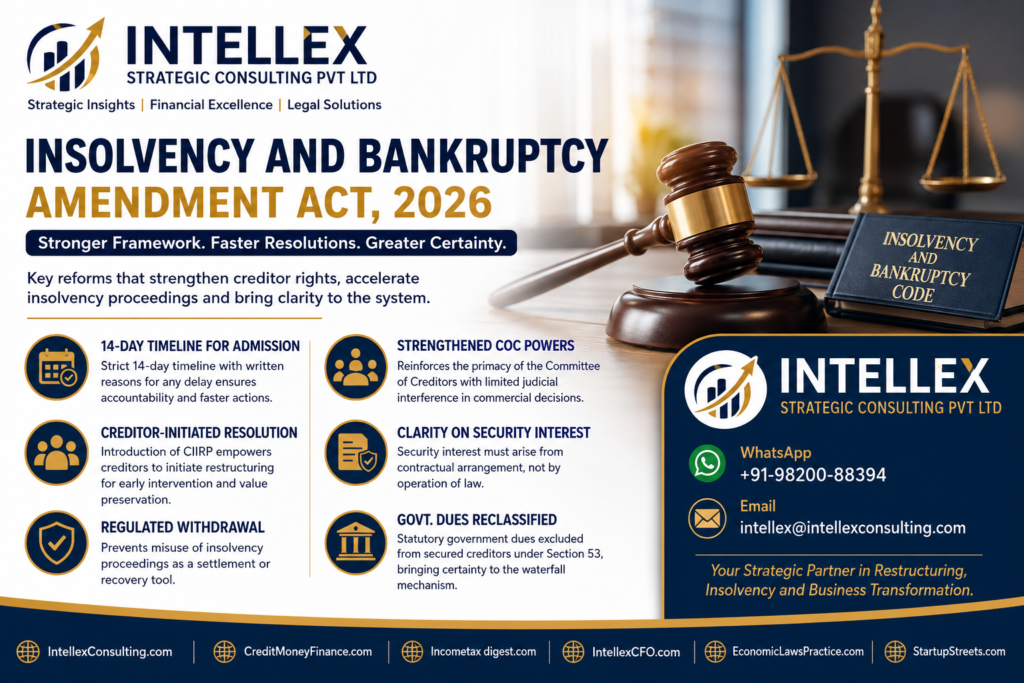
Insolvency and Bankruptcy Code (Amendment) Act, 2026: Transforming India’s Insolvency Framework Through Faster Resolution, Stronger Creditor Rights, and Greater Legal Certainty.
Explore the key provisions, implications, and business impact of the Insolvency and Bankruptcy Code (Amendment) Act, 2026. Learn how the new reforms strengthen creditor rights, introduce CIIRP, clarify priority of government dues, accelerate insolvency admissions, and improve India’s restructuring ecosystem.
Insolvency and Bankruptcy Code (Amendment) Act, 2026: A Landmark Reform for India’s Credit and Restructuring Ecosystem
India’s insolvency framework has undergone another significant transformation with the enactment of the Insolvency and Bankruptcy Code (Amendment) Act, 2026. Since the introduction of the Insolvency and Bankruptcy Code (IBC) in 2016, the law has fundamentally reshaped the country’s credit culture by providing a structured mechanism for resolving corporate distress.
However, over the years, practical implementation exposed several challenges, including delays in admission of insolvency applications, excessive litigation, uncertainty regarding creditor priorities, and attempts to use insolvency proceedings as debt recovery tools.
The 2026 amendment seeks to address these concerns through targeted but far-reaching reforms that strengthen creditor rights, accelerate insolvency proceedings, enhance certainty in recoveries, and reduce judicial intervention in commercial matters.
The amendments are expected to significantly improve the efficiency, predictability, and effectiveness of India’s insolvency regime while reinforcing confidence among lenders, investors, and stakeholders.
Background: Why the 2026 Amendment Was Necessary
Despite the success of the IBC framework, several issues continued to impact timely resolution:
- Delays in admission of insolvency petitions.
- Frequent litigation at the threshold stage.
- Judicial scrutiny extending into commercial decisions of creditors.
- Ambiguity regarding government dues secured through statutory charges.
- Misuse of insolvency proceedings for settlement negotiations.
- Prolonged timelines resulting in erosion of enterprise value.
These challenges often undermined the core objective of the IBC maximization of value through time-bound resolution.
The Insolvency and Bankruptcy Code (Amendment) Act, 2026 aims to address these structural bottlenecks and reinforce the original legislative intent.
Key Amendments Under the Insolvency and Bankruptcy Code (Amendment) Act, 2026
1. Reinforcement of the 14-Day Timeline for Admission of Insolvency Applications
One of the most significant reforms is the strengthening of the statutory requirement that insolvency applications be admitted or rejected within 14 days.
What Has Changed?
The amendment now requires adjudicating authorities to:
- Adhere to the prescribed 14-day timeline.
- Record written reasons whenever the timeline cannot be met.
- Ensure greater accountability in admission proceedings.
Impact of the Amendment
The introduction of a “comply or explain” framework is expected to:
- Reduce procedural delays.
- Enhance transparency.
- Promote institutional accountability.
- Improve predictability for creditors and debtors.
This amendment seeks to ensure that insolvency proceedings commence without unnecessary delay, preserving the value of distressed businesses.
2. Default-Based Determination at the Admission Stage
The amendment narrows the scope of disputes that can be raised during admission of insolvency applications.
Earlier Scenario
Debtors frequently raised:
- Technical objections.
- Procedural challenges.
- Preliminary disputes.
- Jurisdictional arguments.
Such objections often delayed admission for months or even years.
New Framework
The focus is now squarely on determining whether:
- A financial debt exists.
- A default has occurred.
The amendment discourages extensive litigation at the admission stage and limits opportunities for dilatory tactics.
Business Significance
The change promotes:
- Faster initiation of insolvency proceedings.
- Reduced litigation costs.
- Greater certainty for creditors.
- Efficient utilization of judicial resources.
Introduction of Creditor-Initiated Insolvency Resolution Process (CIIRP)
Perhaps the most transformative reform is the introduction of the Creditor-Initiated Insolvency Resolution Process (CIIRP).
What is CIIRP?
CIIRP provides creditors with a restructuring mechanism that allows intervention at an earlier stage of financial distress without necessarily requiring a full-fledged Corporate Insolvency Resolution Process (CIRP).
The framework is intended to facilitate:
- Early restructuring.
- Business preservation.
- Faster negotiations.
- Reduced insolvency costs.
Objectives of CIIRP
The new mechanism aims to:
Early Detection of Financial Stress
Creditors can initiate corrective action before value destruction becomes irreversible.
Business Continuity
Companies can explore restructuring options while preserving operations.
Lower Costs
Avoiding full CIRP proceedings may significantly reduce legal and administrative expenses.
Improved Recoveries
Earlier intervention generally results in higher recoveries for creditors.
Strengthening the Primacy of the Committee of Creditors (CoC)
The amendment further reinforces the commercial authority of the Committee of Creditors.
Existing Position
Indian courts have repeatedly held that commercial decisions of the CoC should not ordinarily be interfered with.
However, litigation frequently challenged:
- Resolution plans.
- Distribution mechanisms.
- Commercial wisdom of creditors.
What the Amendment Does
The 2026 amendment explicitly strengthens:
- Creditor autonomy.
- Commercial decision-making.
- Resolution flexibility.
At the same time, it limits judicial review of purely commercial matters.
Benefits
Faster Resolutions
Reduced litigation means fewer delays.
Greater Predictability
Investors and lenders gain confidence in outcomes.
Improved Market Confidence
Financial institutions can make commercial decisions without fear of excessive judicial intervention.
Regulation of Withdrawal of Insolvency Proceedings
Another important reform addresses the growing concern that insolvency proceedings were being used primarily as recovery and settlement tools.
The Issue
In many cases:
- Insolvency applications were filed merely to pressure debtors.
- Settlements were negotiated after admission.
- Proceedings were withdrawn after achieving recovery objectives.
This diluted the purpose of the insolvency framework.
Amendment Measures
The new provisions introduce safeguards to ensure:
- Genuine use of insolvency mechanisms.
- Disciplined settlement practices.
- Prevention of procedural abuse.
Expected Outcomes
The reforms help maintain the integrity of the insolvency ecosystem and ensure that insolvency remains a restructuring mechanism rather than a coercive recovery tool.
Clarification of Security Interest and Government Dues
One of the most consequential amendments relates to the treatment of government dues under the IBC.
Historical Controversy
A long-standing dispute existed regarding whether statutory charges created under various laws entitled government authorities to be treated as secured creditors.
Several government departments asserted priority over secured lenders based on:
- Tax laws.
- Revenue recovery statutes.
- State enactments creating statutory charges.
This created uncertainty in insolvency distributions.
Amendment to Section 3(31): Defining Security Interest
The amendment introduces an Explanation to Section 3(31) clarifying that:
A security interest must arise from a contractual arrangement between parties and cannot be created solely by operation of law.
This clarification has major implications.
What It Means
Statutory charges arising under:
- Tax laws
- Revenue statutes
- Government recovery provisions
will no longer qualify as security interests for purposes of the IBC unless supported by contractual arrangements.
Impact on Section 53 Waterfall Mechanism
The amendment directly affects the distribution hierarchy under Section 53.
Earlier Position
Government authorities frequently argued that statutory charges elevated their claims to secured creditor status.
This led to:
- Litigation.
- Conflicting interpretations.
- Delayed distributions.
New Position
Government dues secured solely through statutory charges are excluded from the category of secured creditors.
As a result:
- Financial creditors retain priority.
- Waterfall distribution becomes clearer.
- Litigation is expected to reduce significantly.
Major Implications for Stakeholders
1. Faster Insolvency Admissions
The strengthened 14-day admission framework will:
- Accelerate commencement of proceedings.
- Reduce procedural bottlenecks.
- Preserve enterprise value.
Businesses facing distress can expect quicker outcomes and reduced uncertainty.
2. Enhanced Rights of Financial Creditors
Financial creditors emerge as major beneficiaries of the amendment.
Advantages include:
- Stronger CoC control.
- Clearer recovery rights.
- Reduced litigation.
- Improved resolution outcomes.
The reforms further align the insolvency regime with international creditor-driven restructuring models.
3. Greater Legal Certainty
The clarification regarding security interests resolves years of uncertainty.
Stakeholders now have:
- Predictable recovery expectations.
- Clear priority rankings.
- Reduced legal disputes.
Such certainty is critical for lending institutions, investors, and distressed asset funds.
4. Better Recovery Prospects for Lenders
By excluding statutory charges from secured creditor status, the amendment improves recovery prospects for:
- Banks.
- Financial institutions.
- Asset reconstruction companies.
- Bondholders.
This may positively influence credit availability and lending confidence.
5. Reduced Judicial Intervention
The amendment reinforces the principle that commercial decisions belong to creditors rather than courts.
This promotes:
- Speed.
- Efficiency.
- Commercial pragmatism.
It also aligns Indian insolvency jurisprudence with global best practices.
Impact on Businesses, Banks, Investors, and Insolvency Professionals
Corporate Borrowers
Companies may experience:
- Faster resolution processes.
- Earlier restructuring opportunities through CIIRP.
- Reduced uncertainty during financial distress.
Banks and Financial Institutions
Lenders stand to benefit from:
- Higher recoveries.
- Stronger control.
- Reduced litigation costs.
Investors
Private equity funds, distressed asset investors, and strategic acquirers gain:
- Greater transparency.
- Predictable resolution timelines.
- Improved investment confidence.
Insolvency Professionals
The new framework creates opportunities for:
- Early-stage restructuring assignments.
- CIIRP implementation.
- Complex creditor negotiations.
Conclusion
The Insolvency and Bankruptcy Code (Amendment) Act, 2026 represents a decisive step toward creating a faster, creditor-centric, and commercially efficient insolvency ecosystem in India.
By reinforcing the 14-day admission timeline, introducing the Creditor-Initiated Insolvency Resolution Process (CIIRP), strengthening the authority of the Committee of Creditors, regulating withdrawal of proceedings, and clarifying the treatment of statutory government dues, the amendment addresses several long-standing challenges that have affected insolvency resolution in practice.
Most importantly, the clarification that security interests must arise from contractual arrangements restores certainty to the Section 53 waterfall mechanism and significantly strengthens the position of secured lenders.
As India continues to deepen its credit markets and attract investment, these reforms are expected to improve recovery rates, reduce litigation, enhance creditor confidence, and promote a more robust restructuring environment for distressed businesses.
Professional Advisory and Implementation Support
For advisory, compliance, restructuring, insolvency planning, creditor strategy, CIRP support, CIIRP implementation, distressed asset transactions, lender negotiations, and insolvency-related legal and financial consulting services, organizations may seek professional assistance from:
Intellex Strategic Consulting Pvt. Ltd.
WhatsApp: +91-98200-88394
Email: intellex@intellexconsulting.com
Websites:
- Intellex Consulting
- Credit Money Finance
- Income Tax Digest
- Intellex CFO
- Economic Laws Practice Portal
- Startup Streets
More Featured Compliance Posts:
RBI FLA Return 2026: Compliance Challenges for GIFT IFSC Entities Under FEMA Explained.
The Ultimate Guide to Company Registration in Dubai 2026: Benefits, Compliance, and Costs.
Ultimate Guide to Singapore Company Registration 2026: Rules, Costs, and Compliance
Expert Guidance on Compliance for Private Limited Companies and LLP in India
Expert Accounting & Taxation and Statutory Compliances Solutions across Indian Cities
Venture Debt in India: The Complete 2026 Guide for Startups, Founders, CFOs & Growth Companies.