
How to Successfully Raise Capital from LPs for Your VC/PE Fund: A Deep-Dive Playbook for Modern Fund Managers.
A comprehensive guide for VC and PE fund managers on raising capital from LPs, including strategies, real-world insights, fund math, anchor LP tactics, and institutional best practices.
Raising capital from Limited Partners (LPs) for a Venture Capital (VC) or Private Equity (PE) fund is no longer just about pedigree, past returns, or market narratives. The landscape has matured. LPs today operate with institutional rigor, psychological precision, and deep comparative benchmarking across global fund managers.
If one were to closely study top-tier firms such as Khosla Ventures, Sequoia, and Andreessen Horowitz, a clear pattern emerges. Fundraising success is not accidental. It is engineered through narrative control, operational excellence, and intellectual honesty.
This article distills those insights into a practical and strategic playbook designed for fund managers who are serious about raising institutional capital and building enduring investment franchises.
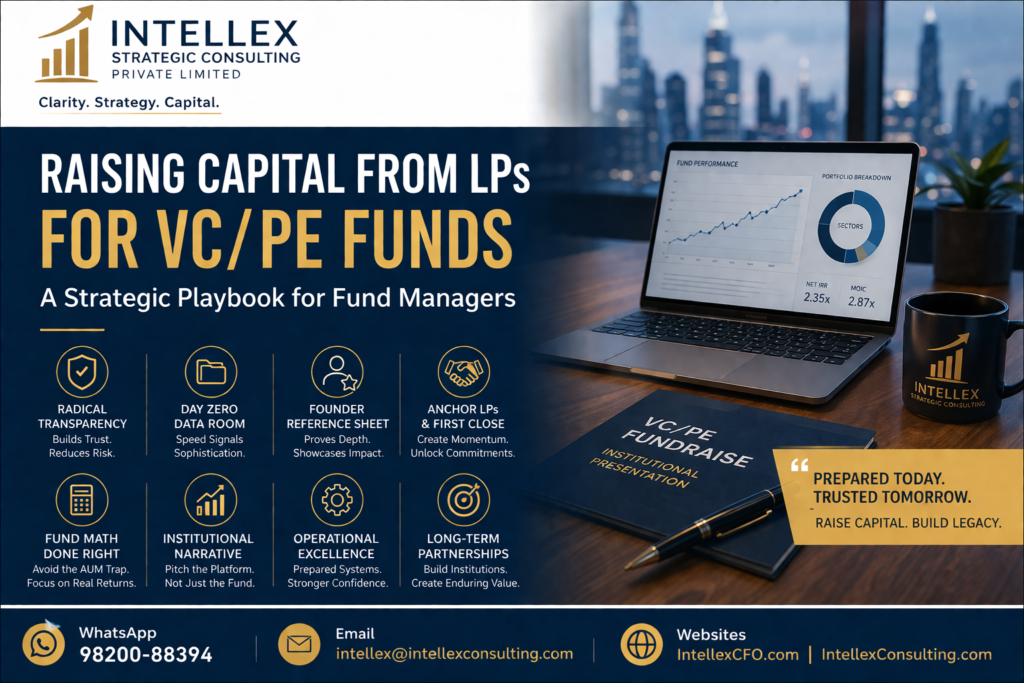
1. Radical Transparency as a Competitive Moat
The instinct to hide failure is natural. However, in venture capital, it is counterproductive.
LPs understand that venture investing is inherently risky. A portfolio without visible failures signals either lack of ambition or lack of honesty. Neither is acceptable to a sophisticated investor.
What distinguishes elite General Partners (GPs) is their willingness to institutionalize failure. They do not merely acknowledge mistakes. They dissect them, document them, and present them proactively.
Consider a scenario where a GP is raising Fund III after experiencing a $20 million loss in Fund II due to a fintech collapse. A conventional approach would be to minimize discussion around this event. A superior approach is to lead with it.
By including a “Lessons Learned” section early in the pitch, the GP reframes the narrative. Instead of risk, the LP perceives evolution. Instead of failure, the LP sees reduced probability of repeat mistakes.
Transparency builds trust. Over time, trust compounds into capital.
2. The Day Zero Data Room: Speed as a Signal of Sophistication
Fundraising momentum is fragile. The moment an LP expresses interest, the evaluation clock begins ticking.
Delays in sharing information signal disorganization. In contrast, preparedness signals institutional maturity.
A “Day Zero Data Room” is not just a repository of documents. It is a strategic asset. It allows a GP to transition instantly from conversation to diligence.
Imagine meeting a senior decision-maker from a sovereign wealth fund. During the discussion, they inquire about portfolio concentration risk. Instead of deferring the answer, the GP opens a live portfolio construction model within the data room.
This does two things simultaneously. It demonstrates command over data and shifts the psychological balance of power. The LP is no longer leading the diligence process. They are reacting to it.
Speed communicates confidence. Confidence accelerates conviction.
3. The Founder Reference Sheet: Demonstrating Depth, Not Breadth
In 2026, capital is abundant. Differentiation lies elsewhere.
The best founders have access to dozens of funding options. Their choice of investor is not dictated by capital, but by value.
This is precisely what LPs evaluate through founder references.
A superficial reference sheet listing well-known founders is insufficient. What matters is depth of engagement, especially during challenging periods.
LPs often conduct off-script calls with founders. They are not looking for praise. They are looking for authenticity.
The most compelling validation comes when a founder admits to making a financial sacrifice to work with a particular GP. For instance, accepting a lower valuation because the GP provides unique access to enterprise networks, strategic customers, or critical hires.
This phenomenon can be described as “network gravity.” It is the ability of a GP to attract high-quality founders based on intangible advantages.
A strong founder reference sheet transforms the GP from a capital provider into a strategic partner. That distinction is crucial.
4. First Close and Anchor LPs: Managing the Most Fragile Phase
The initial phase of fundraising is the most precarious.
LPs are inherently risk-averse. Their concern is not limited to underlying portfolio risk. They also evaluate fund viability. A partially raised fund introduces structural uncertainty.
This creates a paradox. LPs prefer not to be the first to commit, yet they are reluctant to miss out on high-quality opportunities.
The solution lies in securing an anchor LP.
An anchor LP serves as a validation mechanism for the broader market. Their commitment reduces perceived risk for subsequent investors.
However, anchor capital comes at a cost. GPs must be prepared to offer economic and strategic incentives such as reduced management fees, advisory committee participation, or co-investment rights in high-performing portfolio companies.
These concessions are not a compromise. They are a strategic investment in momentum.
Once the first close is achieved, the fundraising narrative shifts dramatically. The fund is no longer hypothetical. It is operational.
Momentum becomes self-reinforcing.
5. Fund Math: Avoiding the AUM Trap
One of the most subtle yet destructive pitfalls in fund management is the AUM (Assets Under Management) trap.
As GPs gain success, the temptation to raise larger funds increases. While higher AUM translates to higher management fees, it also imposes significantly greater return expectations.
The mathematics of venture capital is unforgiving.
Consider a seed fund scaling from $100 million to $1 billion. To achieve a 5x return, the fund must generate $5 billion in exits. This typically requires ownership stakes in companies achieving aggregate valuations of tens of billions.
In weaker market cycles, such outcomes become statistically improbable.
This misalignment between fund size and market reality erodes performance.
A disciplined GP approaches fund sizing with precision.
For example:
- Fund Size: $100 million
- Target Return: 5x ($500 million)
- Average Ownership at Exit: 15%
This implies a required exit value of approximately $3.33 billion across the portfolio.
This level of clarity reassures LPs. It demonstrates that the GP is not chasing scale for its own sake, but is committed to delivering returns.
Fund size is not a vanity metric. It is a strategic decision.
6. Institutional Narrative: Beyond Pitch Decks
Top-tier GPs do not pitch funds. They present institutional narratives.
An LP evaluates not just the current fund, but the long-term viability of the platform. They are effectively underwriting a multi-decade relationship.
This requires clarity across several dimensions:
- Investment Thesis: Is it differentiated and defensible?
- Team Composition: Does it combine experience with adaptability?
- Deal Flow Sources: Are they proprietary or commoditized?
- Value Creation Strategy: How does the GP influence outcomes post-investment?
Firms like Sequoia and Andreessen Horowitz have mastered this approach by positioning themselves as ecosystem builders rather than mere investors.
Their narrative extends beyond capital deployment into founder enablement, market shaping, and long-term value creation.
Emerging GPs must adopt a similar mindset. The goal is not to raise a fund. The goal is to build an institution.
7. Psychological Dynamics of LP Decision-Making
Fundraising is not purely analytical. It is deeply psychological.
LPs operate within constraints such as allocation limits, internal approvals, and peer benchmarking. Their decisions are influenced by both quantitative metrics and qualitative perceptions.
Several behavioral patterns are worth noting:
- Fear of Missing Out (FOMO): Strong momentum can accelerate commitments.
- Social Proof: Anchor LPs and early commitments influence others.
- Risk Mitigation: Transparency reduces perceived downside.
A skilled GP understands these dynamics and structures the fundraising process accordingly.
For instance, creating controlled access to the fund, maintaining consistent communication, and demonstrating progress can subtly influence LP behavior.
Fundraising, in this sense, is as much about narrative timing as it is about financial performance.
8. Operational Excellence: The Hidden Differentiator
While strategy and narrative are visible, operations often determine success.
Institutional LPs expect a high level of operational readiness. This includes:
- Robust reporting frameworks
- Clear governance structures
- Compliance and regulatory alignment
- Technology-enabled portfolio tracking
A well-structured data room is only one component. The underlying systems must support ongoing transparency and efficiency.
Operational excellence reduces friction during diligence and builds long-term confidence.
9. Real-World Alignment: Learning from Elite Firms
A closer look at leading venture firms reveals consistent patterns:
- They embrace transparency, even when it is uncomfortable.
- They invest heavily in infrastructure before fundraising begins.
- They prioritize relationships over transactions.
- They maintain discipline in fund sizing.
These principles are not theoretical. They are observable in the behavior of successful funds across cycles.
For emerging managers, the lesson is clear. Excellence in fundraising is a byproduct of excellence in fund management.
10. Positioning Yourself for Success
Ultimately, raising capital from LPs is about positioning.
You are not merely asking for capital. You are offering access to a carefully constructed investment engine.
Every element, from your pitch deck to your data room to your reference calls, contributes to this perception.
The most successful GPs operate with intentionality. They anticipate LP concerns, address them proactively, and create an environment of trust and momentum.
Conclusion: Turning Strategy into Capital
Fundraising for a VC or PE fund is a complex, multi-dimensional process. It requires a blend of financial acumen, strategic clarity, and psychological insight.
The principles outlined in this deep-dive are not shortcuts. They are structural advantages that compound over time.
For fund managers who aspire to build enduring platforms, the focus must shift from transactional fundraising to institutional development.
How Intellex Strategic Consulting Can Help
Navigating the complexities of LP fundraising requires experience, precision, and strategic foresight.
Intellex Strategic Consulting Private Limited brings deep expertise in:
- Structuring VC and PE funds
- Preparing institutional-grade data rooms
- Designing LP outreach and engagement strategies
- Financial modeling and fund math validation
- Anchor LP negotiations and deal structuring
With a strong understanding of both global investor expectations and the Indian ecosystem, Intellex serves as a trusted advisor for fund managers looking to raise capital efficiently and credibly.
Get in touch:
- WhatsApp: 98200-88394
- Email: intellex@intellexconsulting.com
- Websites: IntellexCFO.com | IntellexConsulting.com
A well-prepared fundraise is not just faster. It is more successful.
Team – Intellex Strategic Consulting Pvt Ltd
More Featured Articles:
Venture Debt in India: The Complete 2026 Guide for Startups, Founders, CFOs & Growth Companies.
How Startups Can Raise Funding in Dubai: A Comprehensive Guide for Founders and Entrepreneurs.