
AHIDF Scheme 2026:: A Major Financing Opportunity for Dairy, Meat, Animal Feed, Veterinary and Livestock Infrastructure Businesses in India.
Complete Guide to Animal Husbandry Infrastructure Development Fund, Eligible Businesses, Loans, Interest Subsidy and Investment Opportunities
Explore AHIDF 2026 opportunities for dairy, meat processing, animal feed, breed improvement, veterinary drugs, animal waste management and wool processing businesses. Learn about project financing, 3% interest subvention, eligibility and investment planning.
AHIDF: Turning India’s Livestock Economy into an Infrastructure Investment Opportunity
India’s animal husbandry and dairy economy is undergoing a significant transformation. Rising demand for milk and value-added dairy products, organized meat processing, animal nutrition, veterinary products, improved livestock genetics and sustainable waste management is creating opportunities beyond traditional farming.
One of the important government mechanisms designed to encourage investment in this infrastructure is the Animal Husbandry Infrastructure Development Fund (AHIDF).
The scheme is particularly relevant for entrepreneurs, MSMEs, private companies, Farmer Producer Organisations (FPOs), dairy cooperatives and other eligible entities looking to establish or expand capital-intensive projects in the livestock value chain.
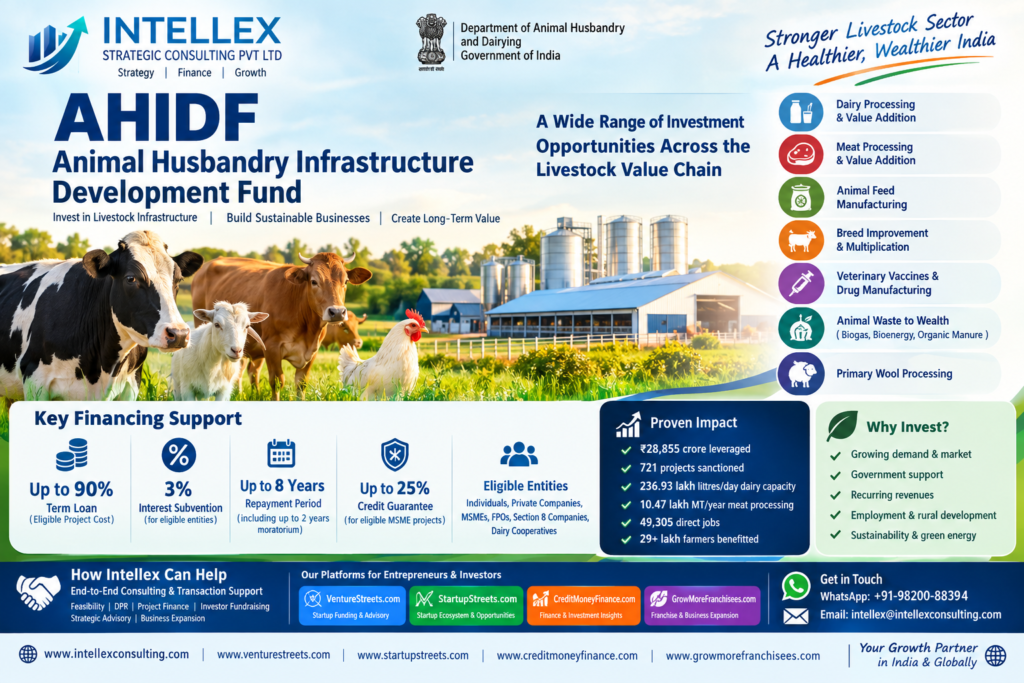
According to the Department of Animal Husbandry and Dairying (DAHD), AHIDF covers areas including dairy processing and value addition, meat processing, animal feed plants, breed improvement and multiplication, veterinary vaccine and drug manufacturing, animal-waste-to-wealth projects and primary wool processing.
For investors and entrepreneurs, the important point is that AHIDF is not simply a livestock-farming scheme. It is fundamentally an infrastructure and enterprise financing opportunity across multiple parts of the animal husbandry value chain.
What Exactly Is AHIDF?
The Animal Husbandry Infrastructure Development Fund was created to encourage private-sector investment in modern infrastructure in the animal husbandry sector.
The government subsequently continued AHIDF as a component under the broader Infrastructure Development Fund (IDF), with the Dairy Processing Infrastructure Development Fund (DIDF) being subsumed into AHIDF in February 2024. Dairy cooperatives consequently became eligible under AHIDF according to the applicable operational guidelines.
The official AHIDF framework covers seven broad areas:
- Dairy processing and value addition
- Meat processing and value addition
- Animal feed manufacturing
- Breed improvement technology and breed multiplication farms
- Veterinary vaccine and drug manufacturing
- Animal waste-to-wealth/agri-waste management
- Primary wool processing infrastructure
This creates a surprisingly broad investment universe.
Why AHIDF Matters to Entrepreneurs
A livestock business can be profitable at the farm level, but the larger economic opportunity often lies in the infrastructure surrounding the farm.
Consider the chain:
Livestock → Milk/Meat → Collection → Processing → Value Addition → Packaging → Cold Chain → Distribution → Retail/Export
Similarly:
Animal Feed → Livestock Nutrition → Productivity → Milk/Meat Output
And:
Animal Waste → Biogas/Bio-CNG/Organic Inputs/Other Products → Additional Revenue
AHIDF is designed to strengthen several of these infrastructure links.
That makes it relevant not only to conventional dairy and livestock entrepreneurs, but also to companies developing food-processing, biotechnology, veterinary, waste-management, manufacturing and agri-infrastructure businesses.
1. Dairy Processing: One of the Largest Opportunity Areas
Dairy is perhaps the most familiar segment covered by AHIDF.
But investors should look beyond simply setting up a conventional milk plant.
The opportunity includes value-added dairy products, which can potentially offer better product differentiation than commodity milk.
Potential project categories can include:
- Milk processing plants
- Milk chilling and handling infrastructure
- Paneer manufacturing
- Cheese manufacturing
- Yogurt and fermented dairy products
- Flavoured milk
- Milk powder-related infrastructure
- Other value-added dairy products
- Packaging and associated processing infrastructure, subject to scheme eligibility
The business case should therefore focus on processing capacity, procurement network, product mix, utilization and market access, rather than merely the size of the proposed factory.
What an investor should examine
Before investing in a dairy-processing project, the following questions become critical:
- Where will the milk come from?
- What is the procurement radius?
- Is there a dependable farmer network?
- What is the expected daily milk procurement?
- What percentage of plant capacity will be utilized?
- What products will be manufactured?
- What are the margins by product?
- Is there a strong distribution network?
- How much working capital is required?
- Is cold-chain infrastructure adequate?
- Is there a realistic route to institutional sales or exports?
A technically impressive plant without adequate raw-material procurement and market access can become a capital-intensive underutilized asset.
2. Meat Processing and Value Addition
India’s meat industry also presents opportunities for modern processing infrastructure.
AHIDF specifically includes meat processing and value-added meat products within its eligible areas.
Potential businesses can include:
- Modern meat processing facilities
- Hygienic slaughter-linked processing infrastructure where eligible
- Chilling and freezing facilities
- Processed meat products
- Packaging
- Cold-chain infrastructure associated with eligible projects
- Export-oriented processing infrastructure
However, this is a highly regulated business.
Entrepreneurs need to examine:
- State and local permissions
- Food safety requirements
- Animal-health regulations
- Environmental permissions
- Waste disposal
- Cold-chain requirements
- Traceability
- Export standards, where applicable
- Availability of animals/raw material
- Market and institutional contracts
For investors, regulatory compliance should be treated as part of the investment thesis rather than as an afterthought.
3. Animal Feed Manufacturing: A Major B2B Opportunity
Animal nutrition represents another important AHIDF opportunity.
Modern livestock productivity depends heavily on consistent and scientifically formulated feed.
The official objectives of AHIDF specifically include increasing availability of concentrated animal feed for cattle, buffalo, sheep, goats, pigs and poultry.
An entrepreneur could therefore consider projects involving:
- Cattle feed
- Dairy feed
- Poultry feed
- Pig feed
- Sheep and goat feed
- Feed supplements
- Specialized nutrition products
- Feed processing and related infrastructure
Why investors may examine this segment
Feed is essentially a repeat-purchase B2B product.
Once a feed company establishes relationships with farmers, dairy cooperatives, distributors and institutional buyers, recurring demand can potentially provide a more predictable revenue base than one-time equipment sales.
But the economics depend heavily on:
Raw material procurement + formulation + manufacturing efficiency + capacity utilization + distribution + pricing power.
Feed projects therefore need careful commodity-price and working-capital analysis.
4. Breed Improvement and Breed Multiplication
AHIDF also supports infrastructure for breed improvement technology and breed multiplication farms covering livestock categories specified in the scheme.
This opens a more technology-oriented investment area.
Potential opportunities include:
- Modern breeding infrastructure
- Genetic improvement
- Breed multiplication
- Scientific livestock management
- Modern farm infrastructure
- Technology-enabled breeding systems
The government’s 2025-26 annual report indicates that AHIDF-supported projects have already included breed improvement and multiplication infrastructure. As of December 31, 2025, the department reported 121 projects in this category.
For investors, this segment can be particularly interesting where technology, genetics, productivity improvement and organized livestock management come together.
5. Veterinary Vaccines and Pharmaceutical Manufacturing
Another important category is veterinary vaccine and drug manufacturing facilities.
This moves the investment opportunity beyond agriculture and into the broader life-sciences and animal-health ecosystem.
Potential areas include:
- Veterinary medicines
- Vaccines
- Animal-health products
- Manufacturing facilities
- Specialized veterinary pharmaceutical infrastructure
This segment, however, requires significantly greater technical, regulatory and quality-control capabilities.
An investor should therefore evaluate:
- Regulatory approvals
- Manufacturing licences
- Technical personnel
- R&D capabilities
- Product registrations
- Quality systems
- Manufacturing technology
- Intellectual property
- Distribution network
- Market size
For a technology-driven veterinary company, the project may potentially combine industrial infrastructure finance with a scalable healthcare-style business model.
6. Animal Waste-to-Wealth: The Emerging Green Opportunity
Perhaps one of the most interesting categories from an investment perspective is animal waste-to-wealth management.
Livestock generates substantial quantities of organic waste.
Instead of viewing this only as a disposal problem, entrepreneurs can develop businesses around converting waste into useful products or energy.
Potential business models can include, subject to applicable project eligibility and approvals:
- Biogas
- Bioenergy
- Organic manure
- Compost
- Resource recovery
- Waste-processing infrastructure
- Other circular-economy applications
This segment connects three major themes:
Animal Husbandry + Renewable Energy + Circular Economy
That makes it potentially relevant to impact investors, climate-focused investors, infrastructure investors and entrepreneurs working in the clean-energy ecosystem.
7. Primary Wool Processing
AHIDF also covers primary wool processing infrastructure, expanding the scheme beyond dairy, meat and feed.
This can create opportunities in areas where sheep and wool production is geographically concentrated.
Potential infrastructure may include processing, sorting and other primary wool-related activities, subject to detailed scheme eligibility.
For entrepreneurs, proximity to wool-producing regions and dependable raw-material procurement can be critical to project viability.
How Much Financing Can an AHIDF Project Get?
One of the most important features of AHIDF is its financing structure.
The official scheme information states that eligible entities can obtain term loans of up to 90% of eligible project cost, with the balance arranged as promoter contribution/margin as applicable.
The scheme provides 3% interest subvention for eligible entities. The official material also states that there is no ceiling on the eligible term-loan amount, subject to project appraisal and lending conditions.
The reported maximum repayment period is up to eight years, including a moratorium of up to two years on principal, subject to the applicable guidelines and lender terms.
Important clarification
An AHIDF benefit should not be interpreted as a 90% government grant.
It is essentially a financing framework in which eligible projects can receive bank/institutional term finance with an interest-subvention benefit.
Therefore:
Project viability + promoter contribution + lender appraisal + security/credit assessment + compliance = critical components of financing.
Credit Guarantee Support for MSMEs
AHIDF also has a credit-guarantee component for eligible MSME projects.
DAHD’s reported framework provides for credit guarantee coverage of up to 25% of the credit facility for eligible MSME projects, subject to the scheme’s conditions.
This is particularly relevant for smaller entrepreneurs who may otherwise face difficulty arranging conventional collateral-based financing.
However, a credit guarantee does not mean that every project automatically receives funding.
Banks and financial institutions still examine:
- Promoter background
- Credit history
- Project viability
- DSCR
- Cash flows
- Equity contribution
- Security
- Technical feasibility
- Market demand
- Regulatory compliance
What Kind of Entrepreneur Can Consider AHIDF?
The official AHIDF framework identifies several eligible categories, including:
- Individual entrepreneurs
- Private companies
- MSMEs
- Farmer Producer Organisations
- Section 8 companies
- Dairy cooperatives
The eligibility framework has evolved over time, so applicants should always check the latest operational guidelines and amendments applicable on the date of application.
DAHD has also issued multiple amendments/addenda to the AHIDF implementation guidelines, including a 7th addendum dated January 19, 2026.
This is important because entrepreneurs should not prepare a large investment proposal solely on the basis of an old AHIDF brochure or social-media post.
What Does the Bank Look For?
This is where many entrepreneurs misunderstand government-backed financing schemes.
Having an eligible business activity does not automatically make a project bankable.
A lender is likely to examine the complete financial and operational structure.
1. Promoter profile
The bank will want to understand:
- Experience
- Net worth
- Existing business
- Credit history
- Industry knowledge
- Management capability
2. Project cost
The project report should clearly establish:
- Land, where applicable
- Building
- Plant and machinery
- Utilities
- Installation
- Technology
- Pre-operative expenses
- Other eligible capital expenditure
3. Promoter contribution
The entrepreneur must demonstrate the ability to bring the required equity/margin contribution.
4. Revenue model
A lender needs a credible answer to:
Who will buy the product?
A project report should preferably contain realistic market assumptions rather than generic statements about India’s huge dairy or livestock market.
5. Cash-flow projections
Revenue alone does not repay a loan.
The project needs adequate:
- EBITDA
- Operating cash flow
- Debt-service capacity
- Working-capital management
The Most Important Document: A Bankable DPR
For a serious AHIDF project, the Detailed Project Report (DPR) becomes one of the most important documents.
A professional DPR should ideally cover:
Business Overview
- Promoter background
- Company structure
- Business model
- Project objectives
Industry Analysis
- Market size
- Demand drivers
- Competition
- Regional opportunity
Technical Feasibility
- Location
- Capacity
- Technology
- Machinery
- Utilities
- Manufacturing process
Raw Material Plan
- Sources
- Procurement strategy
- Pricing
- Supply contracts
Marketing Plan
- Customer segments
- Distribution
- Institutional buyers
- Pricing
- Sales projections
Financial Model
- Project cost
- Means of finance
- Revenue projections
- EBITDA
- Working capital
- Cash flows
- DSCR
- Break-even
- Sensitivity analysis
Risk Analysis
- Commodity-price risk
- Disease risk
- Regulatory risk
- Market risk
- Execution risk
- Technology risk
- Working-capital risk
What Investors Should Look for Before Investing
For an equity investor, the analysis is different from that of a bank.
An investor should examine whether the business can eventually create enterprise value, not merely repay a loan.
Important questions include:
Is there a scalable market?
A plant that can produce ₹100 crore of products does not necessarily have a ₹100 crore market.
Is the facility strategically located?
Transportation costs can significantly affect dairy, feed and meat economics.
Is raw material secured?
A processing plant without dependable procurement can suffer from low utilization.
Is technology competitive?
Older technology may create higher energy, maintenance and labour costs.
Is there product differentiation?
Commodity products can face margin pressure.
Can the company scale?
An attractive first facility can become the foundation for multiple plants, brands or geographies.
AHIDF and the Investor’s Capital Stack
A well-designed project may potentially have several layers of capital.
For example:
Promoter Equity
↓
AHIDF-linked Term Finance
↓
Credit Guarantee Support, where applicable
↓
Working Capital Facility
↓
Strategic/Institutional Equity
This should not be viewed as a standard formula. The exact financing structure depends on the project, promoter, lender, eligibility and financial requirements.
For larger projects, entrepreneurs may also explore strategic investors, private equity, venture capital, family offices or industry partners alongside debt financing.
Government Support Does Not Replace Business Fundamentals
This is perhaps the most important message for prospective entrepreneurs.
AHIDF can improve the financing economics of an eligible project, but it cannot compensate for a fundamentally weak business model.
A project should ideally answer five questions convincingly:
1. What are we building?
2. Why is the market going to buy it?
3. How much will it cost?
4. How will the debt be repaid?
5. How will the investor/promoter eventually generate an attractive return?
If these questions are answered properly, government-linked financing can become one component of a much larger capital strategy.
India’s Livestock Infrastructure Opportunity
The scale of existing AHIDF-supported investment demonstrates that this is not merely a theoretical opportunity.
DAHD’s Annual Report 2025-26 reported that, as of December 31, 2025, AHIDF had leveraged about ₹28,855 crore of investments, with 721 projects worth ₹22,996 crore sanctioned by lending institutions.
The report also stated that 461 projects had been approved by the department, with infrastructure developed across dairy processing, meat processing, animal feed and other categories.
Among the reported outcomes were:
- Dairy processing capacity of approximately 236.93 lakh litres per day
- Meat processing capacity of approximately 10.47 lakh metric tonnes annually
- Animal feed manufacturing capacity of approximately 109.33 lakh metric tonnes annually
- About 49,305 direct employment opportunities from 461 projects
- More than 29 lakh farmers benefiting from the scheme as of December 31, 2025.
These figures illustrate the breadth of the infrastructure ecosystem being developed around India’s livestock economy.
Opportunity for Startups and New-Age Businesses
AHIDF should not be viewed only through the traditional lens of dairy plants and livestock farms.
There is potential for new-age businesses working at the intersection of:
Agritech + Animal Health + Food Processing + Biotechnology + Renewable Energy + Waste Management + Rural Supply Chains
Examples could include:
- Technology-enabled dairy processing
- Precision animal nutrition
- Veterinary technology
- Livestock genetics
- Waste-to-energy businesses
- Digital procurement platforms linked to physical infrastructure
- Traceability systems
- Cold-chain businesses
- Export-oriented processing
- Sustainable livestock infrastructure
The key question is whether the proposed capital expenditure and business activity fall within the applicable AHIDF framework and whether the overall project is financially viable.
AHIDF Opportunity for Investors
For investors looking at this sector, there are several potential investment themes:
Dairy
Value-added products, processing and organized procurement.
Animal Nutrition
Feed manufacturing and specialized nutrition.
Animal Health
Veterinary pharmaceuticals, vaccines and related products.
Livestock Genetics
Breed improvement and multiplication.
Food Processing
Modern meat and dairy processing.
Circular Economy
Animal waste-to-value and bioenergy.
Rural Infrastructure
Facilities serving organized livestock supply chains.
The strongest investment opportunities may emerge where infrastructure financing + recurring revenues + strong management + technology + market access converge.
A Word of Caution for Entrepreneurs
AHIDF is often discussed online using phrases such as “90% loan”, “3% subsidy” or “government funding”.
Entrepreneurs should interpret these carefully.
It is not simply free government money.
The project must satisfy applicable eligibility conditions and undergo financing and appraisal processes.
The official AHIDF page itself directs applicants to the operational guidelines, FAQs and the application/loan portal.
Furthermore, because DAHD has issued amendments to the scheme and its implementation guidelines, applicants should verify the latest applicable provisions before finalizing their project structure.
Current Status: An Important 2026 Consideration
There is an important timing issue for anyone planning a new project in 2026.
The DAHD’s AHIDF webpage states that the revised outlay was approved through FY 2025-26, ending March 31, 2026.
At the same time, DAHD’s Budget/IFD section records government action concerning temporary extension of schemes beyond March 31, 2026 pending appraisal and approval for the 16th Finance Commission cycle. DAHD has also published a 7th AHIDF guideline addendum dated January 19, 2026.
Therefore, any entrepreneur making a fresh investment decision in September 2026 should verify the current application window, applicable guidelines, lender availability and continuation provisions directly before committing capital.
This distinction is important: an old AHIDF brochure should not be treated as proof that every historical benefit remains unchanged for a new application.
How Intellex Strategic Consulting Can Help
For entrepreneurs considering dairy, meat processing, animal feed, veterinary products, livestock infrastructure or animal-waste businesses, the challenge is often not identifying the government scheme.
The bigger challenge is converting the business concept into a financially viable, lender-ready and investor-ready project.
Intellex Strategic Consulting Pvt Ltd provides strategic consulting and transaction support for businesses seeking to develop, finance and scale projects across India and internationally.
Our support can include:
- Business feasibility assessment
- Project structuring
- Project finance strategy
- DPR/business-plan preparation
- Financial modelling
- Debt financing strategy
- Government scheme assessment
- Investor presentation
- Equity fundraising support
- Strategic investor outreach
- Business valuation support
- Capital structuring
- Expansion planning
- Investor and lender documentation
For startups and growth businesses seeking equity capital, VentureStreets.com can support fundraising and investor outreach.
For startup ecosystem, business and investment opportunities, StartupStreets.com provides an additional platform for entrepreneurs and investors.
For finance-oriented information and business opportunities, CreditMoneyFinance.com complements the ecosystem.
Entrepreneurs exploring franchise and business expansion opportunities can also explore GrowMoreFranchisees.com.
A Potentially Powerful Intersection: Government Finance + Private Capital
The AHIDF framework demonstrates an important principle for entrepreneurs:
Government-supported financing and private investment do not necessarily have to be alternatives.
A well-structured enterprise may potentially combine:
Promoter Capital + Institutional Debt + Government Interest Support + Strategic Equity + Working Capital
The precise combination will depend upon the project and applicable rules.
For an entrepreneur, the objective should therefore not simply be:
“How do I get an AHIDF loan?”
A better strategic question is:
“How do I build an economically viable animal-husbandry infrastructure business and use every eligible source of capital efficiently?”
That shift in thinking can make a substantial difference to the quality of the project.
Conclusion
India’s livestock economy is evolving from a largely fragmented production system toward a more organized ecosystem encompassing processing, value addition, animal nutrition, genetics, veterinary products, cold chains, waste management and exports.
AHIDF has been designed to encourage investment in many of these infrastructure segments.
For entrepreneurs, the opportunity lies in identifying a genuine market requirement and building a commercially viable project around it.
For investors, the opportunity lies in identifying businesses where strong management, scalable infrastructure, recurring demand, technology and disciplined capital deployment can combine to create sustainable enterprise value.
And for both, the most important first step is the same:
Build the project correctly before seeking the capital.
Need Assistance With an AHIDF / Animal Husbandry Infrastructure Project?
Intellex Strategic Consulting Pvt Ltd
Project Finance | Business Strategy | Investor Fundraising | Financial Advisory
📱 WhatsApp: +91-98200-88394
📧 Email: intellex@intellexconsulting.com
Our Websites:
VentureStreets.com | StartupStreets.com | CreditMoneyFinance.com | GrowMoreFranchisees.com
AHIDF eligibility, financing terms, eligible activities, application procedures and government support are subject to the latest applicable guidelines, amendments, lender appraisal and government approvals. Prospective applicants should verify the current position with DAHD and the relevant lending institution before making financial commitments.
Official reference: Department of Animal Husbandry & Dairying – AHIDF
More Featured Articles
LLP vs Private Limited Company in India: Which Business Structure is Best for Your Startup.
Collateral-Free Import Finance in India: Funding Up to USD 5 Million for Growing Businesses.
Private Equity & Venture Capital: Financing the Next Growth Chapter of Startups and Businesses.
Venture Debt in India: The Complete 2026 Guide for Startups, Founders, CFOs & Growth Companies.