
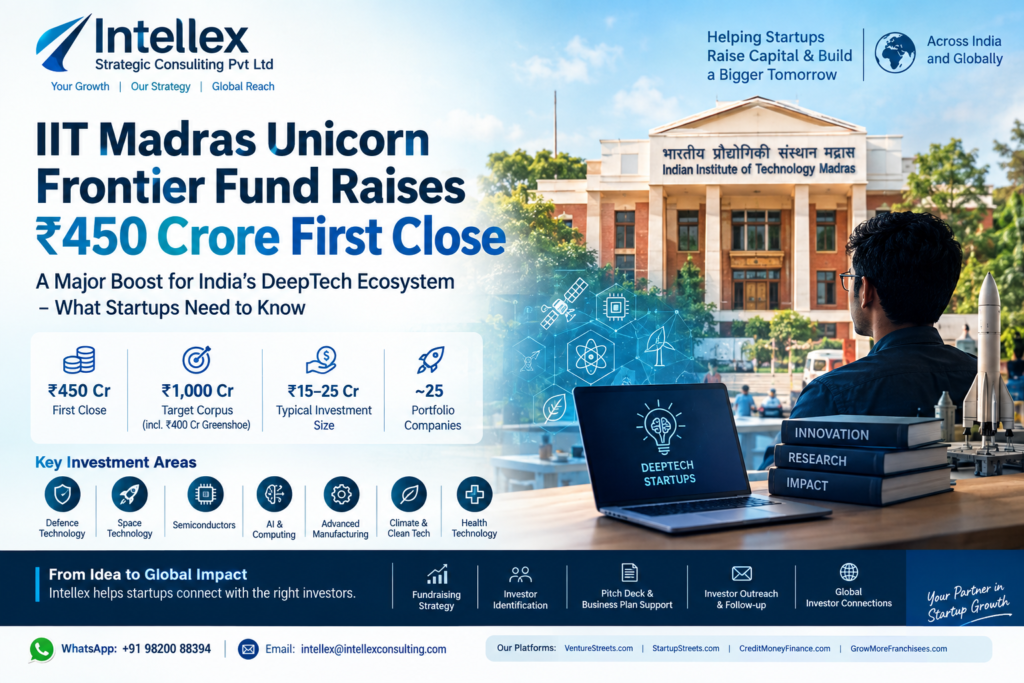
IIT Madras Unicorn Frontier Fund Raises ₹450 Crore First Close: A Detailed Funding Guide for DeepTech Startups Seeking ₹15–25 Crore Capital.
IIT Madras Unicorn Frontier Fund I has raised ₹450 crore of its ₹1,000 crore target and invested ₹55 crore in four deeptech startups. Here’s what founders need to know.
IIT Madras’ ₹1,000 Crore DeepTech Fund Opens a New Funding Route for Indian Startups
India’s deeptech ecosystem has received a significant new source of institutional capital.
IIT Madras, IIT Madras Research Park (IITMRP) and Unicorn India Ventures (UIV) have announced the first close of the IITM Unicorn Frontier Fund-I at ₹450 crore, against a planned corpus of ₹1,000 crore, including a ₹400 crore greenshoe option. The fund has already deployed approximately ₹55 crore across four deeptech startups working in space technology, quantum technology, advanced batteries and climate technology.
For founders, however, the headline number is only part of the story.
The more important question is:
What kind of startup is this fund actually looking for, and how can a founder prepare to approach it?
The answer is particularly relevant for startups working on intellectual property, advanced engineering, scientific research, hardware, semiconductors, defence, space, robotics, AI infrastructure, healthcare and other capital-intensive technologies.

What Is the IITM Unicorn Frontier Fund-I?
The fund is a partnership between IIT Madras Research Park and Unicorn India Ventures, combining IIT Madras’ technology, research and incubation ecosystem with UIV’s venture-capital investment and portfolio-management capabilities.
The fund was originally announced in February 2026 with a ₹600 crore base corpus plus a ₹400 crore greenshoe option, taking the potential size to ₹1,000 crore. The fund’s own website describes it as a SEBI Category-II AIF focused on IP-led deeptech. IIT Madras
The September 2026 first close of ₹450 crore represents capital committed at this stage; the fund is continuing towards its larger target.
The latest announcement says the fund aims to build a portfolio of approximately 25 deeptech companies. ADU – Aviation Defence Universe
Key fund parameters
| Parameter | Current publicly reported details |
|---|---|
| Fund | IITM Unicorn Frontier Fund-I |
| Strategic partners | IIT Madras Research Park + Unicorn India Ventures |
| Structure | SEBI Category-II AIF |
| Original base corpus | ₹600 crore |
| Greenshoe | ₹400 crore |
| Overall target | Up to ₹1,000 crore |
| First close | ₹450 crore |
| Capital already deployed | Nearly ₹55 crore |
| Target portfolio | Around 25 startups |
| Typical/current reported cheque | Approximately ₹15–25 crore |
| Primary stage | Early-stage deeptech |
| Technology readiness | Majority targeted around TRL 3–4 |
| Fund life | 10 years + 2-year extension |
| Geography | Primarily Indian deeptech ecosystem |
| Follow-on capital | Specifically built into the strategy |
| Fund manager | Unicorn India Ventures |
The original IIT Madras announcement said the majority of the portfolio would consist of companies at TRL 3–4, with patient capital and a 10+2-year fund structure. IIT Madras
What Does the Fund Invest In?
The investment thesis is considerably narrower than that of a generalist venture fund.
The fund has identified six broad areas:
1. Defence Technology
The emphasis includes technologies capable of reducing import dependence and strengthening domestic technological capabilities.
This could include:
- defence electronics
- sensors
- unmanned systems
- propulsion
- advanced materials
- communications
- surveillance
- robotics
- strategic technologies
2. Space Technology
This is one of the clearest focus areas.
The fund is looking for technologies around the space value chain, including:
- propulsion
- launch systems
- satellite systems
- space-qualified hardware
- in-space infrastructure
- advanced components
- space electronics
The fund’s investment philosophy specifically refers to space hardware capable of achieving globally competitive economics. ADU – Aviation Defence Universe
3. Semiconductors
This includes:
- fabless semiconductor design
- semiconductor IP
- advanced electronics
- sensors
- chip design
- specialised computing
- industrial electronics
4. Manufacturing, Robotics & Automation
The fund is also positioned for engineering-heavy companies developing:
- industrial robotics
- automation
- advanced manufacturing
- industrial machinery
- precision engineering
- Industry 4.0 technologies
5. AI Infrastructure & Generative AI
The thesis goes beyond conventional consumer AI applications.
The focus includes AI infrastructure and sovereign enterprise AI, which potentially creates opportunities for companies working on:
- AI infrastructure
- specialised computing
- enterprise AI
- AI hardware
- AI systems
- foundational technology
6. Health Technology
Healthtech is another stated vertical, particularly technologies capable of addressing large-scale healthcare needs.
The fund’s stated investment process also considers global export potential, strategic import substitution and sovereign technological advantage. ADU – Aviation Defence Universe
Geography: Is This a Global Fund?
This is an important distinction for international founders.
The publicly disclosed investment strategy is primarily India-focused.
At launch, IIT Madras said a significant portion of portfolio companies would be sourced from the IIT Madras ecosystem, with the balance coming from the wider Indian deeptech ecosystem. IIT Madras
Therefore, a startup headquartered in India, or a company with a meaningful Indian technology, R&D, manufacturing or strategic nexus, is naturally closer to the fund’s stated ecosystem.
The fund website highlights “global exit capability”, but that should not be confused with a statement that it is a general global-geography VC fund. IITM Unicorn Frontier Fund
For an overseas startup, the founder should therefore establish why India is strategically relevant to the company’s future, rather than simply presenting an international business looking for Indian capital.
The Four Startups Already Backed
The first four investments provide perhaps the clearest indication of what the fund considers investable deeptech.
1. Hathor — Rocket Propulsion & Space Technology
Location: Chennai
Sector: Space technology
Founders: Keerthivarman V.K. and S. Sri Sindhuja
Hathor is developing semi-cryogenic and cryogenic liquid rocket engines aimed at small and medium satellite launch vehicles. Business Standard
Public company records identify Keerthivarman and Sri Sindhuja as the company’s directors, while industry profiles identify Keerthivarman as founder and CEO. Hathor was incorporated in 2023. IndiaFilings
Its technology journey also includes support from the Space Technology Innovation and Incubation Centre (STIIC) at IIST, where Hathor’s semi-cryogenic liquid rocket-engine project has undergone Level-2 review and was listed as ready for pre-incubation. IIST Website
In 2026, Hathor was also among the regional winners of Boeing BUILD 5.0, following a selection process involving more than 250 applications. LinkedIn
Why this is relevant to founders
Hathor illustrates that the fund is willing to finance hard engineering and long technology-development cycles, rather than restricting itself to software businesses with immediate revenue scalability.
2. Quanstra — Quantum Technology
Location: Delhi
Sector: Quantum technology
Founder publicly identified: Dr. Vidhur Raj
Quanstra is developing single-photon detection systems and advanced quantum instrumentation for research and emerging industrial quantum applications. ADU – Aviation Defence Universe
Publicly available institutional material identifies Dr. Vidhur Raj as Founder of Quanstra Pvt. Ltd. and connects the company to India’s National Quantum Mission ecosystem. Heyzine
Quanstra’s selection is particularly significant because it demonstrates that the fund is interested in frontier technologies where commercial markets may still be developing, provided the underlying science and technology have sufficient potential.
For quantum startups, this means a pitch should go substantially beyond:
“Quantum computing is a huge market.”
The founder needs to demonstrate the specific technological breakthrough, IP, applications, validation, TRL, customer problem and route to commercialisation.
3. Triolt Energy — Advanced Lithium-Ion Batteries
Location: Chennai
Sector: Energy storage / batteries
Founders: Raghu Sripada, Ananya Gangadharan and Rajesh Thomas
Triolt is developing advanced lithium-ion cells designed for applications including electric mobility, drones and energy storage.
The founding team combines IIT Madras and IISc backgrounds. FineTrain
Importantly for fundraising founders, Triolt had already demonstrated an ability to attract external capital before the IITM Unicorn Frontier Fund investment.
In 2024, the company raised ₹71 lakh from Campus Angels Network, following an earlier ₹1.29 crore investment from Little Angels Network and SIDBI. Business Standard
The company has been working on issues including:
- fast charging
- high discharge rates
- cycle life
- battery safety
- cell design
- manufacturing
- EV applications
Triolt therefore provides another useful example of the type of company that can fit the fund’s thesis: science-heavy technology + significant market opportunity + technology validation + a pathway towards manufacturing scale.
4. Carbelim — Microalgae-Based Carbon Capture
Sector: Climate technology / carbon capture / air purification
Founders: Dr. Karthika Gopi, Rahul Babu and Gopakumar G.
Carbelim is developing microalgae-powered carbon capture and air-purification systems.
Its technology integrates microalgae with engineered systems to capture carbon dioxide and pollutants while producing biomass and other potential commercial products. Carbelim
Dr. Karthika Gopi is the founder and CEO, with a research background in environmental science and algal biotechnology. Carbelim’s team also includes Rahul Babu and Gopakumar G. Carbelim
The company had already raised pre-seed capital from Campus Fund, while its technology has been supported/incubated by organisations including IIT Madras and IIM Lucknow. Crunchbase
Carbelim’s public materials also cite patent activity and pilots/interest across international markets, illustrating another feature relevant to the Frontier Fund thesis: Indian-origin technology with potential global applications. Carbelim
Who Is Behind the Fund?
The investment partnership brings together two different strengths.
IIT Madras Research Park
IIT Madras Research Park is India’s first university-based research park and has been designed to bridge academia, industry and technology commercialisation. It provides access to research infrastructure, laboratories, faculty and technical expertise. IIT Madras
The IIT Madras ecosystem is therefore particularly relevant to startups where scientific validation, engineering expertise and research collaboration matter.
Unicorn India Ventures
UIV was founded by Bhaskar Majumdar and Anil Joshi.
According to UIV’s own current team profile, Bhaskar Majumdar has invested across approximately 40 startups in India and the UK, while Anil Joshi previously held leadership roles at Mumbai Angels and Bangalore Angels. Unicorn IVC
UIV has built multiple venture funds. Its Fund III closed at ₹1,200 crore in February 2026, above its original ₹1,000 crore target. The firm said Fund III had backed 14 companies at that point, with a focus including deeptech, semiconductors, spacetech and AI infrastructure. The Economic Times
UIV’s current portfolio information reports exposure across multiple technology sectors and says its portfolio includes companies such as Open, Genrobotics, OrbitAID, Netrasemi, EyeROV and QubeHealth. Its website reports 12 exits and companies across 12 Indian states. Unicorn IVC
For founders, this matters because the Frontier Fund is not being managed as a standalone university grant programme; it combines research ecosystem access with an established venture-investment platform.
What Does the Fund’s Investment Thesis Really Mean for Founders?
The four initial investments reveal several recurring characteristics.
1. IP matters
This is not simply a “startup with a good business model” fund.
The fund explicitly describes itself as focused on IP-led deeptech. IITM Unicorn Frontier Fund
Founders should therefore clearly identify:
- patents
- proprietary technology
- trade secrets
- algorithms
- proprietary processes
- scientific breakthroughs
- technological barriers to replication
2. Technology readiness matters
The fund originally stated that the majority of its portfolio would be around TRL 3–4.
That is an important signal for founders developing technologies that have moved beyond pure research but have not yet reached full commercial deployment. IIT Madras
3. Import substitution alone is not enough
The fund’s stated screening criteria include:
Global export potential + strategic import substitution + technological advantage. ADU – Aviation Defence Universe
So the strongest pitch is not merely:
“India currently imports this product.”
It is:
“We can build this technology in India at competitive economics and eventually sell it globally.”
4. Patient capital is important
Rocket engines, quantum instrumentation, batteries, semiconductors and carbon-capture technologies can require years of R&D, certification, testing and customer validation.
The fund was specifically designed around patient capital, with a 10+2-year structure and follow-on funding capability. IIT Madras
What Should Startups Prepare Before Approaching This Fund?
A founder should ideally prepare a funding package containing:
A. Technology dossier
- What exactly has been developed?
- What is proprietary?
- Patent status
- TRL
- Laboratory validation
- Independent testing
- Technology milestones
B. Commercialisation plan
- Target customers
- Current pilots
- LOIs
- Purchase orders
- Revenue
- Gross margins
- Manufacturing economics
- Customer acquisition strategy
C. Competitive analysis
Show:
Your technology → existing alternatives → global competitors → cost/performance advantage.
D. Capital requirement
Clearly explain:
- amount being raised
- valuation
- equity offered
- use of funds
- R&D requirement
- manufacturing capex
- working capital
- regulatory/certification expenditure
- next milestone
E. The next financing milestone
A strong deeptech pitch should answer:
“If we give you ₹20 crore today, what will the company look like 18–30 months from now?”
That could mean:
- TRL 6
- commercial prototype
- certification
- first 10 customers
- ₹10 crore ARR
- 100 MWh production capacity
- orbital demonstration
- semiconductor tape-out
- regulatory approval
The milestone should be measurable.
A Major Lesson for Indian DeepTech Founders
The IITM Unicorn Frontier Fund is particularly interesting because it addresses one of the biggest problems in deeptech fundraising:
the gap between scientific validation and commercial scale.
Traditional startup investors can sometimes find a five-year hardware development cycle difficult to accommodate.
A specialist deeptech fund, by contrast, can structure capital around:
Research → Prototype → Validation → Pilot → Certification → Commercialisation → Scale → Follow-on funding.
That is precisely why the combination of IIT Madras’ research ecosystem and UIV’s investment platform is strategically relevant.
Can Startups Outside the IIT Madras Ecosystem Apply?
Yes, the fund should not be interpreted as an IIT Madras alumni-only investment vehicle.
IIT Madras’ launch announcement explicitly stated that the portfolio would include companies sourced from the wider Indian deeptech ecosystem, in addition to companies emerging from the IIT Madras ecosystem. IIT Madras
Therefore, founders from other universities, incubators, research institutions and independent technology companies should not assume that lack of an IIT Madras connection automatically excludes them.
However, the startup needs to fit the deeptech/IP/engineering-heavy investment thesis.
How Intellex Strategic Consulting Can Help Startups Pursue DeepTech Funding
For startups that believe they fit this type of investor thesis, the challenge is not simply finding the investor.
The more difficult task is building the right investor–startup fit.
Intellex Strategic Consulting Pvt Ltd provides startup fundraising and strategic advisory support across India and international markets, helping founders with activities such as:
- Fundraising strategy
- Investor identification
- Investor database research
- Investor–startup matching
- Pitch-deck positioning
- Business-plan preparation
- Financial modelling
- Investor outreach
- Funding documentation
- Strategic capital raising
- International investor outreach
- Follow-up and fundraising coordination
For a deeptech company, investor selection is particularly important because a founder may require an investor who understands long R&D cycles, IP, hardware, regulatory approvals, manufacturing, strategic technology and follow-on funding.
Intellex can assist founders in evaluating the investor landscape and developing a fundraising strategy around the company’s specific stage, sector, geography and capital requirement.
Intellex Strategic Consulting Pvt Ltd
WhatsApp: +91 98200 88394
Email: intellex@intellexconsulting.com
Startup & Funding Platforms:
- VentureStreets.com — Global startup funding advisory
- StartupStreets.com — Startup, investor and entrepreneurial ecosystem
- CreditMoneyFinance.com — Finance and capital ecosystem
- GrowMoreFranchisees.com — Franchise and business expansion opportunities
Final Takeaway for Founders
The ₹450 crore first close of the IITM Unicorn Frontier Fund-I is an important development for Indian deeptech fundraising, particularly because the fund is designed around technologies that may require substantially more time, technical validation and patient capital than conventional software startups.
Its first four investments — Hathor, Quanstra, Triolt Energy and Carbelim — provide a useful window into the fund’s emerging investment pattern: deep intellectual property, engineering intensity, technology validation, strategic relevance and potential for global commercialisation.
For founders, the key lesson is simple:
Don’t approach a deeptech investor merely with an idea and a large market-size slide. Approach with technology, IP, validation, milestones, economics, customers and a clearly defined path from laboratory innovation to global commercial scale.
And with the fund targeting approximately 25 companies, the opportunity is likely to extend well beyond its first four investments as the remaining corpus is deployed and follow-on capital is allocated.
Research and fund details in this article are based on publicly available information reviewed through September 27, 2026. Fund terms, ticket sizes and eligibility can evolve as fundraising progresses; founders should verify the latest terms directly with the fund before submitting an application.
More Featured Articles:
LLP vs Private Limited Company in India: Which Business Structure is Best for Your Startup.
Private Equity & Venture Capital: Financing the Next Growth Chapter of Startups and Businesses.
Venture Debt in India: The Complete 2026 Guide for Startups, Founders, CFOs & Growth Companies.
Can Real Estate Still Beat Mutual Funds in 2026? A Data-Driven Comparison for Indian Investors.
Gold vs Mutual Funds vs Fixed Deposits in 2026: Where Should Indian Investors Put Their Money Now?
Breaking the Ceiling: 10 IPO Myths Holding SME Promoters Back.