
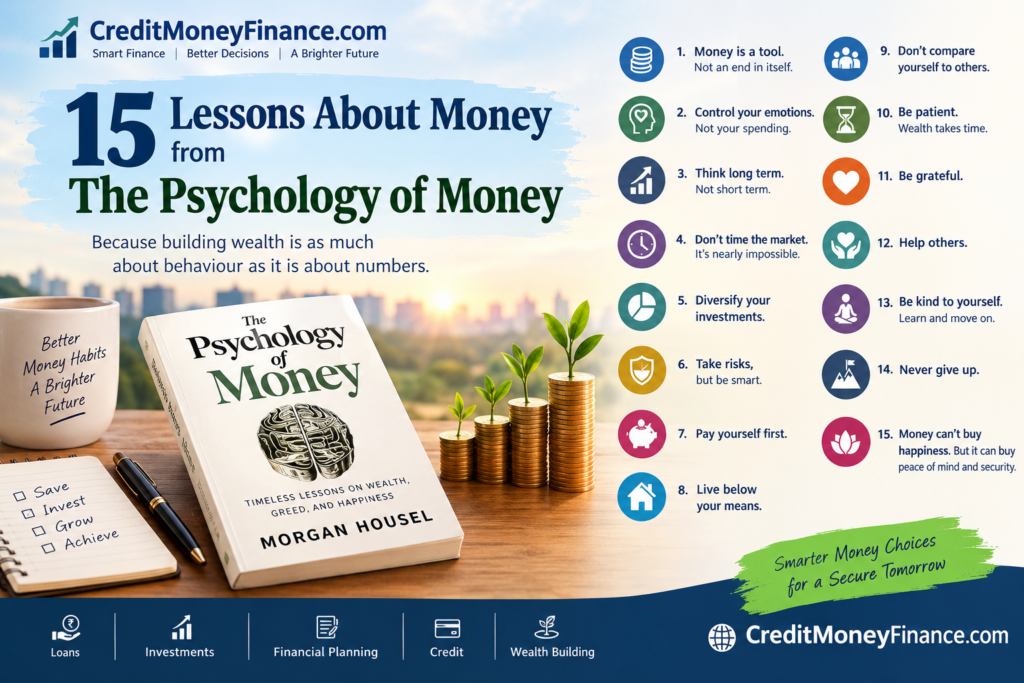
15 Lessons About Money from The Psychology of Money 📚💰
Why building wealth is as much about behaviour as it is about numbers
Money management is often presented as a subject of mathematics—income, expenses, savings, investments, returns and taxes. But one of the most important lessons from Morgan Housel’s widely read book The Psychology of Money is that financial outcomes are also deeply influenced by human behaviour, emotions, habits and personal experiences.
Two people with similar incomes can make completely different financial decisions. One may save consistently and build long-term wealth, while another may spend aggressively, take excessive risks or constantly compare their lifestyle with others.
Here are 15 practical lessons inspired by the central ideas of The Psychology of Money that can help individuals develop a healthier relationship with money.
1. Money Is a Tool — Not the Destination
Money can provide choices, flexibility and financial security, but accumulating money purely for the sake of accumulation may not create a fulfilling life.
The real value of money lies in what it enables—greater independence, security, opportunities and the ability to make choices.
2. Don’t Allow Emotions to Drive Financial Decisions
Fear, greed, excitement, social pressure and impatience can all influence financial behaviour.
Before making a major purchase or investment decision, it can be useful to ask: “Am I making this decision based on my financial plan—or my emotions?”
3. Think Long Term
Building wealth is generally a long-term process.
Markets can experience periods of volatility, corrections and uncertainty. A long-term approach can help investors avoid making impulsive decisions based solely on short-term movements.
4. Avoid the Temptation to Time the Market
Predicting exactly when markets will rise or fall is extremely difficult.
Rather than relying entirely on predictions, investors may consider an approach consistent with their objectives, risk tolerance, time horizon and financial plan.
5. Diversification Matters
Concentrating all your money in a single investment or asset class can increase exposure to specific risks.
Diversification across appropriate investments can help manage portfolio risk, although diversification does not eliminate the possibility of losses.
6. Understand Risk Before Taking It
Taking calculated risks can be an important part of investing and entrepreneurship.
However, there is a significant difference between taking an informed risk and taking a reckless gamble.
Understand what you could lose before deciding what you are willing to risk.
7. Pay Yourself First
Saving should ideally become a habit rather than something that happens only when money is left over at the end of the month.
Automating a portion of income toward savings or investments can help make wealth-building more consistent.
8. Live Below Your Means
One of the simplest principles of personal finance is also one of the most powerful:
Spend less than you earn.
Increasing income can create opportunities, but controlling lifestyle inflation can determine how much of that income ultimately becomes savings and wealth.
9. Don’t Measure Your Financial Life Against Someone Else’s
Social media and modern consumer culture can make other people’s lifestyles appear effortless.
But appearances rarely reveal the complete financial picture.
Instead of competing with someone else’s spending, focus on your own goals, responsibilities, priorities and definition of financial success.
10. Be Patient
Wealth creation rarely happens overnight.
Compounding works over time, and consistent financial habits can become increasingly powerful as the years pass.
The objective should not necessarily be to get rich quickly, but to build financial resilience gradually.
11. Practice Gratitude
Financial success is not measured only by the size of an investment portfolio.
Recognising what you already have—financially and personally—can help reduce unnecessary pressure to constantly pursue more.
12. Use Money to Create Positive Impact
Money can be used not only for personal consumption but also to support family, communities, charitable causes and people who need assistance.
Financial resources can have value beyond personal wealth accumulation.
13. Learn From Financial Mistakes
Almost everyone makes financial mistakes at some point.
A poor investment, unnecessary purchase or missed opportunity does not have to define someone’s financial future.
The more productive response is to understand what happened, learn from it and improve future decision-making.
14. Stay Consistent
Financial independence is usually a long journey rather than a single achievement.
There will be periods of economic uncertainty, unexpected expenses, investment losses and changes in personal circumstances.
Consistency, adaptability and patience can be more valuable than constantly searching for the next financial shortcut.
15. Money Doesn’t Automatically Buy Happiness
Money cannot guarantee happiness.
However, responsible financial management can provide something extremely valuable: greater financial security and peace of mind.
Having an emergency fund, manageable debt, adequate protection and long-term savings can reduce some of the financial pressures that affect everyday life.
The Bigger Lesson: Personal Finance Is Personal
Perhaps the most important message surrounding The Psychology of Money is that financial decisions are rarely based purely on spreadsheets.
Our upbringing, experiences, fears, ambitions, successes and failures can all influence how we think about money.
That is why financial literacy is not simply about learning investment products or understanding market terminology. It is also about developing discipline, patience, self-awareness and sound financial habits.
There is no single financial strategy that is appropriate for everyone. Individual circumstances, income, liabilities, goals, age, time horizon and risk tolerance all matter.
Building Wealth Is a Behavioural Journey
Successful personal finance is often less about finding a perfect investment and more about consistently making sensible decisions over a long period.
Earn responsibly. Spend thoughtfully. Save consistently. Invest according to your circumstances. Manage risk. Stay patient.
These principles may appear simple—but applying them consistently can be much harder.
The Psychology of Money offers an important reminder: how we behave with money can be just as important as what we know about money.
About CreditMoneyFinance.com
CreditMoneyFinance.com brings readers practical and informative content covering personal finance, business finance, credit, loans, investment awareness, financial planning and developments across the financial ecosystem.
Disclaimer: This article is for general financial education and awareness only. It is not investment, tax or financial advice. Readers should evaluate their individual circumstances and seek appropriate professional advice before making financial decisions.
More Featured Articles:
Collateral-Free Import Finance in India: Funding Up to USD 5 Million for Growing Businesses.
Strategic Finance Options for Medical and Hospital Businesses in India (2026)
Revenue-Based Finance in India 2026: The Ultimate Founder’s Guide to Non-Dilutive Growth Capital