

From Business Idea to Investor-Ready Opportunity: Business Plans, Financial Models, Valuation & Fundraising Advisory
How Professional Business Plans, Financial Models, Valuations and Investor Documents Can Strengthen Fundraising.
Turning a Business Opportunity into an Investment-Ready Proposition.
Learn how professional business plans, investor pitch decks, DPRs, TEV reports, financial models, valuations and return metrics can strengthen fundraising and investment decisions.
A promising business idea is only the starting point.
Whether a company is seeking angel investment, HNI funding, venture capital, private equity, project finance, strategic investment or preparing for a merger or acquisition, investors and financial institutions need much more than an attractive presentation. They need to understand the business model, market opportunity, growth strategy, financial potential, risks, valuation and expected returns before making an investment decision.
This is where professionally prepared business and financial documentation becomes critical.
A well-structured business plan, investor pitch deck, Information Memorandum, Detailed Project Report (DPR), Techno-Economic Viability Report (TEV), financial model and valuation report can make a significant difference to how an opportunity is perceived.
At the same time, these documents need to go beyond simply presenting numbers. They must tell a coherent story, demonstrate commercial viability and withstand the questions that sophisticated investors, lenders and institutional decision-makers are likely to ask.
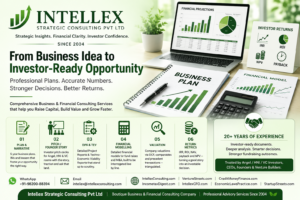
For more than two decades, Intellex Strategic Consulting Pvt Ltd has been helping entrepreneurs, companies, founders and businesses convert their ideas, plans and financial information into professionally structured, investor-ready documentation.
Why Investor-Ready Documentation Matters
Investors see hundreds of business opportunities. Most businesses, however, have only one opportunity to make a strong first impression.
A founder may know the business inside out, but an external investor does not have the same knowledge. The investor needs to quickly understand:
- What problem does the business solve?
- How large is the addressable market?
- What makes the business different?
- Who are its customers?
- What is the revenue model?
- What traction has already been achieved?
- How scalable is the business?
- What are the key risks?
- How much capital is required?
- How will the funds be utilised?
- What valuation is being proposed?
- What returns could the investor potentially generate?
- What is the expected exit opportunity?
A professionally prepared investment document brings these elements together into a logical narrative.
More importantly, it ensures that the business story and financial story support each other.
An impressive pitch without credible numbers can raise doubts. Similarly, a detailed financial model without a compelling business narrative may fail to generate investor interest.
The objective should therefore be to create a complete investment proposition.
1. Business Plans and Investment Narratives
Five-Year Business Plans That Go Beyond Generic Projections
A business plan is often treated as a formal document prepared for the sake of raising funds. In reality, a good business plan should become a strategic roadmap for the company.
A professionally prepared five-year business plan should ideally cover:
- Business overview
- Promoter and management background
- Products and services
- Market opportunity
- Industry analysis
- Target customers
- Competition
- Competitive advantages
- Business model
- Marketing and sales strategy
- Operational strategy
- Expansion plans
- Human-resource requirements
- Capital expenditure
- Funding requirements
- Financial projections
- Key assumptions
- Risk factors
- Potential investor returns
The quality of the assumptions is particularly important.
Investors do not necessarily expect a company to predict the future perfectly. They expect management to demonstrate that it understands the factors that will determine future performance.
A strong business plan therefore explains not only what the company expects to achieve, but also why those projections are realistic.
2. Information Memorandums and Investment Teasers
When approaching investors, the first document an investor may see is often a teaser or a concise investment opportunity summary.
Its purpose is not to explain everything.
Its purpose is to generate sufficient interest for the investor to ask for more information.
An Information Memorandum, on the other hand, provides a much deeper understanding of the opportunity.
A professionally prepared Information Memorandum can cover:
- Investment highlights
- Company background
- Industry opportunity
- Market size
- Business model
- Products and services
- Existing operations
- Growth strategy
- Management
- Financial performance
- Future projections
- Funding requirement
- Proposed transaction
- Valuation considerations
- Risks
- Potential exit opportunities
The challenge is to present information in a manner that is comprehensive without becoming confusing.
Investors should be able to understand the opportunity quickly while having sufficient information to proceed to the next stage of evaluation.
3. Investor Pitch Decks and Founder Stories
Building a Pitch That Works for the Room
A pitch deck is not simply a collection of PowerPoint slides.
It is an investment communication tool.
A startup presenting to an angel investor may need a different emphasis from a company presenting to a venture capital fund, private equity investor or strategic investor.
The underlying story must therefore be adapted to the audience.
A strong investor pitch deck typically addresses:
- The problem
- The solution
- The market
- The product or service
- Business model
- Traction
- Competitive landscape
- Go-to-market strategy
- Management team
- Financial projections
- Funding requirement
- Utilisation of funds
- Valuation
- Investor proposition
- Future growth and exit potential
But the numbers alone do not make a compelling pitch.
The founder story also matters.
Why was the business created?
What insight did the founder identify?
Why is the team capable of executing the opportunity?
Why is the timing right?
Why can this particular company win?
These questions can determine whether an investor moves from curiosity to serious consideration.
4. Detailed Project Reports and Techno-Economic Viability Reports
For projects involving substantial capital expenditure, infrastructure, manufacturing, real estate, renewable energy, technology infrastructure or other asset-intensive businesses, investors and lenders often require significantly more detailed analysis.
This is where a Detailed Project Report (DPR) and Techno-Economic Viability (TEV) Report become important.
A professionally prepared DPR may cover:
- Project background
- Promoter profile
- Project concept
- Location
- Technical configuration
- Capacity
- Technology
- Raw materials
- Infrastructure
- Manpower
- Implementation schedule
- Project cost
- Means of finance
- Revenue assumptions
- Operating expenses
- Financial projections
- Break-even analysis
- Sensitivity analysis
- Risk assessment
- Debt-servicing capability
- Economic viability
A TEV analysis goes further by examining whether the project is technically feasible and economically viable.
For lenders and institutional investors, the quality and credibility of these assessments can be crucial.
5. Financial Modelling for Fundraising, Investment and M&A
Numbers That Can Withstand Investor Scrutiny
A financial model is one of the most important components of an investment transaction.
However, a financial model should not merely produce an attractive profit figure.
It should allow investors, lenders and transaction advisors to understand how the business works financially.
A robust financial model may include:
- Revenue build-up
- Customer acquisition assumptions
- Pricing assumptions
- Cost structure
- Gross margins
- EBITDA
- Working capital
- Capital expenditure
- Depreciation
- Debt
- Interest
- Taxes
- Cash flows
- Balance sheet
- Profit and loss statement
- Scenario analysis
- Sensitivity analysis
- Valuation
- Investor returns
- Exit assumptions
The model should also be flexible enough to test different scenarios.
For example:
What happens if revenue grows 20% slower than expected?
What happens if customer acquisition costs increase?
What happens if margins decline?
What happens if the company requires additional capital?
What happens to investor returns if the exit takes two years longer?
These are the kinds of questions sophisticated investors may ask.
A properly structured financial model allows management and investors to explore these scenarios rather than relying solely on a single set of projections.
6. Business Valuation
Moving Beyond a Single Valuation Number
Determining the value of a company is often one of the most sensitive aspects of fundraising or M&A.
A valuation should ideally be supported by appropriate methodologies rather than simply being based on what the promoter believes the company is worth.
Depending on the nature and maturity of the business, valuation may involve methodologies such as:
Discounted Cash Flow — DCF
DCF valuation considers the future cash-generating capability of the business and discounts projected cash flows to their present value.
Comparable Company Analysis
The business is compared with similar listed or private companies using relevant valuation multiples.
Precedent Transactions
Previous transactions involving comparable businesses can provide useful reference points.
Other Relevant Approaches
Depending on the business, asset values, revenue multiples, EBITDA multiples, NAV or other approaches may also be relevant.
The objective is not simply to produce a number.
It is to establish a defensible valuation range supported by appropriate assumptions and market benchmarks.
7. Investor Return Metrics
Converting Business Potential into an Investment Decision
An investor ultimately wants to understand one fundamental question:
What is the potential return on my investment, and what risks am I taking to achieve it?
This is why investor return metrics are so important.
Depending on the transaction, relevant metrics may include:
- ROI — Return on Investment
- IRR — Internal Rate of Return
- NPV — Net Present Value
- NAV — Net Asset Value
- Payback Period
- Equity Multiple
- Cash-on-Cash Return
- Exit Value
For funds, private equity transactions and project investments, these metrics can be particularly important.
For example, a company may have excellent revenue growth but require substantial additional capital. An investor therefore needs to understand not only the projected growth but also the capital required to achieve that growth and the eventual return available to the investor.
A professionally constructed return analysis connects the business plan with the investment decision.
8. Understanding How Investors Think
One of the biggest advantages of working with experienced business and financial advisors is understanding the perspective of the person sitting on the other side of the table.
Founders naturally focus on:
“Why is my business a great opportunity?”
Investors tend to think:
“What could go wrong, how much capital will be required, what return can I generate and how can I eventually exit?”
This difference in perspective is extremely important.
Investors may examine:
- Market attractiveness
- Scalability
- Competitive advantage
- Management capability
- Financial discipline
- Capital efficiency
- Unit economics
- Cash burn
- Governance
- Regulatory considerations
- Valuation
- Exit potential
- Downside risks
Investor-ready documentation should anticipate these questions rather than waiting for investors to raise them.
9. Why Professional Financial Documentation Can Strengthen Fundraising
A professionally prepared set of documents can provide several advantages.
Greater Credibility
Well-structured documents demonstrate that the promoters understand their business and financial requirements.
Better Investor Communication
Complex business information can be presented in a manner that investors can understand quickly.
Greater Consistency
The business plan, pitch deck, financial model, valuation and investor memorandum should all tell the same story.
Improved Decision-Making
A robust financial model enables promoters to understand the implications of different fundraising and growth scenarios.
Better Negotiation
Understanding valuation and investor-return expectations can place founders in a stronger position during discussions.
Institutional Readiness
Professional documentation can help businesses move towards the standards expected by institutional investors, lenders and strategic stakeholders.
10. The Importance of Consistency Across Documents
One of the most common weaknesses in fundraising documentation is inconsistency.
For example, the pitch deck may show one revenue projection, while the financial model shows another.
The business plan may assume one funding requirement while the Information Memorandum mentions a different figure.
The valuation may be based on assumptions that do not correspond with the financial model.
These inconsistencies can immediately raise questions.
Investor-ready documentation should therefore be treated as an integrated system.
The:
Business Plan → Pitch Deck → Information Memorandum → Financial Model → Valuation → Investor Return Analysis
should be interconnected.
Every important number should have a logical explanation.
11. Experience Matters When Preparing Investor Documents
Preparing investor-facing documents is not simply a matter of formatting information into attractive pages.
It requires an understanding of:
- Business strategy
- Financial analysis
- Investment expectations
- Industry dynamics
- Market trends
- Valuation
- Capital raising
- Investor psychology
- Transaction structures
With more than 20 years of experience, Intellex Strategic Consulting Pvt Ltd understands that different businesses require different approaches.
A technology startup, manufacturing company, real estate project, consumer business, healthcare company and professional-services business cannot all be presented using the same template.
The objective is to understand the business first and then develop the appropriate documentation around its investment proposition.
12. From Documentation to a Complete Fundraising Strategy
Good documentation is important, but it is only one component of a successful fundraising exercise.
A company must also identify the right investors, determine the appropriate fundraising structure, establish realistic valuation expectations and develop an effective investor outreach strategy.
This is particularly important because the right investor is not necessarily the investor with the largest cheque.
An investor’s:
- sector preference,
- investment stage,
- geography,
- cheque size,
- investment philosophy,
- portfolio,
- strategic value and
- expected returns
can all influence whether the investor is appropriate.
Consequently, investor-ready documentation should be developed with the intended investor audience in mind.
Intellex Strategic Consulting Pvt Ltd — Business & Financial Consulting Since 2004
Intellex Strategic Consulting Pvt Ltd is a boutique business and financial consulting company providing professional advisory services since 2004.
With more than 20 years of experience, we work with entrepreneurs, startups, founders, companies, venture builders and businesses requiring professional support in preparing investor-ready and institution-ready business and financial documentation.
Our core services include:
01. Business Plans & Investment Narratives
Five-year business plans, Information Memorandums and investment teasers designed to frame the opportunity in a manner that investors, lenders and diligence teams can understand and evaluate.
02. Pitch Decks & Founder Stories
Startup and business pitch decks developed for Angels, HNIs, VCs, PE investors and other stakeholders, with the story, traction, opportunity and funding requirement structured to communicate effectively.
03. DPR & TEV Reports
Detailed Project Reports and Techno-Economic Viability Reports designed to provide the level of commercial, technical and financial analysis expected by lenders and institutional stakeholders.
04. Financial Modelling
Detailed financial models for fundraising, M&A and strategic decision-making, structured to withstand detailed review and scenario analysis.
05. Business Valuation
Company valuations using appropriate methodologies including DCF, comparable companies and precedent transactions, with the objective of developing a balanced and defensible valuation assessment.
06. Investor Return Metrics
Calculation and analysis of IRR, ROI, NAV, payback, NPV and other relevant investment metrics that help convert a business proposition into an investment decision.
More Than Documents — Understanding the Investment Perspective
Our experience goes beyond drafting and compiling documents.
Having worked with businesses and investment-related assignments for more than two decades, we understand that an investor-ready document must answer the questions that investors are likely to ask.
It must demonstrate commercial logic, financial credibility, scalability, opportunity, risk awareness and potential returns.
Our work has been appreciated by Angel Investors, HNIs, Venture Capital Investors, CEOs, Founders and Venture Builders for its focus on clarity, commercial substance and investor-oriented presentation.
Whether a business is preparing for its first institutional fundraise, seeking expansion capital, approaching lenders, evaluating an acquisition or preparing for a strategic transaction, professionally structured business and financial documentation can significantly strengthen the process.
Need Help Preparing Your Business for Investors?
If you are planning to raise capital, approach investors, secure project finance, undertake an M&A transaction or simply want to understand the financial potential and valuation of your business, the first step is to ensure that your opportunity is presented professionally and supported by credible financial analysis.
Intellex Strategic Consulting Pvt Ltd can assist in converting your business information, strategy and financial data into a structured, professional and investor-ready proposition.
Contact Us
Intellex Strategic Consulting Pvt Ltd
Boutique Business & Financial Consulting | Since 2004
WhatsApp: +91-98200-88394
Email: intellex@intellexconsulting.com
Websites:
IntellexConsulting.com | VentureStreets.com | CreditMoneyFinance.com | IncomeTaxDigest.com | IntellexCFO.com | EconomicLawsPractice.com | StartupStreets.com
Business Plans | Investor Pitch Decks | Information Memorandums | DPR & TEV | Financial Modelling | Valuation | Fundraising Advisory | Investor Return Analysis
More Featured Articles:
Private Equity & Venture Capital: Financing the Next Growth Chapter of Startups and Businesses.
Venture Debt in India: The Complete 2026 Guide for Startups, Founders, CFOs & Growth Companies.
Why Kjøller (Dubai) is an important Venture Capital Investor for Startups Globally.
How Startups Can Raise Funding in Dubai: A Comprehensive Guide for Founders and Entrepreneurs.
The Ultimate Guide to Company Registration in Dubai 2026: Benefits, Compliance, and Costs
Indians in top in Number of foreign born founders who founded billion dollar American companies: