
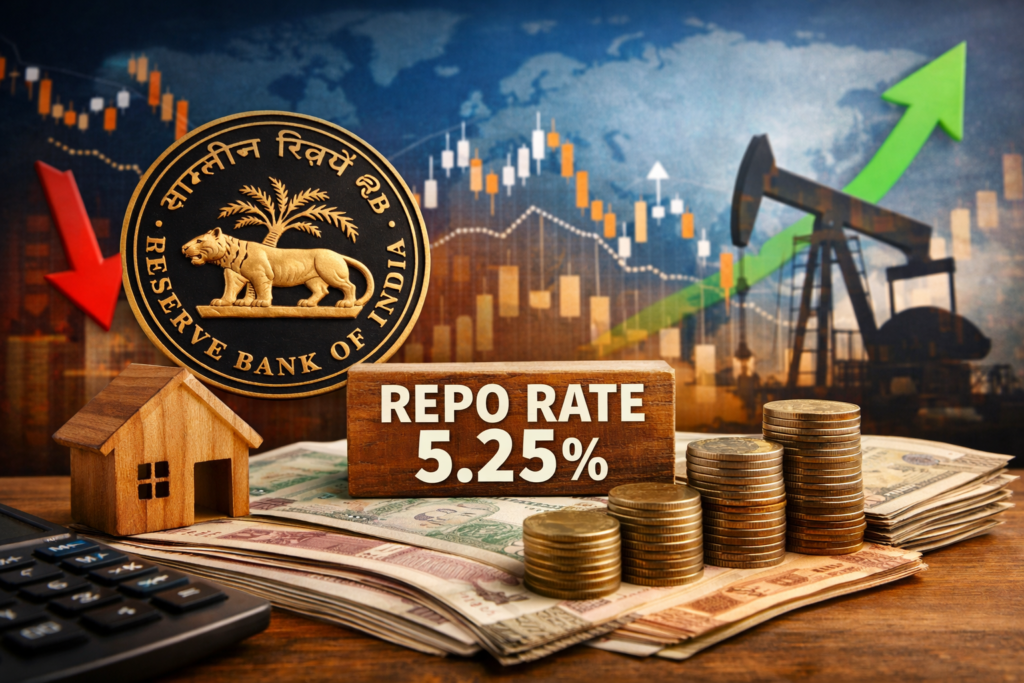
RBI Holds Repo Rate at 5.25%: What It Means for Borrowers, Markets, and the Economy.
RBI keeps repo rate unchanged at 5.25% in the latest MPC meeting. Understand the impact on EMIs, loans, inflation, markets, and future rate outlook.
The Reserve Bank of India (RBI), in its latest Monetary Policy Committee (MPC) meeting, has decided to keep the repo rate unchanged at 5.25%. This move signals a continuation of the current monetary stance, indicating that the central bank is not inclined toward an immediate shift in interest rate direction.
Understanding the Repo Rate at 5.25%
The repo rate is the rate at which the RBI lends funds to commercial banks. It serves as a key benchmark influencing lending and borrowing costs across the economy. With the rate remaining unchanged:
Loan EMIs are expected to remain largely stable, providing relief to borrowers.
There is no immediate change in borrowing costs for individuals or businesses.
The decision reflects a cautious approach, suggesting that the RBI is neither rushing to stimulate growth nor aggressively tightening liquidity.
Policy Stance Remains Neutral
The RBI has maintained its policy stance as “neutral,” which reflects a balanced approach between controlling inflation and supporting economic growth. This stance allows the central bank to remain flexible and responsive to evolving macroeconomic conditions.
A neutral stance implies that:
Interest rates could be increased if inflationary pressures intensify.
Rate cuts remain a possibility if economic growth shows signs of slowing.
This flexibility is crucial in an environment marked by both domestic and global uncertainties.
Inflation Continues to Be a Key Concern
Inflation remains one of the primary factors guiding the RBI’s decision-making process. Several elements continue to exert upward pressure on prices:
Rising crude oil prices, influenced by geopolitical tensions, are increasing input costs.
Food inflation, driven by supply-side disruptions, remains volatile.
Global economic uncertainties are adding to inflationary risks.
Given these factors, the RBI has adopted a cautious stance, preferring to assess incoming data before considering any rate cuts.
Global Uncertainty Influencing Policy Decisions
The global economic environment continues to play a significant role in shaping India’s monetary policy outlook. Ongoing geopolitical tensions, particularly in regions such as Iran, have implications for crude oil prices and global trade dynamics.
Additionally:
The trajectory of US interest rates and the strength of the US dollar are impacting capital flows.
Global financial market volatility is influencing investor sentiment.
These external factors necessitate a measured and vigilant approach from the RBI.
Liquidity and Financial System Stability
The RBI is actively monitoring liquidity conditions within the banking system to ensure a balance between adequate credit flow and inflation control.
Stable interest rates contribute to:
Maintaining equilibrium in financial markets.
Ensuring sufficient liquidity without triggering excessive inflation.
Supporting orderly functioning of the banking sector.
Impact on Loans and Deposits
For consumers and businesses, the decision translates into stability in financing costs:
Home loans, auto loans, and business loans are expected to remain unchanged in the near term.
Banks are unlikely to revise lending rates immediately.
Fixed deposit rates are also expected to stay stable in the short term.
This consistency provides predictability for both borrowers and savers.
Market Expectations and Reaction
The decision to hold rates steady was largely anticipated by market participants. As a result, the immediate market reaction has been relatively muted.
Going forward:
Investor focus will shift to the RBI’s forward guidance.
Market participants will closely monitor upcoming MPC meetings for signals on future policy direction.
What Lies Ahead?
The RBI’s future policy actions will be guided by a combination of domestic and global factors, including:
Inflation trends and price stability
Economic growth momentum
Global geopolitical and financial developments
The central bank retains the flexibility to act swiftly should conditions warrant a change in policy direction.
In summary, the RBI’s decision to maintain the repo rate at 5.25% reflects a calibrated and cautious approach in a complex economic environment. By holding rates steady and maintaining a neutral stance, the central bank aims to balance inflation control with sustainable economic growth while remaining prepared to respond to evolving risks.
CreditMoneyFinance.com
More Featured Posts:
RBI Proposes One-Hour Delay on UPI Transfers Above ₹10,000 to Combat Rising Digital Fraud.
RBI FLA Return 2026: Compliance Challenges for GIFT IFSC Entities Under FEMA Explained.
RBI Tightens NBFC Lending Norms: Mandatory Board Policy for Loans to Defaulting Borrowers.
RBI’s Groundbreaking Draft Amendments for NBFC Registration & Deregistration (2026).
RBI Cheque Bounce Rules 2025: New Penalties, Jail Provisions & Faster Legal Process Explained.
RBI Allows Silver as Loan Collateral – A New Era for Metal-Backed Financing
RBI Simplifies External Borrowing Rules under FEMA!
The Ultimate Guide to Company Registration in Dubai 2026: Benefits, Compliance, and Costs
Ultimate Guide to Singapore Company Registration 2026: Rules, Costs, and Compliance