
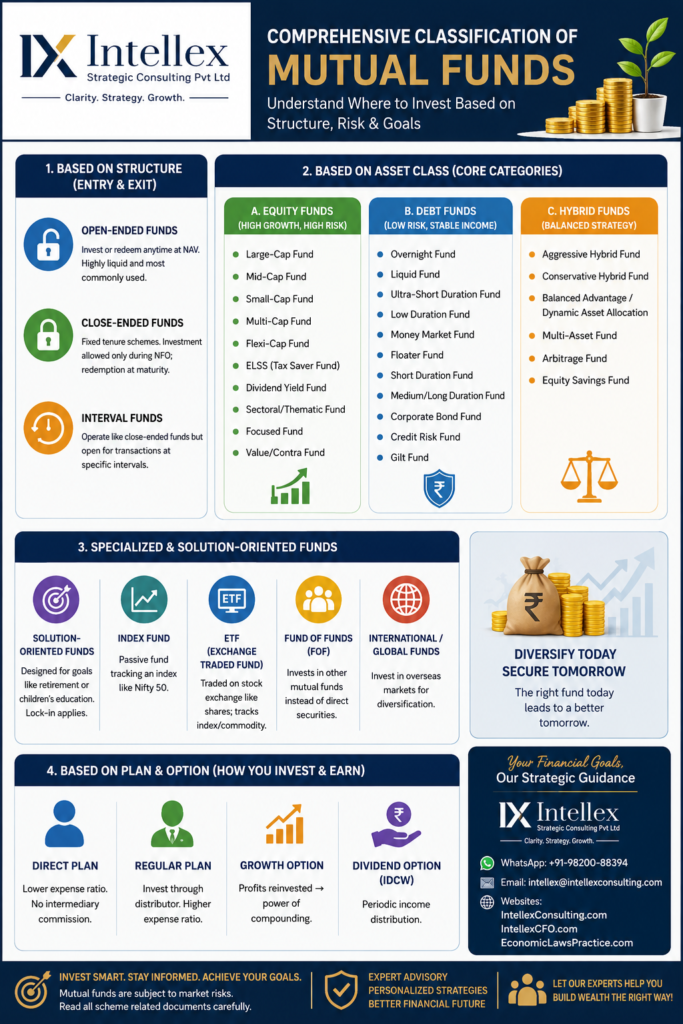
Comprehensive Classification of Mutual Funds in India (2026): Structure, Risk, Returns & Smart Investment Strategies Explained
A complete guide to mutual fund classification in India—understand fund structures, asset classes, risk levels, and investment strategies. Learn how to choose the right mutual fund for your financial goals with expert insights from Intellex Strategic Consulting Pvt Ltd.
📘 Comprehensive Classification of Mutual Funds Updates
Understand Where to Invest Based on Structure, Risk & Goals
Mutual funds have become one of the most preferred investment avenues in India due to their diversification, professional management, and accessibility. However, choosing the right fund requires a clear understanding of how mutual funds are classified.
This guide provides a comprehensive and updated classification of mutual funds, helping investors align their investments with risk appetite, financial goals, and time horizon.
🧩 1. Based on Structure (Entry & Exit)
This classification determines liquidity and accessibility of your investment.
🔹 Open-Ended Funds
These are the most popular mutual funds where investors can buy or redeem units anytime at the Net Asset Value (NAV).
✔ High liquidity
✔ Suitable for most investors
✔ Ideal for SIP investments
🔹 Close-Ended Funds
These funds have a fixed maturity period and are available only during the New Fund Offer (NFO).
✔ Limited liquidity
✔ Listed on stock exchanges
✔ Suitable for disciplined long-term investors
🔹 Interval Funds
A hybrid structure combining features of open and close-ended funds.
✔ Transactions allowed only at specific intervals
✔ Moderate liquidity
✔ Useful for planned investment cycles
📊 2. Based on Asset Class (Core Categories)
This is the most important classification, as it defines risk and return potential.
🟢 A. Equity Funds (High Growth, High Risk)
Equity funds invest primarily in stocks, making them ideal for long-term wealth creation.
🔸 Large-Cap Funds
Invest in top 100 companies by market capitalization
✔ Stable returns
✔ Lower risk compared to other equity funds
🔸 Mid-Cap Funds
Focus on emerging companies ranked 101–250
✔ Higher growth potential
✔ Moderate to high risk
🔸 Small-Cap Funds
Invest in smaller companies beyond top 250
✔ Very high return potential
✔ Highly volatile
🔸 Multi-Cap Funds
Minimum 25% allocation each in large, mid, and small caps
✔ Diversified exposure
✔ Balanced risk-return
🔸 Flexi-Cap Funds
No fixed allocation—fund manager decides dynamically
✔ Flexible strategy
✔ Suitable for changing market conditions
🔸 ELSS (Tax Saver Funds)
Eligible for tax deduction under Section 80C
✔ 3-year lock-in
✔ Combines tax saving with wealth creation
🔸 Dividend Yield Funds
Invest in companies offering consistent dividends
✔ Regular income potential
✔ Lower volatility
🔸 Sectoral / Thematic Funds
Focused on specific sectors like IT, Pharma, Banking
✔ High returns possible
✔ High concentration risk
🔸 Focused Funds
Invest in a limited number of stocks (max 30)
✔ High conviction strategy
✔ Higher risk
🔸 Value / Contra Funds
Invest in undervalued or out-of-favor stocks
✔ Long-term gains
✔ Requires patience
🔵 B. Debt Funds (Low Risk, Stable Income)
Debt funds invest in fixed income instruments such as bonds and treasury bills.
🔹 Overnight Fund
Invests in securities with 1-day maturity
✔ Lowest risk
✔ Ideal for parking funds
🔹 Liquid Fund
Maturity up to 91 days
✔ High liquidity
✔ Alternative to savings account
🔹 Ultra-Short Duration Fund
3–6 months maturity
✔ Slightly higher returns than liquid funds
🔹 Low Duration Fund
6–12 months maturity
✔ Low volatility
🔹 Money Market Fund
Invests in short-term instruments up to 1 year
✔ Stable returns
🔹 Floater Fund
Invests in floating rate instruments
✔ Protection against interest rate fluctuations
🔹 Short Duration Fund
1–3 years maturity
✔ Balanced risk and return
🔹 Medium to Long Duration Fund
Higher duration exposure
✔ Higher returns potential
✔ Sensitive to interest rate changes
🔹 Corporate Bond Fund
Invests in high-rated corporate bonds
✔ Relatively safe
✔ Better yield than government securities
🔹 Credit Risk Fund
Invests in lower-rated bonds
✔ Higher returns
✔ Higher default risk
🔹 Gilt Fund
Invests in government securities
✔ No credit risk
✔ Subject to interest rate risk
🟡 C. Hybrid Funds (Balanced Strategy)
Hybrid funds combine equity and debt for balanced investing.
🔸 Aggressive Hybrid Fund
65–80% equity allocation
✔ Higher growth
✔ Moderate risk
🔸 Conservative Hybrid Fund
75–90% debt allocation
✔ Stability
✔ Lower risk
🔸 Balanced Advantage / Dynamic Asset Allocation
Automatically shifts between equity and debt
✔ Risk management
✔ Suitable for volatile markets
🔸 Multi-Asset Fund
Invests in at least 3 asset classes (equity, debt, gold)
✔ Diversification
✔ Reduced risk
🔸 Arbitrage Fund
Profits from price differences in markets
✔ Low risk
✔ Tax-efficient
🔸 Equity Savings Fund
Mix of equity, arbitrage, and debt
✔ Moderate returns
✔ Lower volatility
🎯 3. Specialized & Solution-Oriented Funds
These funds are designed for specific financial goals or strategies.
🔹 Solution-Oriented Funds
Target goals like retirement or children’s education
✔ Lock-in period
✔ Goal-based investing
🔹 Index Funds
Passively track indices like Nifty 50
✔ Low cost
✔ No active management risk
🔹 ETF (Exchange Traded Fund)
Traded on stock exchanges like shares
✔ Real-time pricing
✔ Low expense ratio
🔹 Fund of Funds (FoF)
Invests in other mutual funds
✔ Diversification
✔ Suitable for global exposure
🔹 International / Global Funds
Invest in overseas markets
✔ Geographic diversification
✔ Currency advantage
⚙️ 4. Based on Plan & Option (How You Invest & Earn)
🔹 Direct Plan
✔ Lower expense ratio
✔ Higher returns over long term
🔹 Regular Plan
✔ Invest through distributor
✔ Includes advisory support
🔹 Growth Option
✔ Profits reinvested
✔ Power of compounding
🔹 Dividend Option (IDCW)
✔ Periodic income payout
✔ Suitable for income-seeking investors
🧠 How to Choose the Right Mutual Fund?
Choosing the right mutual fund depends on:
✔ Financial goals (wealth creation, income, tax saving)
✔ Risk tolerance (low, medium, high)
✔ Investment horizon (short-term vs long-term)
✔ Liquidity needs
✔ Market conditions
A well-diversified portfolio often includes a mix of equity, debt, and hybrid funds aligned with your life goals.
🚀 Why Professional Guidance Matters
While mutual funds offer flexibility and diversification, selecting the right combination requires expertise in asset allocation, taxation, and risk management.
🤝 Expert Advisory Services
Intellex Strategic Consulting Pvt Ltd offers comprehensive financial advisory and investment planning services tailored to your needs.
📱 WhatsApp: +91-98200-88394
📧 Email: intellex@intellexconsulting.com
🌐 Websites:
- IntellexConsulting.com
- IntellexCFO.com
- EconomicLawsPractice.com
💼 Partner with experts to build a robust, goal-driven investment portfolio.
📌 Final Thoughts
Mutual funds are not one-size-fits-all. Understanding their classification empowers investors to make informed, strategic decisions. Whether you’re a conservative investor or a high-risk wealth creator, there’s a mutual fund tailored for you.
The key lies in aligning investments with your financial journey and reviewing them regularly.
Intellex Strategic Consulting Pvt Ltd
More Featured Articles:
Revenue-Based Finance in India 2026: The Ultimate Founder’s Guide to Non-Dilutive Growth Capital
Strategic Finance Options for Medical and Hospital Businesses in India (2026)
Infrastructure Finance in India: Concept, Evolution, Key Players, and the Road Ahead.
SME IPO in India: A Comprehensive Guide for Growing Businesses Looking to Go Public: