
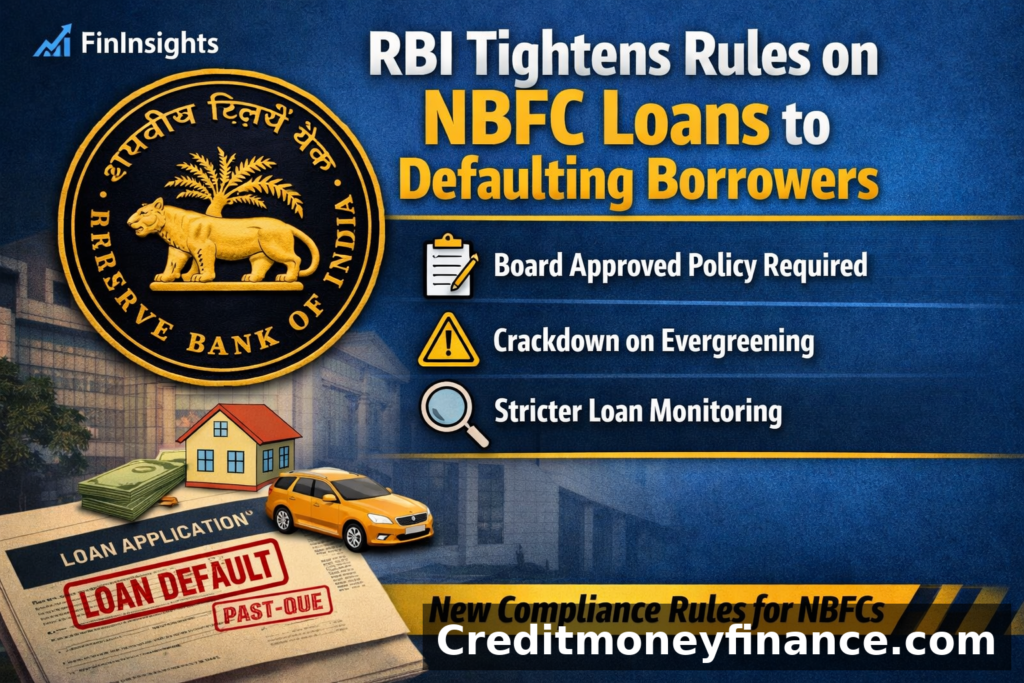
RBI Tightens NBFC Lending Norms: Mandatory Board Policy for Loans to Defaulting Borrowers.
RBI tightens NBFC lending norms, mandating board-approved policies for loans to defaulting borrowers. Learn how this impacts evergreening, NPAs, and NBFC compliance.
Introduction
In a significant move to strengthen financial discipline and curb risky lending practices, the Reserve Bank of India (RBI) has tightened its scrutiny on Non-Banking Financial Companies (NBFCs). The regulator has raised concerns over NBFCs extending fresh loans to borrowers who have already defaulted on existing obligations.
The central bank is now insisting on a board-approved lending policy to govern such decisions—marking a critical step towards improving transparency, accountability, and risk management in the shadow banking sector.
What Triggered RBI’s Action?
During its annual inspections, the RBI flagged instances where NBFCs provided new loans to borrowers who had already defaulted on previous loans especially across different loan categories.
For example:
- A borrower defaulting on a vehicle loan was granted a fresh loan against property (LAP) or home loan
- Such practices raised concerns about risk exposure and potential misuse of funds
While the RBI is not banning such lending outright, it is emphasizing the need for clear internal governance and justification.
Mandatory Board-Approved Lending Policy
The RBI has made it clear that NBFCs must:
- Develop a formal, board-approved policy
- Clearly define:
- Conditions under which loans can be extended to defaulting borrowers
- Risk assessment frameworks
- Safeguards against misuse of funds
- Ensure complete documentation and transparency in such lending decisions
If an NBFC’s lending policy is silent on this issue, the RBI considers that non-compliant and unacceptable.
Focus on Preventing “Evergreening”
A key concern behind this move is the prevention of evergreening of loans.
What is Evergreening?
Evergreening is a practice where lenders:
- Provide new loans to struggling borrowers
- Use those funds to repay existing loans
- Artificially keep loan accounts “standard” instead of recognizing stress
This results in:
- Hidden bad loans
- Misleading financial statements
- Increased systemic risk
The RBI has clearly indicated that any such lending must include strong safeguards to ensure funds are not used for evergreening purposes.
Understanding Loan Stress Classification
To track early signs of financial stress, loans are categorized before turning into NPAs:
- SMA-0: Payment overdue up to 30 days
- SMA-1: Overdue between 31–60 days
- SMA-2: Overdue between 61–90 days
- NPA (Non-Performing Asset): Overdue beyond 90 days
This classification helps lenders and regulators identify stress early and take corrective action.
Applicability to Larger NBFCs
Sources indicate that this regulatory approach will likely extend to:
- NBFCs with net worth above ₹250 crore
- Entities required to follow Indian Accounting Standards (Ind AS)
This signals RBI’s intent to enforce uniform risk management standards across large NBFCs.
Impact on NBFC Sector
1. Strengthened Risk Governance
NBFCs will need to enhance internal frameworks, ensuring every lending decision is backed by policy and risk logic.
2. Increased Compliance Burden
Documentation, approvals, and monitoring processes will become more rigorous.
3. Reduced Scope for Aggressive Lending
NBFCs may become more cautious in extending credit to high-risk borrowers.
4. Improved Financial Transparency
Better recognition of stressed assets will improve investor confidence and sector credibility.
What It Means for Borrowers
- Defaulting borrowers may still get loans—but under stricter conditions
- Increased scrutiny may reduce easy access to credit for high-risk profiles
- Borrowers will need to demonstrate repayment capacity and intent more clearly
Conclusion
The RBI’s latest directive reflects its continued effort to ensure prudence and transparency in India’s financial system. By mandating a board-approved policy for lending to defaulting borrowers, the regulator aims to strike a balance between credit flow and financial stability.
For NBFCs, this is a clear signal: growth cannot come at the cost of governance. For the broader economy, it’s a step toward a more resilient and trustworthy lending ecosystem.
Team: Credit Money Finance
More Featured Articles:
RBI’s Groundbreaking Draft Amendments for NBFC Registration & Deregistration (2026).
RBI Cheque Bounce Rules 2025: New Penalties, Jail Provisions & Faster Legal Process Explained.
Working Capital Solutions for Growing Businesses across India from Banks and NBFC