
MCA Revises DIR-3 KYC Fees (April 2026): Complete Guide for Directors, Companies & Professionals.
MCA updates DIR-3 KYC fees effective April 21, 2026. Know revised charges, compliance rules, penalties, and practical impact for directors and professionals in India.
Introduction: A Crucial Compliance Update from MCA
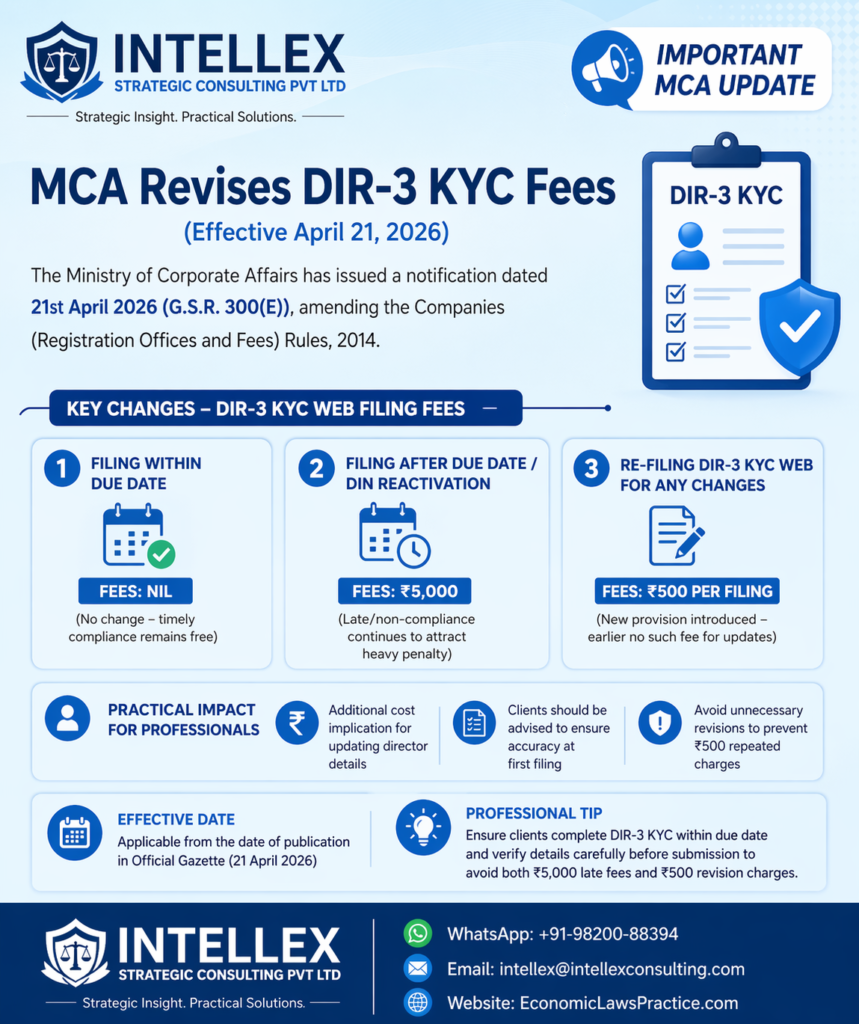
In a significant regulatory development, the Ministry of Corporate Affairs (MCA) has issued a notification dated 21st April 2026 (G.S.R. 300(E)), introducing amendments to the Companies (Registration Offices and Fees) Rules, 2014.
This update directly impacts DIR-3 KYC filings, a mandatory annual compliance requirement for all individuals holding a Director Identification Number (DIN) in India.
The revised fee structure aims to encourage timely compliance while introducing a structured cost for corrections and delays.
Understanding DIR-3 KYC: Why It Matters
DIR-3 KYC is an annual verification process mandated by MCA to:
- Maintain updated records of directors
- Prevent identity fraud and misuse of DINs
- Ensure transparency in corporate governance
Failure to comply can lead to DIN deactivation, restricting an individual from acting as a director in any company.
Key Changes in DIR-3 KYC Fees (Effective April 21, 2026)
1. Filing Within Due Date
- Fees: NIL
- No change from previous framework
- Reinforces the importance of timely compliance
Timely filing continues to be completely free, encouraging directors to adhere to deadlines.
2. Filing After Due Date / DIN Reactivation
- Fees: ₹5,000
- Applies in cases of:
- Missed deadlines
- Deactivated DINs requiring reactivation
This remains a significant penalty, underlining the MCA’s strict stance on non-compliance.
3. Re-filing DIR-3 KYC Web for Changes (New Provision)
- Fees: ₹500 per filing
This is a newly introduced fee, applicable when:
- Corrections are made after initial submission
- Director details require updates or modifications
Earlier, such revisions did not attract any charges. The introduction of this fee marks a shift towards discouraging repeated corrections and careless submissions.
Effective Date of the Amendment
The revised fee structure is applicable from April 21, 2026, i.e., the date of publication in the Official Gazette.
All filings made on or after this date must comply with the updated fee regime.
Practical Impact on Directors & Professionals
This update carries important implications for:
1. Directors
Directors must now:
- Ensure accuracy of details during first submission
- Avoid casual or incomplete filings
- Plan compliance well before deadlines
Even minor corrections can now result in additional costs.
2. Company Secretaries & Consultants
Professionals advising clients should:
- Strengthen pre-filing verification processes
- Educate clients on financial implications of revisions
- Implement checklists and validation protocols
Repeated corrections could lead to unnecessary expenses for clients and reputational risks for professionals.
3. Businesses & Corporate Entities
Organizations must:
- Maintain updated records of directors
- Coordinate timely KYC completion
- Avoid operational disruptions due to DIN deactivation
Comparison: Before vs After Amendment
| Particulars | Earlier | Revised (April 2026) |
|---|---|---|
| Filing within due date | NIL | NIL |
| Late filing / DIN reactivation | ₹5,000 | ₹5,000 |
| Re-filing for changes | NIL | ₹500 per filing |
The introduction of ₹500 per re-filing is the most notable change.
Compliance Strategy: How to Avoid Extra Costs
A disciplined approach can help avoid penalties and repeated charges:
- Verify all personal details before submission
- Ensure mobile number and email OTP access is active
- Cross-check PAN, Aadhaar, and address details
- Maintain updated documentation
- File well before the deadline
A small oversight today could lead to multiple ₹500 charges or a ₹5,000 penalty.
Professional Insight: What This Change Signals
The MCA’s move reflects a broader regulatory trend:
- Encouraging accuracy over repeated corrections
- Promoting digitally verified compliance systems
- Increasing accountability among directors and professionals
This is not just a fee revision but a step toward stricter corporate governance standards in India.
How Intellex Strategic Consulting Pvt Ltd Can Help
Navigating regulatory changes requires precision and expertise.
Intellex Strategic Consulting Pvt Ltd offers comprehensive support for:
- DIR-3 KYC filing and verification
- DIN activation and compliance management
- Corporate regulatory advisory
- End-to-end MCA compliance services
Contact Details:
📱 WhatsApp: +91-98200-88394
📧 Email: intellex@intellexconsulting.com
🌐 Website: EconomicLawsPractice.com
Conclusion
The April 2026 amendment to DIR-3 KYC fees introduces a cost for inaccuracy and delay, while continuing to reward timely compliance. Directors and professionals must now adopt a more careful, proactive approach to avoid unnecessary financial outflows.
In an environment of tightening compliance norms, accuracy is no longer optional—it is economical.
Intellex Strategic Consulting Pvt Ltd
More Featured Articles:
The Ultimate Guide to Company Registration in Dubai 2026: Benefits, Compliance, and Costs.
BSE Main Board Listed Company without any Business Available for Strategic Acquisition.
Transfer Pricing Overhaul in India: A Complete Guide to New Form 48 (Effective FY 2026-27)
Income Tax Form 104: A Complete Guide to the New NPO Registration Process in India (2026).
8 Types of Tax-Free Income in India You Must Know (2026 Guide for Smart Tax Planning)