
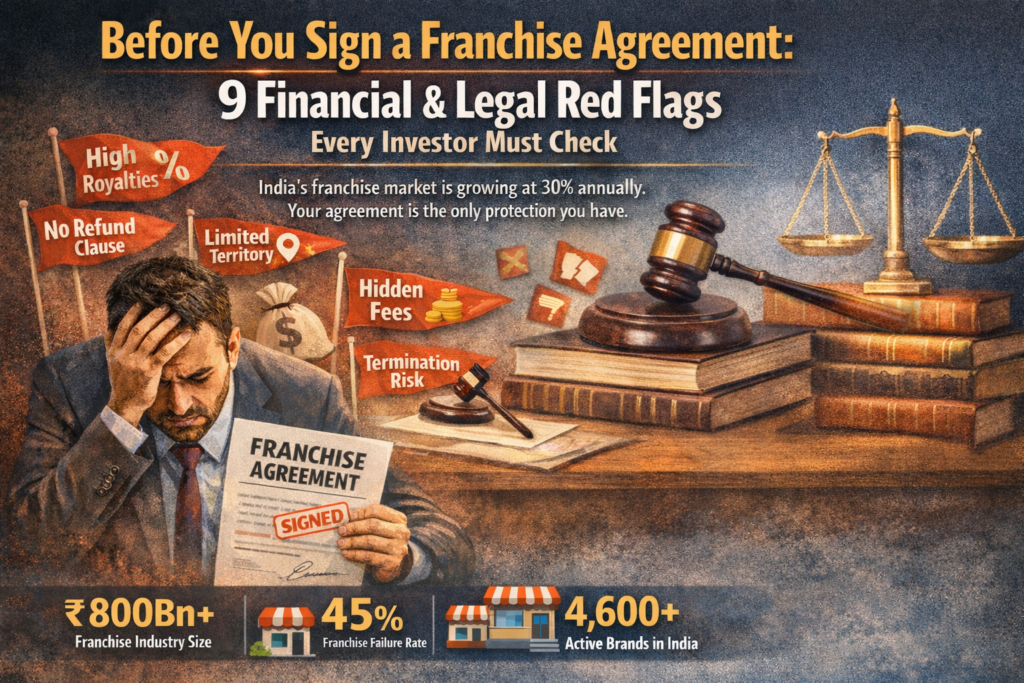
Before You Sign a Franchise Agreement: 9 Financial & Legal Red Flags Every Investor Must Check.
Before signing a franchise agreement in India, discover 9 critical financial and legal red flags that can destroy your investment. Learn how to avoid hidden fees, unfair royalty clauses, weak territory rights, and costly legal traps with expert insights from a Chartered Accountant.
India’s franchise market is growing at 30% annually. Your agreement is the only protection you have.
The Call That Comes Too Late
It usually starts the same way. A call — sometimes from a first-time investor, sometimes from a seasoned SME owner, occasionally from an HNI who treated a franchise like a fixed deposit. By the time they reach a finance professional, they have already signed. They have already paid the franchise fee. And now the agreement they signed — in excitement, often without legal review — is working against them.
Territory shrinking. Royalties on gross revenue, not net. Renewal on the franchisor’s terms alone. No refund clause. Dispute resolution locked to a distant city’s court.
This article will not tell you franchising is a bad idea. The data says otherwise. What it will tell you is that a good business model and a bad agreement can produce the same outcome: a failed investment.
The Numbers You Should Know Before You Sign
₹800Bn+ | Size of India’s franchise industry (FranCast Whitepaper 2023-24). Growing at 30–35% CAGR annually. |
4,600+ | Active franchise brands in India operating nearly 2 lakh outlets across F&B, retail, education, and wellness sectors. |
45% | Global franchise failure rate within the first 5 years (multiple industry studies). India-specific data is not publicly disclosed — a regulatory gap that directly increases investor risk. |
4%–12% | Typical royalty range on gross revenue (global benchmark). Some agreements in India go higher — and calculate on gross, not net profit. |
Key context: India has no dedicated franchise legislation. Agreements are governed by the Indian Contract Act 1872, Competition Act 2002, Consumer Protection Act 2019, IT Act 2000, and FEMA 1999 (for foreign brands). There is no mandatory Franchise Disclosure Document (FDD) requirement, unlike the US or Australia. This makes your pre-signing due diligence the only safety net you have. |
9 Red Flags — Financial and Legal
Red Flag #1: Royalties Calculated on Gross Revenue, Not Net
This is the most common financial trap in Indian franchise agreements. The distinction sounds technical. The impact is direct.
If your outlet does ₹10 lakh in monthly revenue with a 30% cost of goods and 20% operating expense, your gross is ₹10 lakh but your effective margin is roughly ₹5 lakh. A royalty of 8% on gross takes ₹80,000. That same 8% on net would be ₹40,000. The agreement can legally half your margin without a word that looks alarming on the surface.
What to check:
- Request a written breakdown: royalty base (gross vs. net), frequency of payment, and GST applicability on the royalty itself
- Ask for at least 3 existing franchisee P&L comparisons (anonymised is acceptable) to verify real operating margins against the fee structure
- Confirm whether the marketing/advertising fund (typically 1–3% additional) is also on gross revenue
India legal reference: GST applies to franchise royalties under the Indian GST framework. Confirm GSTIN of the franchisor and verify that royalty invoices include proper GST charges — failure to account for this inflates your effective cost further. |
Red Flag #2: Territory That Looks Exclusive But Isn’t
Territory clauses in Indian franchise agreements frequently use language that sounds protective but contains exceptions that render the exclusivity meaningless.
Common carve-outs to watch for: the franchisor retaining the right to sell online within your area; ‘non-exclusive’ language buried in sub-clauses; the right to open company-owned outlets in your territory; no defined radius or pin code — just a vague ‘city’ or ‘zone’ reference.
The McDonald’s-Vikram Bakshi dispute (CPRL) is the most cited example in Indian franchise law of what happens when territory and control clauses are not watertight. The litigation ran for years and damaged both parties.
What to check:
- Territory must be defined by pin code, GPS coordinates, or a clear map annexure — not just city or district name
- Confirm in writing: can the franchisor operate a website, dark kitchen, or delivery-only model within your territory?
- Check whether the Competition Commission of India’s (CCI) guidelines on restrictive trade practices apply to your exclusivity clause — overly restrictive clauses can be challenged, but so can vague ones
India legal reference: The Competition Act 2002 prohibits anti-competitive practices, but non-exclusive territory arrangements are not automatically void. The CCI reviews on a case-by-case basis. The BCCI IPL Franchise case is precedent for CCI intervening in restrictive franchise clauses. |
Red Flag #3: Termination Clauses That Favour Only the Franchisor
Indian franchise agreements routinely include termination rights that are asymmetric — the franchisor can exit or terminate for a wide range of reasons with short notice; the franchisee typically cannot exit without forfeiting the franchise fee and facing a non-compete.
Specific clauses to scrutinise:
- ‘Termination without cause’ with 30–90 days notice — legally valid under Indian Contract Act but financially devastating
- Performance thresholds set in the agreement that the franchisor controls (e.g., minimum monthly purchase from mandated suppliers)
- Termination triggered by brand standard failures — where ‘brand standards’ are defined unilaterally by the franchisor and can be revised without notice
What to check:
- Negotiate a cure period (minimum 30–60 days) before termination can be exercised for any breach other than criminal conduct or insolvency
- Request a pro-rata refund formula for the franchise fee if termination occurs within the first 12 months
- Ensure termination grounds are exhaustively listed — avoid agreements where ‘franchisor’s sole discretion’ appears anywhere near a termination clause
India legal reference: Indian courts apply the Doctrine of Unconscionable Contracts and can strike down one-sided agreements. However, litigation takes 5–7 years at original court level. Your goal is to negotiate, not litigate. |
Red Flag #4: Unregistered Trademark — The Brand You Cannot Own
You are paying a franchise fee for the right to use a brand. If that brand’s trademark is not registered, you have no legal protection — and neither does the franchisor. You could be building a business on intellectual property that a competitor can replicate.
In India, trademark registration can take 18–24 months. Many regional and new-to-franchising brands have applied but not yet received registration. Some have not applied at all.
What to check:
- Search ipindia.gov.in for the brand name and trademark class relevant to the business (Class 43 for food services, Class 35 for retail services, etc.)
- If trademark is ‘applied for’ but not registered, ensure the agreement specifies what happens to your investment if the application is rejected
- For foreign brands: confirm trademark is registered in India, not just in the franchisor’s home country — Indian trademark law is territorial
India legal reference: The Indian Trade Marks Act 1999 governs registration and enforcement. A registered trademark gives the owner exclusive rights in India and the right to sue for infringement. Without it, you are relying on ‘passing off’ protection — harder to enforce. |
Red Flag #5: Hidden Fees — The Costs Not Mentioned at Pitch
The initial franchise fee is the number franchisors advertise. The total cost of operation — including mandatory ongoing fees — is the number that determines whether you make money.
Fees that routinely appear after signing:
- Technology/POS system fees: ₹5,000–25,000/month for mandatory systems
- Audit and inspection fees: some agreements allow the franchisor to charge for compliance visits
- Training fees for additional staff beyond the initial batch
- Advertising fund contributions (1–3% of revenue) — often with no transparency on how the fund is spent
- Mandatory supply sourcing from franchisor-approved vendors at a 20–30% markup over market price
What to check:
- Request a complete fee schedule as an agreement annexure — every recurring cost, not just the franchise fee
- Ask for GST applicability on each fee line item and request a sample invoice format before signing
- If mandatory supplier lock-in exists, request the last 12 months of supplier invoices compared to market rates
India legal reference: GST (18%) applies to franchise fees and royalties paid to Indian franchisors. For foreign franchisors, FEMA regulations govern payment — confirm RBI-compliant remittance procedures. Non-compliance attracts penalties. |
Red Flag #6: Renewal Terms Controlled Entirely by the Franchisor
A franchise agreement typically runs 5–10 years in India. At renewal, the franchisor may revise fee structures, territory definitions, brand standards, and even the core business model. If the renewal clause gives the franchisor unilateral control over terms, you have a depreciating asset — not a business.
What to check:
- Renewal should be ‘on terms not materially less favourable’ than the original agreement — get this in writing
- Any changes to royalty rates or fee structures at renewal must require 90-day minimum written notice
- Confirm whether the renewal requires you to re-invest in store refurbishment — a common hidden cost that can run ₹10–50 lakh depending on category
- Non-renewal without cause should trigger a goodwill/compensation clause — negotiate this upfront
Red Flag #7: Non-Compete Clauses That Are Unreasonably Broad
Post-termination non-compete clauses in Indian franchise agreements frequently prohibit the franchisee from operating in the same sector for 1–3 years within an undefined geographic area. Indian courts have the authority to strike down unreasonable restraints of trade — but only after you litigate.
What to check:
- Non-compete should be limited to the specific brand, not the entire sector
- Geographic scope should match your franchise territory — not ‘all of India’
- Duration beyond 12 months post-termination is increasingly difficult to enforce in Indian courts — but get legal advice specific to your agreement
- Confidentiality clauses should protect genuine brand IP — not prevent you from sharing your own operational learnings
India legal reference: Section 27 of the Indian Contract Act 1872 holds agreements in restraint of trade void — but with exceptions. Courts apply a reasonableness test. A blanket sector-wide, nationwide, 3-year non-compete is challengeable; a brand-specific, territory-limited, 12-month clause is generally defensible. |
Red Flag #8: Dispute Resolution Locked to a Distant City
Franchise agreements drafted by legal teams in Mumbai or Delhi routinely specify that all disputes must be resolved in those cities — regardless of where the franchisee operates. For a franchise owner in Coimbatore, Nagpur, or Guwahati, this creates a structural disadvantage in any dispute.
On average, original court disposal in India takes 5–7 years. An additional 3 years in appeals. A poorly placed jurisdiction clause means disputes are effectively unresolvable.
What to check:
- Negotiate for arbitration — faster than litigation, and location can be agreed upon
- Specify the arbitration seat as the franchisee’s city of operation, or a mutually agreed neutral city
- Confirm the arbitration rules (ICA, LCIA, or ad hoc) and timeline — some agreements reference arbitration but without timelines, effectively negating the benefit
- For foreign brand agreements: Indian courts may not enforce foreign jurisdiction clauses when the franchisee is a small Indian business — but this creates uncertainty, not protection
India legal reference: India is a signatory to the New York Convention on foreign arbitral awards. The Arbitration and Conciliation Act 1996 governs domestic arbitration. A well-drafted arbitration clause in your city is your fastest and cheapest dispute path. |
Red Flag #9: No Disclosure of Franchisee Performance Data
In the US, the Franchise Disclosure Document (FDD) is mandatory and includes Item 19 — financial performance representations — and Item 20 — the number of outlets opened and closed in the last 3 years. India has no such requirement. Franchisors here can make revenue projections with no obligation to back them up.
This is not a technicality. It is how a ₹25 lakh investment gets made based on a projected ₹2 lakh/month profit that has never been achieved by any existing franchisee.
What to check:
- Demand a list of all existing and closed franchisees for the last 3 years — contact at least 5 directly
- Ask for actual (not projected) revenue data from 3 operating outlets in comparable locations
- Request MCA filings or GST return summaries for the franchisor entity — a privately held franchisor refusing to share basic financials is a standalone red flag
- Calculate the payback period yourself: Total investment ÷ (Monthly net profit after all fees) — if this exceeds 36 months, stress-test the assumptions
What Could Go Wrong — Even If You Check Everything
This section is not meant to discourage you. It is meant to make you realistic.
- The franchisor’s business model works nationally but fails in your specific location — due diligence on the agreement does not substitute for location analysis
- Brand deterioration: if the franchisor’s reputation suffers nationally (a food safety incident, a viral social media crisis), your outlet suffers too — you have no legal protection against this
- Regulatory changes: GST rate revisions, FSSAI licensing requirements, or state-specific local body regulations can affect unit economics in ways your agreement never anticipated
- Franchisor financial distress: if the franchisor becomes insolvent, your franchise fee is typically unsecured — recovery is difficult
- Interest rate environment: if you financed the franchise investment via a business loan, rising rates compress already-thin margins. Model your unit economics at 200bps higher than today’s rate
Pre-Signing Checklist: 9 Questions, One Table
# | Red Flag | What to Ask / Check | India-Specific Law / Ref. |
1 | Royalty on gross vs. net? | Request written fee breakdown with GST | GST Act; FEMA for foreign franchisors |
2 | Territory exclusivity — real or vague? | Demand pin code / map annexure | Competition Act 2002; CCI precedent |
3 | Termination clause asymmetry? | Negotiate cure period & refund formula | Indian Contract Act 1872, S.27 |
4 | Trademark registered? | Search ipindia.gov.in before signing | Trade Marks Act 1999 |
5 | Hidden ongoing fees? | Full fee schedule as signed annexure | GST Act; FEMA for remittances |
6 | Franchisor controls renewal? | ‘Not materially less favourable’ clause | Indian Contract Act 1872 |
7 | Non-compete scope reasonable? | Brand-specific, territory-limited, max 12 months | Contract Act S.27; court precedents |
8 | Dispute resolution accessible? | Arbitration in your city; specify rules + timeline | Arbitration Act 1996; New York Convention |
9 | No franchisee performance data? | Contact 5 existing franchisees; calculate payback | No mandatory FDD in India — self-protect |
The Bottom Line
India’s franchise industry is a genuine opportunity. Over 4,600 brands, 2 lakh outlets, 30% CAGR — the market is real and growing. But India also has no dedicated franchise law, no mandatory disclosure requirement, and courts that take years to resolve disputes. The agreement you sign is your only protection.
The nine red flags in this article are not hypothetical. They appear in active franchise agreements being signed today across India. Checking them does not require a law degree. It requires 2–3 weeks of structured due diligence and one consultation with a franchise-experienced lawyer before you sign anything.
A good franchise agreement protects both sides. A franchisor who resists every negotiation point is telling you something important — before you have spent a rupee.
About the Author: CA Pooja T N is a Partner at P N S G & Associates and a practicing Chartered Accountant with 12+ years on the ground advising businesses across taxation, financial due diligence, and investment structuring. She has guided SME owners and investors through franchise evaluations, regulatory compliance, and startup financial planning.Her focus: Cutting through complexity to give business owners the financial clarity they need before they commit capital. |
Sources & References
- FranCast Whitepaper on Franchise Forecast 2023-24 — Indian franchise market size and CAGR
- ICLG Franchise Laws and Regulations Report, India Chapter (October 2024)
- EAC-PM Working Paper: Need for Franchising Laws in India (2024)
- com / Franzy.com — Global franchise failure rate statistics (2025)
- Competition Commission of India — BCCI IPL Franchise case on restrictive clauses
- Indian Trade Marks Act 1999 | ipindia.gov.in
- Arbitration and Conciliation Act 1996 (India)
- Indian Contract Act 1872, Section 27 — Restraint of trade
- FEMA 1999 — Foreign royalty repatriation rules
- Law.asia: Franchise Law in India — Bridging Legal Gaps (August 2025)
More Featured Articles:
SEBI Introduces Debit Freeze for Mutual Funds: A Game-Changer for Investor Security in India.
The Hidden Home Loan Strategy Most Indians Overlook – And It Could Be Costing Them Crores.
Lessons from Warren Buffett on Patience: How Long-Term Thinking Builds Lasting Wealth.
20 Simple Habits That Make People Instantly Respect You
Breaking the Ceiling: 10 IPO Myths Holding SME Promoters Back.
Top 10 Angel Investment Networks in India (2026): The Ultimate Founder’s Guide to Fundraising.
New Income-tax Act 2025: Key Features, Major Changes & What It Means for Taxpayers in India.