
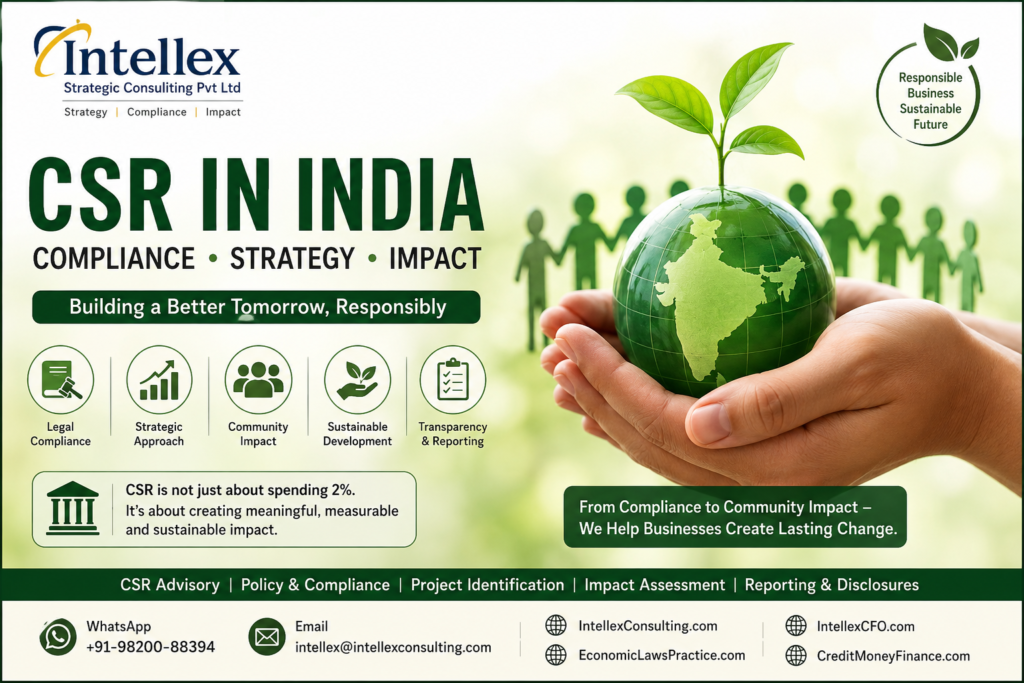
CSR in India: A Complete Guide to Corporate Social Responsibility Compliance, Strategy & Impact (2026).
Comprehensive guide to Corporate Social Responsibility (CSR) in India under the Companies Act, 2013. Learn CSR applicability, compliance, spending rules, impact assessment, disclosures, and how to build meaningful CSR strategies.
Introduction: CSR – Beyond a Statutory Obligation
Corporate Social Responsibility (CSR) in India has evolved from a voluntary philanthropic initiative into a structured legal obligation. However, while most eligible companies are compliant on paper, true CSR lies beyond regulatory adherence—it is about sustainable impact, accountability, and strategic alignment with business values.
This guide offers a detailed overview of CSR provisions in India, along with practical insights into effective implementation.
The Legal Framework of CSR in India
CSR in India is governed by:
- Section 135 of the Companies Act, 2013
- Companies (CSR Policy) Rules, 2014 (as amended)
Applicability Criteria
A company must comply with CSR provisions if it meets any one of the following thresholds in the immediately preceding financial year:
- Net Worth ≥ ₹500 crore
- Turnover ≥ ₹1,000 crore
- Net Profit ≥ ₹5 crore
CSR Committee: Roles & Responsibilities
Eligible companies must constitute a CSR Committee of the Board, typically comprising at least three directors (including one independent director, where applicable).
Key Responsibilities:
- Formulate and recommend CSR Policy
- Recommend CSR expenditure
- Monitor implementation of CSR initiatives
- Ensure alignment with Schedule VII activities
Mandatory CSR Spending: The 2% Rule
Companies are required to spend:
At least 2% of the average net profits of the last three financial years
Important Clarifications:
- Net profit is calculated as per Section 198 of the Companies Act
- CSR expenditure must be project-based, not ad hoc
- Administrative overheads are capped (as per latest rules)
Eligible CSR Activities (Schedule VII)
CSR funds must be deployed only in approved areas, including:
- Eradication of hunger, poverty, and malnutrition
- Promotion of education
- Gender equality and women empowerment
- Environmental sustainability
- Protection of national heritage, art & culture
- Support to armed forces veterans
- Promotion of sports
- Contributions to government relief funds
- Rural development projects
- Technology incubators
What is NOT Allowed:
- Activities benefiting only employees or their families
- Normal business activities (with limited exceptions)
- Political contributions
Treatment of Unspent CSR Amount
CSR compliance does not end with allocation—it extends to actual spending and tracking.
Case 1: Non-Ongoing Projects
- Unspent amount must be transferred within 6 months to a Schedule VII fund
(e.g., PM National Relief Fund)
Case 2: Ongoing Projects
- Transfer unspent amount within 30 days to an Unspent CSR Account
- Spend within 3 financial years
- If still unspent → transfer to Schedule VII fund
Impact Assessment: A Shift Towards Accountability
For companies with large CSR obligations:
- Mandatory impact assessment for projects above prescribed thresholds
- Must be conducted by an independent agency
- Report to be placed before the Board
- Included in Annual Report
This ensures CSR transitions from spending to measurable outcomes.
CSR Reporting & Disclosures
Transparency is a key pillar of CSR compliance.
Mandatory Disclosures in Board Report:
- CSR Policy details
- Composition of CSR Committee
- Prescribed vs actual spending
- Project-wise expenditure details
- Unspent CSR amounts and transfers
- Impact assessment summary (if applicable)
Additionally, CSR Policy must be hosted on the company’s website.
Penalties for Non-Compliance
CSR non-compliance is taken seriously:
- Monetary penalties on company and officers
- Reputational risks
- Increased regulatory scrutiny
Unlike earlier years, CSR is now a strictly enforceable obligation.
Moving Beyond Compliance: Strategic CSR
While legal compliance is mandatory, leading organizations treat CSR as a strategic function.
Characteristics of Effective CSR:
- Alignment with core business expertise
- Long-term, sustainable initiatives
- Community-centric approach
- Measurable impact metrics
- Strong governance and monitoring systems
Example Approach:
A financial services company supporting financial literacy and inclusion can create deeper, more relevant impact than unrelated charitable spending.
Key Challenges in CSR Implementation
- Lack of clarity in project selection
- Inefficient fund utilization
- Weak monitoring mechanisms
- Limited impact measurement
- Compliance-driven (not impact-driven) mindset
How to Build a Strong CSR Framework
- Define clear CSR vision aligned with business goals
- Identify high-impact sectors
- Partner with credible implementing agencies
- Establish monitoring and reporting systems
- Conduct periodic impact assessments
- Ensure legal and documentation compliance
How Intellex Strategic Consulting Pvt Ltd Can Help
CSR today requires a blend of legal compliance, financial structuring, and strategic planning.
Intellex Strategic Consulting Pvt Ltd offers end-to-end CSR advisory services:
- CSR applicability assessment
- CSR policy drafting and structuring
- Identification of eligible CSR projects
- Compliance management and documentation
- Unspent CSR handling and fund structuring
- Impact assessment advisory
- Board and audit readiness
Contact Details:
📱 WhatsApp: +91-98200-88394
📧 Email: intellex@intellexconsulting.com
🌐 Websites:
- IntellexConsulting.com
- IntellexCFO.com
- EconomicLawsPractice.com
- CreditMoneyFinance.com
Conclusion
CSR in India is no longer just a regulatory checkbox—it is an opportunity.
Companies that treat CSR as a strategic investment in society rather than a statutory expense are the ones that build stronger brands, deeper stakeholder trust, and long-term sustainability.
The future of CSR lies in impact, accountability, and integration with business purpose.
Intellex Strategic Consulting Pvt Ltd
More Featured Articles:
Strategic Growth Capital for Manufacturing Businesses in India.
ECB Rules Changed Big Time in 2026: What Indian Businesses Must Know to Unlock Global Funding.
Debt Funding for Businesses in India: Raise ₹30 Lakhs to ₹200 Crore with the Right Capital Partners.
9 Powerful Business Rules to Outgrow Competition and Build a Market-Dominating Enterprise.