
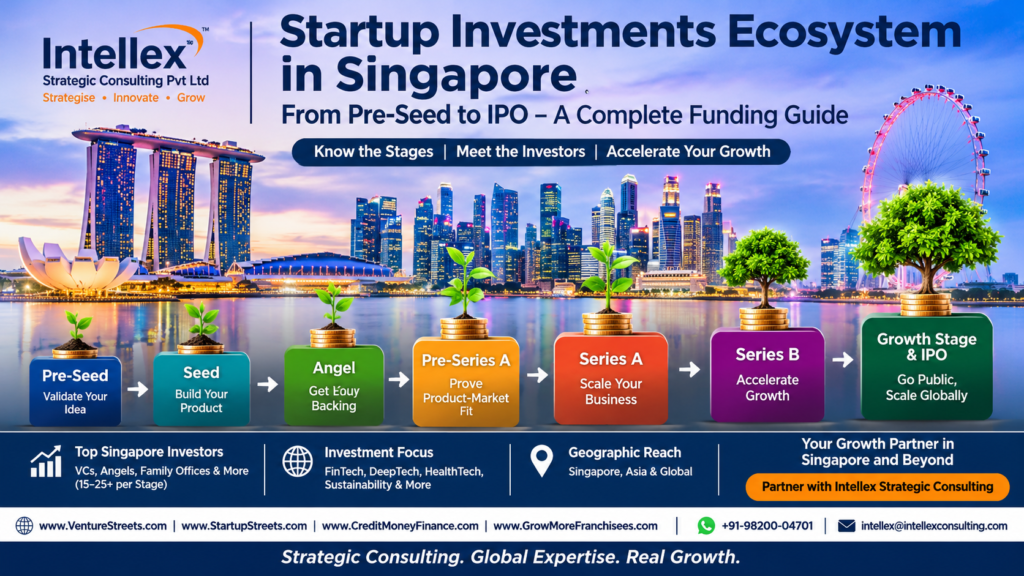
Singapore Startup Funding Ecosystem 2026: 100+ Venture Capital Firms, Angel Investors, Government Funds & Private Equity Investors from Pre-Seed to IPO.
Comprehensive startup fundraising and investor research guide | Singapore
Discover Singapore’s startup investment ecosystem in 2026. Explore 120+ angel investors, venture capital funds, Series A and B investors, growth equity, private equity and IPO funding opportunities, with investment strategies, founders, sectors and eligibility insights.
Focus: Singapore startup investors, Singapore venture capital funds, startup funding in Singapore, pre-seed investors, seed funding, Series A investors, Series B funding, growth capital, private equity and IPO advisory.
1. Introduction: Why Singapore is one of Asia’s most important startup investment destinations
Singapore has established itself as one of the most important startup financing, venture capital and innovation centres in Asia. Its strategic location, international financial infrastructure, investor-friendly regulatory environment, access to Southeast Asian markets and strong government support make it an attractive base for entrepreneurs seeking capital.
Unlike ecosystems that depend primarily on domestic consumer markets, Singapore-based startups can use the country as a regional headquarters to access:
Southeast Asia, including Indonesia, Vietnam, Thailand, Malaysia and the Philippines.
India and South Asia.
China, Hong Kong, Japan and South Korea.
Australia and New Zealand.
Europe, the Middle East and North America.
Singapore is particularly attractive for businesses operating in financial technology, artificial intelligence, enterprise software, healthcare, biotechnology, climate technology, logistics, deep technology, digital commerce and advanced manufacturing.
The latest investment landscape
According to the Singapore Venture Funding Landscape Report 2025, published by Enterprise Singapore and EY-Parthenon in May 2026:
S$5.9B
Funding raised by Singapore-based firms in 2025
472
Funding deals during 2025
AI and deep technology gained momentum, while fintech continued to attract substantial investor interest. However, the funding environment remained selective, with investors showing greater preference for businesses with proven commercial traction and clearer paths to profitability.
An important implication for founders: Singapore is not simply a place to incorporate a company and approach investors. Investors increasingly expect a compelling regional or global business proposition, credible unit economics, scalable technology, experienced management and a realistic capital deployment plan.
2. Understanding Singapore’s startup investment stages
Singapore follows broadly international venture capital conventions, although the distinction between Angel, Pre-Seed, Seed and Pre-Series A can vary from one investor to another.
The following classification is useful for founders approaching investors.
| Funding stage | Indicative funding requirement | Typical business position |
|---|---|---|
| Angel | S$25K–250K | Idea, prototype or founder validation |
| Pre-Seed | S$100K–750K | MVP, initial product development |
| Seed | S$500K–2.5M | Product launched, early customers |
| Pre-Series A | S$1.5M–5M | Initial product-market fit |
| Series A | S$3M–15M | Repeatable business model |
| Series B | S$10M–40M | Regional expansion and scaling |
| Growth / Series C+ | S$20M–100M+ | Established operations and significant revenues |
| Pre-IPO / IPO | S$30M onwards | Institutional-scale business, listing readiness |
These are illustrative fundraising ranges, not published commitments or minimum cheque sizes of the investors listed below. Actual rounds can be significantly smaller or larger.
How the stages differ
Angel and Pre-Seed
Funding founders, prototypes, product development, technology validation and initial market testing.
Seed and Pre-Series A
Funding product-market fit, customer acquisition, initial revenues, team building and repeatable sales.
Funding expansion, geographical growth, technology development, distribution and market leadership.
Funding acquisitions, large-scale expansion, institutional investment, governance and public-market readiness.
3. Angel and Pre-Seed investors in Singapore
Angel and Pre-Seed capital is particularly important for first-time founders, technology entrepreneurs, researchers commercialising intellectual property and founders developing an MVP.
At this stage, investors are often evaluating the founders as much as the business itself.
What do investors look for?
Strong founder-market fit.
A clearly identified market problem.
A compelling product or technology proposition.
A sizeable addressable market.
Evidence of customer validation, even if revenues are limited.
Ability to attract co-founders and build an initial team.
A credible business model and fundraising roadmap.
A. Angel-stage investors and investment networks — 20 prospects
These are prospective sources of angel capital, founder networks, syndication or early institutional support. Some are organised networks rather than individual funds.
| No. | Investor / network | Investment focus and relevance |
|---|---|---|
| 1 | BANSEA | Established in 2001; angel network investing in Singapore and Southeast Asia. |
| 2 | AngelCentral | Singapore angel investor community, syndication and startup investment opportunities. |
| 3 | Singapore Investment Network | Angel and private investor introductions across sectors. |
| 4 | Angel Investment Network Singapore | Online platform connecting entrepreneurs with angel investors. |
| 5 | Business Angel Network of Southeast Asia | Cross-border angel network and startup mentoring. |
| 6 | NUS Enterprise | University-linked entrepreneurial ecosystem, early-stage startup support and investment connections. |
| 7 | NTUitive | Commercialisation of NTU research and technology ventures. |
| 8 | SGInnovate | Deep-tech founders, scientific innovation and venture-building support. |
| 9 | Quest Ventures | Early-stage technology and digital businesses across Asia. |
| 10 | Antler | Day-zero investment, founder formation and early-stage capital. |
| 11 | Iterative | Accelerator and early-stage funding for Southeast Asian startups. |
| 12 | 500 Global | Global early-stage investment and accelerator network. |
| 13 | Entrepreneur First | Invests in talented individuals and helps them form technology startups. |
| 14 | Plug and Play Tech Center | Corporate innovation, accelerator programmes and startup investment connections. |
| 15 | Startupbootcamp | Sector-focused accelerator and investor access. |
| 16 | BLOCK71 | Incubation and access to the NUS and international startup ecosystem. |
| 17 | BEENEXT | Early-stage technology and internet businesses across Asia. |
| 18 | Wavemaker Partners | Early-stage enterprise technology, deep tech and sustainability. |
| 19 | Cocoon Capital | Pre-Seed and Seed deep-tech and enterprise-tech investments. |
| 20 | Saison Capital | Early-stage fintech, commerce and technology businesses. |
BANSEA is particularly relevant to founders seeking angel syndication. It has operated since 2001, and its investment network extends into China, India, Malaysia, the Philippines and Thailand. Its stated startup criteria include operating businesses, a dedicated team, a clear business model and funding requirements generally between S$100,000 and S$1 million. It is not an ideation-stage or traditional-business financing network.
B. Pre-Seed investors — 20 prospects
| No. | Investor | Investment thesis / relevant sectors |
|---|---|---|
| 1 | Antler | Day-zero investment, technology, AI, fintech, consumer and enterprise. |
| 2 | Cocoon Capital | Deep tech and enterprise technology. |
| 3 | Wavemaker Partners | Enterprise software, deep tech, sustainability and climate. |
| 4 | Quest Ventures | Digital businesses, marketplaces and technology. |
| 5 | BEENEXT | Internet, fintech, SaaS and emerging technology. |
| 6 | Iterative | Southeast Asian technology startups. |
| 7 | 500 Global | Technology-led businesses with international scalability. |
| 8 | Entrepreneur First | Exceptional technical and entrepreneurial talent. |
| 9 | Golden Gate Ventures | Consumer internet, fintech, marketplaces and enterprise technology. |
| 10 | Monk’s Hill Ventures | Technology businesses with strong fundamentals and scalable business models. |
| 11 | TRIVE | Early-stage technology and innovation across Southeast Asia. |
| 12 | KK Fund | Internet and technology-enabled businesses in Southeast Asia. |
| 13 | SeedPlus | Early-stage technology and Southeast Asian founders. |
| 14 | TNB Aura | Technology, consumer and enterprise opportunities. |
| 15 | Singtel Innov8 | Strategic technology, telecom, AI and enterprise innovation. |
| 16 | M Venture Partners | Early-stage technology and emerging markets. |
| 17 | January Capital | Enterprise technology, fintech and digital businesses. |
| 18 | Saison Capital | Fintech and embedded finance, commerce and emerging technologies. |
| 19 | Signum Capital | Blockchain, Web3 and digital assets. |
| 20 | Big Idea Ventures | Alternative proteins, food technology and sustainable food systems. |
Important qualification: These are investors worth screening, not a guarantee that all currently accept unsolicited pre-seed proposals or lead first-time rounds. Several operate across multiple stages and may require a Singapore or Southeast Asian market connection.
Selected investor profiles: Angel and Pre-Seed
1. Antler
Headquartered originally in Singapore; global venture capital platform.
Antler is among the most relevant investors for entrepreneurs who are at the beginning of their startup journey. It operates a Day Zero investment model, helping founders develop ideas, find co-founders, validate their business models and secure initial capital.
Its global investment portfolio includes Airalo, Reebelo and other technology businesses.
Singapore investment terms: Its published Singapore programme offers an initial US$150,000 investment for 10% equity, comprising US$100,000 for 10% equity and US$50,000 through an uncapped SAFE with an MFN clause. It also describes potential follow-on investment commitments and access to Antler Elevate. Terms should be reconfirmed for each residency.
Geography: Singapore, Southeast Asia and a global network spanning more than 25 cities.
Best suited for: First-time founders, technology entrepreneurs, AI startups, fintech, digital businesses and founders with global ambitions.
2. Cocoon Capital
Founders: Michael Blakey and William Klippgen.
Singapore-based early-stage venture capital firm.
Cocoon Capital is especially interesting for companies developing technology-led solutions for real-world business problems.
Its published investment information indicates:
Assets under management: US$80 million-plus.
Typical investment: US$500,000–US$1.5 million.
Focus: Deep tech and enterprise technology.
Stages: Pre-Seed and Seed.
Portfolio: 31 companies, as stated on its website.
The fund prefers to lead investments and looks for technically differentiated companies with strong founders, substantial market opportunities and the potential to scale.
It invests across Southeast Asia, India, Australia and Bangladesh, subject to its Singapore holding-company requirement.
3. Wavemaker Partners
Leadership: Paul Santos and the wider Wavemaker investment partnership.
Singapore-based venture capital platform.
Wavemaker has been investing since 2012 and has built a substantial portfolio of enterprise, deep-tech and sustainability companies.
Its published investment thesis reports over 200 investments, approximately US$500 million in assets under management and five funds.
Its key investment interests include:
Enterprise software and SaaS.
Industrial and advanced technologies.
Artificial intelligence.
Sustainability and climate technology.
Technology solutions addressing underserved markets.
Its portfolio-building philosophy emphasises defensible technology, differentiated insights and scalable revenue opportunities.
4. BEENEXT
BEENEXT is a significant early-stage investment platform in Asia. Its investment team includes Teruhide Sato, Dirk Van Quaquebeke, Hiro Maeda and Hero Choudhary.
It is particularly relevant to fintech, internet businesses, marketplaces, software and digital platforms. Its investment philosophy emphasises founder-first relationships, long-term value creation and regional networks.
4. Seed-stage investors in Singapore — 20 prospects
Seed funding is generally the first significant institutional investment in a startup.
At this stage, founders should ideally demonstrate:
A functioning product or MVP.
Initial customers or pilot projects.
Customer feedback and market validation.
Early revenues or credible commercial contracts.
A clear customer acquisition strategy.
An identifiable competitive advantage.
| No. | Investor | Primary investment interests |
|---|---|---|
| 1 | SEEDS Capital | Singapore-based early-stage technology and deep tech. |
| 2 | Antler | Technology, AI, fintech and consumer businesses. |
| 3 | Cocoon Capital | Enterprise and deep technology. |
| 4 | Wavemaker Partners | Enterprise, deep tech and sustainability. |
| 5 | BEENEXT | Fintech, marketplaces and internet businesses. |
| 6 | Golden Gate Ventures | Consumer, fintech and technology platforms. |
| 7 | Quest Ventures | Digital commerce and technology. |
| 8 | Monk’s Hill Ventures | Southeast Asian technology startups. |
| 9 | Insignia Ventures Partners | Technology businesses from seed to growth. |
| 10 | Jungle Ventures | Technology, consumer and enterprise businesses. |
| 11 | Openspace Ventures | Digital platforms and Southeast Asian technology. |
| 12 | Vertex Ventures Southeast Asia & India | Technology and innovation-led businesses. |
| 13 | Saison Capital | Fintech, commerce and financial infrastructure. |
| 14 | TNB Aura | Technology, consumer and enterprise. |
| 15 | Qualgro | Enterprise technology and data-driven businesses. |
| 16 | TRIVE | Technology and early-stage ventures. |
| 17 | KK Fund | Digital and internet businesses. |
| 18 | Singtel Innov8 | Strategic technology and telecommunications innovation. |
| 19 | Makers Fund | Gaming and interactive entertainment. |
| 20 | Big Idea Ventures | Food technology and alternative proteins. |
Special focus: SEEDS Capital
Institution: Enterprise Singapore / SG Growth Capital.
SEEDS Capital is one of the most important institutions for technology startups establishing themselves in Singapore.
It operates a co-investment model, partnering with qualified private investors to fund promising early-stage companies with global potential.
Its investment focus includes:
Advanced manufacturing and engineering.
Health and biomedical sciences.
Urban solutions and sustainability.
Artificial intelligence.
Agritech.
Blockchain.
Quantum computing.
Space technologies.
Its published programme describes more than 100 deep-tech portfolio companies and over 50 co-investment partners.
Important: This is not an unrestricted grant. Startups generally need to qualify under the programme and secure participation from an eligible co-investment partner.
5. Pre-Series A investors in Singapore — 20 prospects
Pre-Series A is an important financing stage for companies that have moved beyond initial product validation but are not yet ready for a conventional institutional Series A.
The company may have initial revenues, customer retention, promising unit economics and a developing sales pipeline.
Investors at this stage typically want to understand whether the company can convert early market traction into a repeatable growth model.
| No. | Investor | Investment focus |
|---|---|---|
| 1 | BEENEXT | Fintech, marketplaces and digital platforms. |
| 2 | Golden Gate Ventures | Consumer internet, commerce and fintech. |
| 3 | Monk’s Hill Ventures | Technology and enterprise platforms. |
| 4 | Quest Ventures | Digital commerce and technology. |
| 5 | Wavemaker Partners | Deep tech, enterprise and sustainability. |
| 6 | Insignia Ventures Partners | Technology companies across Southeast Asia. |
| 7 | Jungle Ventures | Consumer, B2B and technology. |
| 8 | Openspace Ventures | Digital economy and technology. |
| 9 | Vertex Ventures Southeast Asia & India | Technology-led growth companies. |
| 10 | TNB Aura | Enterprise, consumer and technology. |
| 11 | Qualgro | Enterprise software, data and AI. |
| 12 | Saison Capital | Fintech and digital commerce. |
| 13 | January Capital | Enterprise technology and financial technology. |
| 14 | Northstar Group | Southeast Asian technology and consumer businesses. |
| 15 | Dymon Asia Ventures | Technology and innovation-led companies. |
| 16 | Tin Men Capital | B2B technology and enterprise software. |
| 17 | Patamar Capital | Impact-oriented businesses and inclusive growth. |
| 18 | Gobi Partners | Technology and digital businesses across Asia. |
| 19 | East Ventures | Early-stage technology and digital economy. |
| 20 | M Venture Partners | Technology and emerging-market opportunities. |
BANSEA is also worth considering at this stage: its published criteria specifically cover Seed, Pre-Series A and Series A operating companies seeking S$100,000–S$1 million.
6. Series A investors in Singapore — 20 prospects
Series A is generally the stage where a company has demonstrated product-market fit and is looking to scale its business in a structured manner.
Investors will usually expect:
Established revenue or significant commercial traction.
Repeat customers and demonstrable retention.
A scalable sales and distribution strategy.
A strong management team.
Evidence of sustainable unit economics or a credible path towards them.
A regional expansion strategy.
A clear use-of-funds and financial projection.
| No. | Investor | Investment thesis / sector preference |
|---|---|---|
| 1 | Jungle Ventures | Consumer, B2B, enterprise technology and digital platforms. |
| 2 | Insignia Ventures Partners | Technology, fintech, enterprise and digital businesses. |
| 3 | Vertex Ventures Southeast Asia & India | Technology and scalable innovation. |
| 4 | Openspace Ventures | Digital economy and technology-led businesses. |
| 5 | Monk’s Hill Ventures | Enterprise, fintech and scalable technology. |
| 6 | Golden Gate Ventures | Consumer, marketplaces and fintech. |
| 7 | BEENEXT | Technology, internet and financial services. |
| 8 | Wavemaker Partners | Deep tech, enterprise and sustainability. |
| 9 | Northstar Group | Technology, financial services and consumer businesses. |
| 10 | Qualgro | Enterprise software, data analytics and AI. |
| 11 | Tin Men Capital | B2B technology and industrial innovation. |
| 12 | TNB Aura | Technology and digital platforms. |
| 13 | January Capital | Fintech, enterprise software and digital businesses. |
| 14 | Saison Capital | Fintech, payments and financial infrastructure. |
| 15 | East Ventures | Technology and consumer internet. |
| 16 | Gobi Partners | Technology and emerging-market businesses. |
| 17 | Patamar Capital | Impact investment, financial inclusion and essential services. |
| 18 | Vickers Venture Partners | Healthcare, biotechnology and technology. |
| 19 | Arbor Ventures | Financial technology and financial services innovation. |
| 20 | Singtel Innov8 | Telecom, AI, cybersecurity and enterprise technology. |
Detailed investor profiles
1. Jungle Ventures
Jungle Ventures is one of the prominent Singapore-based venture capital firms investing in Southeast Asian and Indian businesses.
Its investment philosophy is to support ambitious founders building large, category-defining businesses.
Investment characteristics:
Stage: Seed through growth.
Typical cheque size: US$500,000–US$20 million, as indicated on its portfolio information.
Geography: Southeast Asia and India.
Sector: Generalist, with significant interest in consumer, B2B, technology and digital platforms.
Follow-on funding: Reserves capital for existing portfolio companies.
Its investment history includes companies such as Moglix, Sociolla, Waresix, Atomberg and other technology-enabled businesses. Moglix is an especially relevant example of its India investment track record.
Best suited for: Businesses with established traction and the ambition to become major regional or international companies.
2. Insignia Ventures Partners
Insignia is a major regional investment platform supporting technology companies from early stage through growth.
Its portfolio includes:
GoTo.
Appier.
J&T Express.
Groww.
Ajaib.
Carro.
Aspire.
Tonik.
YouTrip.
The firm’s website reports more than 90 emerging technology investments since 2017.
Its differentiator is its combination of investment capital and operating support, including engineering resources, talent acquisition, strategic development and follow-on fundraising assistance.
Geography: Southeast Asia and wider Asia, with selected investments extending internationally.
Investment criteria: Ambitious founders, technology-led differentiation, sizeable markets and businesses capable of serving large customer populations.
3. Monk’s Hill Ventures
Monk’s Hill Ventures concentrates on technology businesses addressing large market opportunities in Southeast Asia.
It has invested in more than 50 fast-growing technology companies over the past decade, according to its published portfolio information.
Its interests include:
Fintech and financial services.
SaaS and enterprise software.
Healthcare technology.
Logistics.
Education technology.
Robotics and clean technology.
Digital commerce.
The firm uses a first-principles approach to evaluating founders, business fundamentals and market opportunities.
4. Vertex Ventures Southeast Asia & India
Parent network: Vertex Holdings, part of the Temasek ecosystem.
Vertex Ventures is an important institutional venture capital platform for founders seeking access to Southeast Asia and India.
It invests in technology-enabled businesses with substantial growth potential.
Areas of interest include:
Fintech.
Enterprise software.
Consumer technology.
Healthcare.
Logistics.
AI and emerging technologies.
Its wider Vertex network provides access to international venture investment expertise and corporate relationships.
Best suited for: Startups with a strong product, commercial traction and a credible regional expansion plan.
7. Series B investors in Singapore — 20 prospects
Series B investors generally look for companies that have already demonstrated the ability to scale and now require larger capital commitments to expand operations.
Typical requirements include:
Significant and growing revenues.
Proven customer acquisition economics.
Strong financial reporting and management systems.
Established senior leadership.
Regional or international expansion opportunities.
A defensible competitive position.
Clear prospects of profitability or improving operating margins.
Investor directory
| No. | Investor | Investment thesis / areas of interest |
|---|---|---|
| 1 | Temasek | Technology, consumer, healthcare, financial services and sustainability. |
| 2 | GIC | Global growth businesses and institutional investments. |
| 3 | EDBI | Technology, biomedical sciences and strategic Singapore industries. |
| 4 | Vertex Ventures | Technology, enterprise and innovation-led businesses. |
| 5 | Openspace Ventures | Southeast Asian technology and digital platforms. |
| 6 | Jungle Ventures | Technology, consumer and B2B companies. |
| 7 | Insignia Ventures Partners | Technology from early stage to growth. |
| 8 | Northstar Group | Financial services, consumer and technology. |
| 9 | Hillhouse Investment | Consumer, healthcare, enterprise and technology. |
| 10 | B Capital | Enterprise software, healthcare and technology. |
| 11 | General Atlantic | Growth businesses, consumer and financial technology. |
| 12 | Warburg Pincus | Growth equity, technology and financial services. |
| 13 | TPG | Growth capital, technology, healthcare and consumer. |
| 14 | EQT | Technology, healthcare and growth investments. |
| 15 | KKR | Private equity, infrastructure and growth opportunities. |
| 16 | SoftBank Investment Advisers | Technology-led growth and transformational businesses. |
| 17 | Creador | Growth capital and private equity in Asian markets. |
| 18 | Mubadala Capital | Global technology, private equity and growth investment. |
| 19 | Ardian | Private equity and growth investment. |
| 20 | Singtel Innov8 | Strategic technology and enterprise innovation. |
Qualification: This is a broader Series B prospect list, not a representation that every investor is currently deploying capital into Singapore Series B rounds. Some are global institutional or private equity investors and will consider only larger businesses or selected sectors.
Important investors for Series B
1. Temasek
Temasek is a global investment company headquartered in Singapore. It is not a conventional startup VC fund.
Its investment interests include:
Technology and digitalisation.
Financial services.
Healthcare and life sciences.
Consumer businesses.
Sustainability and energy transition.
Advanced manufacturing.
Temasek invests through direct investments, partnerships, funds and other investment structures.
Its fund partnerships and investment approach emphasise differentiated investment managers, value creation, strong governance and disciplined capital allocation.
Important: Startups should not approach Temasek as though it were a standard seed-stage VC. A more mature business with substantial strategic importance, a significant capital requirement and institutional readiness is a more realistic candidate.
2. GIC
Institution: GIC Pte Ltd.
GIC is Singapore’s sovereign wealth manager and a major global institutional investor.
Its broad investment platform includes public markets, private equity, real estate, infrastructure and other asset classes.
For startup and technology businesses, its more relevant opportunities are generally in later-stage, established companies and private-market investments.
It is more appropriate for companies with significant scale, substantial capital needs and institutional-quality management than for ordinary early-stage startups.
3. EDBI
Institution: EDBI, associated with Singapore’s economic development ecosystem.
EDBI is particularly relevant to companies with strategic technology or economic relevance to Singapore.
Its interests include:
Technology.
Healthcare and biomedical sciences.
Advanced manufacturing.
Digital industries.
Strategic innovation.
Its suitability depends on the company’s business relevance, investment scale, technology differentiation and potential contribution to Singapore’s economic ecosystem.
8. Growth-stage and Series C+ investors in Singapore — 20 prospects
Growth-stage investors generally invest in companies that have already achieved a substantial market position.
These companies may require capital for:
International expansion.
Acquisitions and consolidation.
Entering new product categories.
Technology investments.
Working capital for rapid expansion.
Strategic partnerships.
Pre-IPO restructuring and institutionalisation.
Investor directory — 20 growth capital prospects
| No. | Investor | Investment focus |
|---|---|---|
| 1 | GIC | Global private equity and growth investments. |
| 2 | Temasek | Large-scale strategic and growth businesses. |
| 3 | Vertex Growth Fund | High-growth technology companies. |
| 4 | General Atlantic | Growth equity and transformational businesses. |
| 5 | Warburg Pincus | Global growth equity and private equity. |
| 6 | TPG | Growth, private equity and technology. |
| 7 | KKR | Private equity and large-scale corporate investments. |
| 8 | EQT | Technology, healthcare and growth businesses. |
| 9 | B Capital | Enterprise technology and healthcare. |
| 10 | Hillhouse Investment | Technology, consumer and healthcare. |
| 11 | Northstar Group | Southeast Asian private equity and growth investments. |
| 12 | Openspace Ventures | Technology and digital businesses. |
| 13 | Jungle Ventures | Technology and consumer businesses. |
| 14 | Insignia Ventures Partners | Regional technology and growth investments. |
| 15 | SoftBank Investment Advisers | Global technology and large-scale growth. |
| 16 | Mubadala Capital | Global private equity and growth capital. |
| 17 | CVC Capital Partners | Large-scale private equity and strategic investments. |
| 18 | Creador | Asian growth equity and private equity. |
| 19 | Ardian | Private equity and infrastructure. |
| 20 | Novo Holdings | Life sciences, healthcare and biotechnology. |
Growth investor profiles
1. General Atlantic
Founder: Chuck Feeney.
General Atlantic is a global growth investment firm with an established presence in international technology, consumer and financial services businesses.
Its investment approach focuses on companies that have demonstrated market demand and have significant potential for expansion.
Relevant areas include:
Technology and enterprise software.
Financial services and fintech.
Consumer and retail.
Healthcare.
Digital businesses.
Its international platform makes it a potential investor for mature Singapore-based companies with substantial expansion opportunities.
2. Warburg Pincus
Founders: Eric M. Warburg and Lionel I. Pincus.
Warburg Pincus is an established global private equity investor with a long history of investing in growth businesses.
Relevant investment areas include:
Technology.
Financial services.
Healthcare.
Consumer.
Industrial and business services.
It is more relevant to companies with substantial scale and institutional financial reporting.
3. B Capital
Founders: Eduardo Saverin and Raj Ganguly.
B Capital is a global investment firm focusing on technology-led businesses.
Its investment interests include enterprise software, AI, healthcare technology and financial services.
Its international network and partnerships make it worth considering for companies seeking institutional growth funding and access to international markets.
4. Vertex Growth
Platform: Vertex Holdings.
Vertex Growth focuses on scaling technology businesses and providing later-stage capital.
It is particularly relevant to technology companies with established operations and regional or international expansion opportunities.
Its broader ecosystem provides access to institutional investors and technology networks.
5. Northstar Group
Founders: Patrick Walujo and Glenn Sugita.
Northstar is a Singapore-based private equity firm with an emphasis on Southeast Asia.
Its investment interests include financial services, consumer businesses, technology, telecom and other sectors benefiting from regional economic growth.
It is a potential source of growth capital for established businesses with a strong Southeast Asian operating presence.
9. Pre-IPO and IPO-stage financing in Singapore
Singapore provides a route for mature companies to access public capital through the Singapore Exchange (SGX).
Unlike the earlier venture capital stages, pre-IPO funding is often provided by a combination of:
Private equity funds.
Sovereign wealth funds.
Growth equity funds.
Institutional investors.
Family offices.
Strategic corporate investors.
Pre-IPO investment funds.
Public-market cornerstone and anchor investors.
A. Pre-IPO and late-stage institutional investors — 20 prospects
| No. | Investor | Investment relevance |
|---|---|---|
| 1 | Temasek | Strategic investments and institutional capital. |
| 2 | GIC | Large-scale private market and institutional investments. |
| 3 | Vertex Growth | Technology growth companies. |
| 4 | General Atlantic | Growth equity and established businesses. |
| 5 | Warburg Pincus | Pre-IPO and private equity opportunities. |
| 6 | TPG | Growth capital and private equity. |
| 7 | KKR | Large corporate and strategic investments. |
| 8 | EQT | Growth equity and private equity. |
| 9 | CVC Capital Partners | Mature businesses and private equity. |
| 10 | Bain Capital | Growth equity and buyouts. |
| 11 | Carlyle | Private equity and corporate investments. |
| 12 | Blackstone | Large institutional and alternative investments. |
| 13 | Mubadala Capital | Global private equity and growth investments. |
| 14 | Hillhouse Investment | Consumer, technology and healthcare. |
| 15 | Northstar Group | Southeast Asian growth and private equity. |
| 16 | Creador | Asian growth capital and private equity. |
| 17 | Ardian | Private equity and institutional investment. |
| 18 | Novo Holdings | Healthcare and life sciences. |
| 19 | SoftBank Investment Advisers | Technology and large-scale growth capital. |
| 20 | B Capital | Technology and healthcare growth companies. |
These firms should be treated as potential institutional counterparties, not confirmed commitments to participate in a particular Singapore IPO. Some invest only in very large transactions, and several require an established international business.
B. Singapore IPO and capital-market intermediaries
For a company preparing for an IPO, the investment bank, issue manager, securities broker, legal advisers, auditors and public-market investors become as important as the private equity investor.
The following are 20 organisations worth evaluating for the relevant underwriting, issue-management, brokerage, corporate finance or institutional distribution roles.
| No. | Institution | Capital-market relevance |
|---|---|---|
| 1 | DBS Bank | Corporate finance, investment banking and securities distribution. |
| 2 | United Overseas Bank (UOB) | Corporate banking and capital markets. |
| 3 | OCBC | Corporate finance and capital markets. |
| 4 | UOB Kay Hian | Singapore securities brokerage and corporate finance. |
| 5 | Maybank Securities | Equity capital markets and securities. |
| 6 | CGS International Securities | Brokerage and investment banking. |
| 7 | Phillip Securities | Securities brokerage and corporate finance. |
| 8 | RHB Investment Bank | Investment banking and equity capital markets. |
| 9 | CIMB | Investment banking and regional capital markets. |
| 10 | Morgan Stanley | Global equity capital markets. |
| 11 | Goldman Sachs | Global investment banking and institutional distribution. |
| 12 | J.P. Morgan | Equity capital markets and institutional finance. |
| 13 | Citigroup | Global capital markets and underwriting. |
| 14 | HSBC | International banking and capital markets. |
| 15 | Standard Chartered | International corporate banking and capital markets. |
| 16 | UBS | Investment banking and equity capital markets. |
| 17 | Barclays | Global investment banking. |
| 18 | Jefferies | Equity capital markets and corporate finance. |
| 19 | Daiwa Capital Markets | Asian investment banking and securities. |
| 20 | OCBC Securities | Securities distribution and brokerage. |
This is a prospect list, not a list of 20 currently authorised SGX Catalist full sponsors. An issuer must verify the intermediary’s relevant regulatory authorisation, SGX sponsor status and transaction-specific eligibility before appointment.
C. Understanding the SGX listing routes
Singapore has two principal equity listing boards:
1. SGX Mainboard
Generally suitable for more established businesses seeking access to a broad public-market investor base and meeting the applicable listing requirements.
2. SGX Catalist
Catalist is designed for growing companies that may not yet satisfy the quantitative requirements associated with the Mainboard.
One important distinction is that Catalist applicants do not have to satisfy a prescribed minimum operating track record, profit or market capitalisation requirement. However, they must satisfy the applicable admission and distribution requirements and be sponsored by an SGX-approved full sponsor.
According to the SGX Catalist rules, key requirements include:
Appointment of a full sponsor.
At least 15% of post-invitation share capital in public hands.
At least 200 public shareholders.
Appropriate management and director experience.
Compliance with ongoing disclosure and governance requirements.
These provisions make Catalist a potentially interesting route for qualifying growth companies. It is not an automatic route to listing: sponsor due diligence, regulatory scrutiny, disclosure and ongoing compliance remain essential.
10. Singapore government-backed startup investment and funding programmes
Government-supported capital is a particularly important component of Singapore’s startup ecosystem.
Founders should examine these programmes before approaching commercial investors, especially if they are developing proprietary technology or building businesses with strategic relevance to Singapore.
1. Startup SG Equity
Startup SG Equity is a government co-investment programme administered through Enterprise Singapore and the Singapore Economic Development Board ecosystem.
In March 2026, the Singapore Government announced an additional S$1 billion allocation to expand support for Singapore-based deep-tech startups, including growth-stage deep-tech companies.
Its areas of relevance include:
Artificial intelligence.
Advanced manufacturing.
Biotechnology.
Healthcare.
Quantum computing.
Space technology.
Climate technology.
Other strategic deep-tech businesses.
The programme uses co-investment structures involving qualified private investors. It is therefore important for startups to identify eligible investment partners rather than approach it as a conventional grant application.
2. SEEDS Capital
SEEDS Capital is particularly relevant to early-stage and deep-tech businesses.
It co-invests with qualified third-party investors in eligible Singapore-based technology startups.
It is useful for companies commercialising proprietary innovations and technologies that have global potential.
3. Startup SG Founder
This programme supports entrepreneurs through Accredited Mentor Partners and funding assistance.
Applications are evaluated on:
Business concept.
Feasibility of the business model.
Management team.
Market potential.
The latest application framework requires a Letter of Recommendation and matching capital arrangements. Founders should check the current programme terms and eligibility before applying.
4. Startup SG Tech
This is relevant to startups that are developing proprietary technology and need assistance with technology commercialisation.
It supports Proof-of-Concept and Proof-of-Value activities.
It is particularly relevant to companies developing:
AI and machine learning.
Advanced engineering.
New materials.
Biotechnology.
Deep-tech solutions.
Innovative industrial technologies.
5. Enterprise Financing Scheme
The Enterprise Financing Scheme can help qualifying businesses access financing for working capital, fixed assets, trade, projects and other business needs.
This is worth exploring when the company needs debt rather than further equity dilution.
6. EDGE Grant
An important administrative update for founders: Enterprise Singapore’s published information states that the previous EDG, MRA and PSG schemes ceased accepting applications on 29 September 2026, with the EDGE Grant replacing them from 30 September 2026.
Eligible Singapore businesses should check the new scheme’s specific terms rather than rely on older grant articles.
11. What Singapore investors expect in a startup investment proposal
One of the biggest mistakes founders make is sending the same generic pitch deck to 100 investors.
A better approach is to prepare different presentations depending on the funding stage, investor type and sector.
Essential investor documentation
| Document | Why investors need it |
|---|---|
| Executive summary | Quick understanding of the opportunity. |
| Investor pitch deck | Business model, market and growth story. |
| Detailed business plan | Commercial strategy and execution roadmap. |
| Financial model | Revenue, expenses, cash flows and projections. |
| Cap table | Existing shareholders and ownership. |
| Valuation analysis | Justification of the proposed valuation. |
| Use-of-funds statement | How investment capital will be deployed. |
| Product demonstration | Evidence of technology and product capability. |
| Customer contracts | Commercial validation. |
| Revenue and KPI dashboard | Evidence of traction and growth. |
| Management profiles | Founder and leadership capabilities. |
| Legal documentation | Corporate structure, IP ownership and compliance. |
| Data room | Due diligence and verification documents. |
Suggested pitch deck structure
Company overview.
Problem being addressed.
Product or service.
Market size and opportunity.
Competitive landscape.
Business and revenue model.
Technology and differentiation.
Customer traction.
Sales and distribution strategy.
Management team.
Financial performance.
Three-to-five-year financial projections.
Fundraising requirement.
Valuation and investment structure.
Use of funds and milestones.
Exit possibilities.
How to determine the amount of funding to raise
The amount should be linked to the company’s next measurable value-creation milestones.
For example, a Seed-stage company might raise enough capital to:
Complete product development.
Build the initial sales team.
Acquire the first 100–500 customers, depending on the business model.
Demonstrate repeatable customer acquisition.
Achieve agreed revenue milestones.
Become eligible for a larger institutional round.
A Series A company might instead seek funding to enter three additional markets, expand enterprise sales, strengthen technology infrastructure and reach a specified revenue target.
The key is to demonstrate how the capital will increase the company’s enterprise value.
12. Singapore startup sectors with attractive fundraising potential
1. Artificial Intelligence and Enterprise AI
AI is an important investment category in Singapore.
Potential opportunities include:
Enterprise AI platforms.
Generative AI applications.
AI-powered financial services.
Cybersecurity.
AI infrastructure.
Industrial automation.
AI for healthcare.
Investors to research: Antler, Wavemaker Partners, Vertex Ventures, Insignia Ventures, B Capital and Singtel Innov8.
2. Fintech and Financial Infrastructure
Singapore’s financial services ecosystem provides opportunities for startups developing:
Digital payments.
Cross-border remittances.
Wealth management technology.
Embedded finance.
Lending platforms.
Regtech.
Insurtech.
Financial infrastructure and APIs.
Investors to research: Saison Capital, Insignia Ventures, BEENEXT, Arbor Ventures, Golden Gate Ventures and Monk’s Hill Ventures.
3. Healthcare and Biotechnology
Singapore has a strong research and biomedical ecosystem.
Potential areas include:
Drug discovery.
Medical devices.
Diagnostics.
Digital health.
Biotechnology.
Precision medicine.
Healthcare software.
Investors to research: EDBI, Novo Holdings, Vickers Venture Partners, Heritas Capital, Vertex Ventures and LYFE Capital.
4. Climate Technology and Sustainability
Singapore’s regional role in energy, logistics and sustainable finance creates opportunities in:
Carbon management.
Renewable energy.
Energy storage.
Electric mobility.
Sustainable materials.
Waste management.
Water technology.
Climate risk analytics.
Investors to research: Wavemaker Partners, SEEDS Capital, TRIVE, Big Idea Ventures and Openspace Ventures.
5. Advanced Manufacturing and Deep Technology
Opportunities include:
Robotics.
Semiconductor technology.
Industrial automation.
Aerospace technology.
Quantum technology.
Space technology.
Advanced materials.
Investors to research: SEEDS Capital, SGInnovate, EDBI, Wavemaker Partners, Vickers Venture Partners and ST Engineering Ventures.
6. Consumer Technology and Digital Commerce
The regional market provides opportunities for:
E-commerce.
Digital marketplaces.
Consumer brands.
Logistics technology.
Education technology.
Travel technology.
Subscription-based digital businesses.
Investors to research: Jungle Ventures, Openspace Ventures, Golden Gate Ventures, BEENEXT, East Ventures and Northstar Group.
13. Important Singapore and international VC firms: founder background and investment strategy comparison
For founders researching investors, it is important to distinguish between a firm’s investment track record and its current investment mandate.
The following comparison brings together some of the most relevant firms from the preceding lists.
| Investor | Founder / key leadership | Notable investment history or positioning | Principal geography |
|---|---|---|---|
| Antler | Magnus Grimeland and co-founders | Airalo, Reebelo; day-zero investing | Global |
| Cocoon Capital | Michael Blakey, William Klippgen | Deep-tech and enterprise-tech portfolio | SEA, India, Australia and Bangladesh |
| Wavemaker Partners | Singapore investment partnership | 200+ investments; enterprise and deep tech | Southeast Asia |
| BEENEXT | Teruhide Sato | Asian technology and internet companies | Asia |
| Jungle Ventures | Amit Anand, Arpit Beri | Moglix, Sociolla, Waresix | India and Southeast Asia |
| Insignia Ventures | Yinglan Tan | GoTo, Appier, J&T Express, Groww, Carro | Southeast Asia and wider Asia |
| Monk’s Hill Ventures | Peng T. Ong, Kuo-Yi Lim | 50+ technology companies | Southeast Asia |
| Golden Gate Ventures | Vinnie Lauria, Michael Lints and partners | Early-stage Asian technology ecosystem | Southeast Asia and international markets |
| Vertex Ventures | Vertex Holdings investment network | Technology and innovation-led businesses | Global, including SEA and India |
| Openspace Ventures | Shane Chesson and Hian Goh | Southeast Asian digital businesses | Southeast Asia |
| Quest Ventures | James Tan and the investment team | Digital platforms and early-stage companies | Asia |
| Northstar Group | Patrick Walujo, Glenn Sugita | Private equity and growth businesses | Southeast Asia |
| B Capital | Eduardo Saverin, Raj Ganguly | Technology and healthcare companies | Global |
| General Atlantic | Chuck Feeney | Global growth equity investments | Global |
| Warburg Pincus | Eric M. Warburg, Lionel I. Pincus | Global private equity and growth businesses | Global |
| Temasek | Singapore state investment institution | Diversified global investments | Global |
| GIC | Singapore sovereign wealth manager | Institutional and private-market investments | Global |
The historical portfolio references are illustrative, not an exhaustive list of investments made by each firm. Founders, original founders and current management should not be confused. The firms’ investment mandates and teams can change.
What about current fund sizes and dry powder?
This is an important distinction for startups.
Many Singapore-based venture funds do not publish their current uncalled capital, remaining deployment capacity or the amount available for new investments.
Consequently, a fund’s historical size cannot be treated as its currently available investment capital.
Some publicly disclosed reference points from the firms’ published information include:
| Fund / investor | Publicly available fund information |
|---|---|
| Antler | Its Singapore programme currently describes an initial US$150,000 investment and access to Antler Elevate, a US$285 million global growth fund. |
| Cocoon Capital | US$80M+ reported AUM; US$500K–1.5M typical investment. |
| Wavemaker Partners | Approximately US$500M AUM across five funds, as published in its investment thesis. |
| Jungle Ventures | US$500K–US$20M typical cheque range, according to its published portfolio information. |
| Insignia Ventures | More than 90 investments reported since 2017; institutional LP base. |
| Monk’s Hill Ventures | More than 50 technology portfolio companies reported. |
| Startup SG Equity | Additional S$1 billion announced in March 2026 for early- and growth-stage deep-tech investment support. |
Recommendation for founders: Before preparing an investor approach, confirm four things directly with the fund:
Is its latest fund actively investing?
What is its current investment cheque range?
Does it have capital reserved for first-time investments or only follow-ons?
Is it currently investing in Singapore-based or Singapore-linked companies in your particular sector?
This is much more useful than simply knowing that an investor has previously funded companies in your industry.
14. How Indian startups can use Singapore to raise international capital
Singapore is particularly relevant to Indian startups seeking to expand internationally or attract Southeast Asian investors.
There are several potential strategies.
Strategy 1: Singapore as a regional headquarters
An Indian company can explore establishing a legitimate Singapore operating or holding structure where commercially and legally appropriate.
Potential advantages include access to regional investors, international banking, cross-border partnerships and Southeast Asian customers.
However, restructuring an existing Indian business requires careful analysis of Indian foreign exchange regulations, overseas investment rules, tax, transfer pricing, intellectual property ownership and shareholder rights.
Strategy 2: Raise capital from Singapore-based investors for Indian operations
Several investors in Singapore actively invest in India and Southeast Asia.
Relevant prospects include:
Jungle Ventures.
Vertex Ventures Southeast Asia & India.
BEENEXT.
Insignia Ventures Partners.
Cocoon Capital.
Gobi Partners.
Northstar Group.
Openspace Ventures.
Strategy 3: Use Singapore as a launchpad for Southeast Asian expansion
Indian companies in fintech, SaaS, AI, healthcare, logistics and enterprise technology can approach Singapore-based investors with a well-defined regional expansion proposition.
Strategy 4: Explore strategic corporate investors
Companies with strong B2B propositions should also consider corporate venture capital and strategic investment arms.
Potential targets include:
Singtel Innov8.
SC Ventures.
Corporate innovation investment programmes.
Strategic technology investment platforms.
Strategy 5: Combine equity and debt financing
Companies with established revenue streams should not restrict their fundraising to equity.
Depending on eligibility and commercial circumstances, they can evaluate:
Venture debt.
Working capital.
Trade finance.
Receivables financing.
Structured finance.
Acquisition finance.
A combination of equity and debt can help optimise dilution and funding costs.
15. Common reasons Singapore VC funds reject startup proposals
Even companies with promising technology can face difficulties raising institutional capital.
The common reasons include:
The market opportunity is too small.
The founders cannot demonstrate product-market fit.
The valuation is unrealistic.
The company has no clear competitive advantage.
The financial projections are unsupported.
Customer acquisition costs are too high.
The management team lacks relevant execution experience.
The business has insufficient regional scalability.
The cap table is complicated.
The company has unresolved legal or intellectual property issues.
The investor is outside the startup’s sector or investment stage.
The fund has already stopped making new investments from its current vintage.
A founder should also understand that Singapore investors are generally interested in the quality of the opportunity, rather than merely the company’s incorporation location.
16. Recommended investor fundraising strategy: A practical 90-day roadmap
For companies looking to raise capital in Singapore, the following approach can improve fundraising efficiency.
90-day fundraising preparation and execution plan
Days 1–15: Fundraising readiness
Review corporate structure and cap table.
Finalise pitch deck and financial model.
Determine funding requirement and valuation.
Prepare investment documentation.
Days 16–30: Investor identification
Identify 50–100 relevant investors.
Classify investors by stage and sector.
Research founders, partners and investment teams.
Identify previous portfolio investments.
Prioritise investors with relevant geography and cheque sizes.
Days 31–45: Investor outreach
Obtain warm introductions.
Submit targeted investment proposals.
Arrange introductory meetings.
Share relevant financial and commercial information.
Days 46–60: Investor discussions
Present the business proposition.
Address financial and commercial questions.
Discuss valuation and investment structures.
Identify potential lead investors.
Days 61–75: Due diligence
Provide access to the data room.
Complete financial and legal due diligence.
Negotiate the term sheet.
Finalise investor participation.
Days 76–90: Closing preparation
Finalise investment documentation.
Complete regulatory and corporate formalities.
Execute agreements.
Arrange funding disbursement.
Illustrative execution plan, not a guaranteed fundraising or closing timeline. Institutional funding can take considerably longer.
17. How Intellex Strategic Consulting Pvt Ltd can assist startups with fundraising in Singapore and globally
Intellex Strategic Consulting Pvt Ltd provides corporate finance, strategic financial advisory, fundraising and business consulting services to companies seeking capital, expansion opportunities and strategic growth.
With a focus on India and international markets, Intellex can assist startups, SMEs and established businesses in developing structured fundraising strategies and approaching suitable funding sources.
Our fundraising and corporate finance services
1. Startup Fundraising
Angel and Pre-Seed fundraising.
Seed and Series A funding.
Series B and growth capital.
International venture capital fundraising.
Strategic investor identification.
2. Venture Capital and Private Equity
Identification of relevant VC and PE funds.
Investor research and profiling.
Investment thesis and mandate analysis.
Investor presentation and pitch deck preparation.
Fundraising strategy and transaction support.
3. Debt Syndication and Structured Finance
Working capital financing.
Corporate debt.
Project finance.
Structured debt.
Acquisition financing.
International financing opportunities, subject to applicable regulations.
4. Corporate Finance Consulting
Financial modelling.
Business valuation.
Capital structuring.
Financial planning and analysis.
Investment strategy.
Mergers and acquisitions advisory.
5. IPO and Pre-IPO Advisory
IPO readiness assessment.
Financial and corporate restructuring.
Pre-IPO fundraising strategy.
Investor relations preparation.
Capital-market preparation.
Post-IPO compliance and investor relations support.
6. International Fundraising
Intellex can assist businesses evaluating fundraising opportunities across:
Singapore and Southeast Asia.
India.
Australia.
Africa.
Europe.
Middle East.
North America.
Our objective is to help companies identify suitable funding sources, develop investor-ready documentation and establish meaningful investor relationships.
Contact Intellex Strategic Consulting Pvt Ltd
INTELLEX STRATEGIC CONSULTING PVT LTD
Corporate Finance | Fundraising | Strategic Advisory
WhatsApp: 91-98200-04701
Email: intellex@intellexconsulting.com
Our business websites
VentureStreets.com – Venture capital and fundraising ecosystem.
StartupStreets.com – Startup ecosystem and entrepreneurial opportunities.
CreditMoneyFinance.com – Finance and credit solutions.
GrowMoreFranchisees.com – Franchise growth and business opportunities.
Intellex Strategic Consulting Pvt Ltd provides advisory and fundraising support. Investment commitments, regulatory approvals and funding outcomes remain subject to the relevant investors, financial institutions and applicable laws.
18. Conclusion: Singapore offers funding opportunities from the earliest startup stage to IPO
Singapore offers one of the most internationally connected startup investment ecosystems in Asia.
From angel investors and day-zero venture capital firms to institutional private equity, sovereign wealth funds and public-market investors, entrepreneurs can explore a wide spectrum of financing opportunities.
However, successful fundraising depends on identifying the right investor for the right stage.
A Pre-Seed company should concentrate on founder-oriented early-stage investors. A Seed or Series A company should prioritise venture capital funds with relevant sector experience. A Series B or growth-stage business should increasingly explore larger institutional investors, private equity funds and strategic capital providers.
Companies preparing for an IPO need a much broader approach involving investment banks, issue managers, legal advisers, auditors, institutional investors and regulatory specialists.
For founders from India and other international markets, Singapore can also be a valuable gateway to Southeast Asia and the global investment community.
The most important fundraising principle is simple: approach investors whose investment mandate, cheque size, geographical focus and current deployment strategy match your business.
More Similar Posts:
How Startups Can Raise Funding in Dubai: A Comprehensive Guide for Founders and Entrepreneurs.
The Ultimate Guide to Company Registration in Dubai 2026: Benefits, Compliance, and Costs.
Why Kjøller (Dubai) is an important Venture Capital Investor for Startups Globally.
Dubai’s Dual-Zone Advantage – Uniting DIFC and JAFZA for Seamless Global Growth
Venture Debt in India: The Complete 2026 Guide for Startups, Founders, CFOs & Growth Companies.
LLP vs Private Limited Company in India: Which Business Structure is Best for Your Startup.
Collateral-Free Import Finance in India: Funding Up to USD 5 Million for Growing Businesses.
Top Health Care Investors in India: Navigating the 2026 Investment Landscape.