
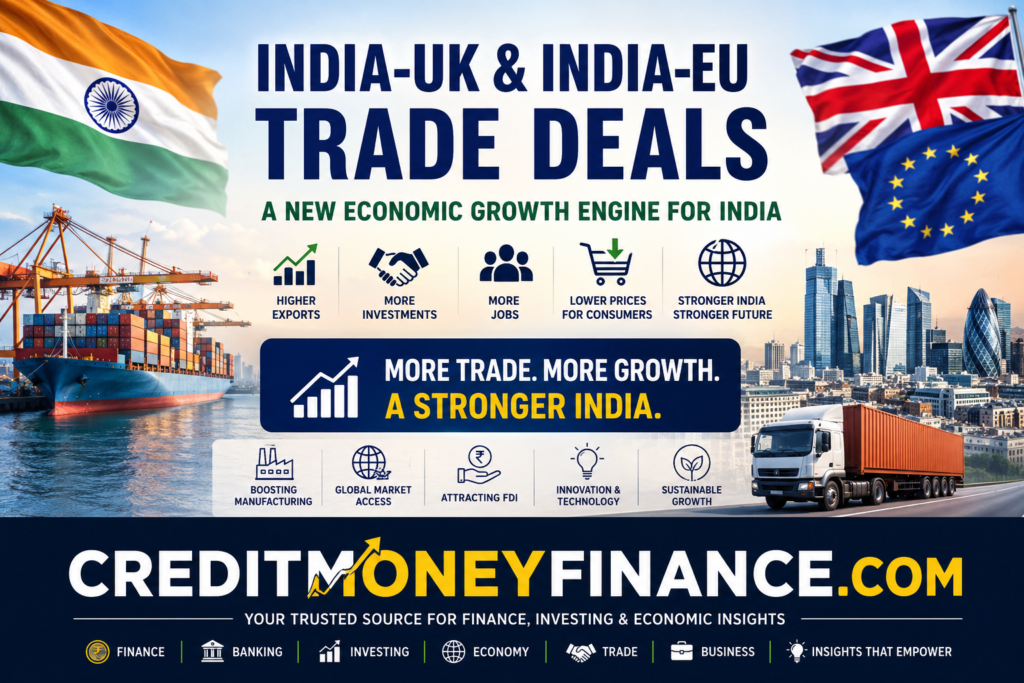
India-UK and India-EU Trade Deals: A New Economic Growth Engine for India, Lower Prices for Consumers and Bigger Opportunities for Businesses.
India’s trade agreements with the UK and the European Union are set to transform the country’s economy by boosting exports, attracting investments, creating jobs, reducing import costs, and strengthening India’s position as a global manufacturing and trade hub. Here’s a detailed analysis of the impact on India’s growth story.
India-UK and India-EU Trade Deals: A New Economic Growth Engine for India’s Economy
By CreditMoneyFinance.com
India is entering a defining phase in its economic journey as it strengthens trade ties with some of the world’s largest and most influential economic blocs. The recently concluded India-UK Free Trade Agreement (FTA), expected to come into force shortly, and the ongoing negotiations for a comprehensive India-European Union (EU) trade pact are being viewed as landmark developments that could reshape India’s economic landscape for decades.
While consumers are likely to benefit from lower prices on several imported products, the bigger story lies in the transformational impact these agreements could have on India’s exports, manufacturing sector, employment generation, foreign investments, and overall economic growth.
For a country aspiring to become a $10 trillion economy in the coming decades, these trade agreements represent much more than tariff reductions—they are strategic instruments that can accelerate India’s rise as a global economic powerhouse.
Understanding the India-UK and India-EU Trade Agreements
The India-UK FTA is designed to significantly reduce tariffs on goods traded between the two nations while opening greater access for services, investments, and professional mobility.
Similarly, India and the European Union are working toward a comprehensive trade agreement that could become one of the most important trade partnerships globally. The EU collectively represents one of India’s largest trading partners and a market of more than 450 million consumers with substantial purchasing power.
Together, these agreements would give Indian businesses preferential access to markets worth trillions of dollars annually.
What Products Could Become Cheaper in India?
One of the immediate benefits consumers may experience is lower prices on several imported products due to reduced customs duties.
Products likely to benefit include:
From the United Kingdom
- Premium automobiles
- Luxury vehicles
- Scotch whisky
- High-end consumer goods
- Medical equipment
- Specialized industrial machinery
- Educational and research products
From the European Union
- Luxury automobiles
- Electronics
- Medical devices
- Industrial equipment
- Fashion and apparel brands
- Premium food and beverages
- Green technology products
However, the extent of price reductions will depend on tariff schedules, local taxes, logistics costs, and currency fluctuations.
The Bigger Story: Massive Export Opportunities for India
The greatest economic advantage lies not in cheaper imports but in India’s ability to export more goods and services.
Indian exporters stand to gain substantially in sectors such as:
Textiles and Garments
India’s textile industry employs millions and competes globally with countries such as Bangladesh, Vietnam, and China.
Lower tariffs in UK and EU markets can make Indian textile products more competitive, leading to increased export orders and job creation.
Pharmaceuticals
India is already known as the “Pharmacy of the World.”
Improved market access could significantly boost exports of:
- Generic medicines
- Vaccines
- Medical formulations
- Healthcare products
Information Technology Services
India’s IT sector remains one of its strongest export engines.
Trade agreements can facilitate:
- Easier movement of professionals
- Greater collaboration between companies
- Expansion of digital services exports
- Increased outsourcing opportunities
Engineering Goods
Indian manufacturers producing:
- Machinery
- Automotive components
- Industrial equipment
- Precision engineering products
could see increased demand from European and British buyers.
Agricultural Products
Indian farmers and food processors could benefit through exports of:
- Tea
- Coffee
- Spices
- Rice
- Seafood
- Processed food products
Boosting Foreign Direct Investment (FDI)
Trade agreements typically increase investor confidence because they provide greater market certainty and long-term stability.
Global corporations often prefer investing in countries that have strong trade links with major economies.
India could witness higher investments in:
Manufacturing
International companies may establish production facilities in India to serve both domestic and export markets.
Renewable Energy
European companies are leaders in:
- Solar technology
- Wind energy
- Green hydrogen
- Sustainable infrastructure
Enhanced cooperation could accelerate India’s green transition.
Financial Services
The UK remains one of the world’s leading financial centers.
Closer integration may encourage:
- Banking investments
- Insurance partnerships
- Fintech collaborations
- Capital market development
Strengthening the “Make in India” Initiative
The Government of India’s Make in India program aims to transform the country into a global manufacturing hub.
Trade agreements can support this objective by:
- Expanding export markets
- Attracting global manufacturers
- Increasing production scale
- Encouraging technology transfer
- Improving competitiveness
As global companies seek alternatives to concentrated supply chains, India is emerging as a preferred destination.
The India-UK and India-EU agreements could accelerate this trend significantly.
Job Creation Across Multiple Sectors
One of the most important outcomes could be employment generation.
As exports increase and investments flow in, jobs are likely to be created in:
Manufacturing
- Factories
- Industrial parks
- Export-oriented units
Services
- IT
- Finance
- Consulting
- Professional services
Logistics and Supply Chains
- Warehousing
- Transportation
- Ports
- Shipping services
Agriculture and Food Processing
- Farming
- Processing units
- Export operations
Millions of direct and indirect jobs could emerge over the next decade if trade volumes increase substantially.
Enhancing India’s Global Competitiveness
Trade agreements often compel domestic industries to improve efficiency and innovation.
Indian businesses will face stronger competition from international players, which can encourage:
- Better product quality
- Greater innovation
- Improved productivity
- Adoption of advanced technologies
Over time, this strengthens India’s overall industrial ecosystem.
Strategic Importance Beyond Economics
These agreements are not merely commercial arrangements.
They also strengthen India’s geopolitical position by:
Diversifying Trade Relationships
India reduces overdependence on any single region by expanding trade with Europe and the UK.
Strengthening Supply Chains
Global companies are increasingly seeking resilient supply chains.
India can become a trusted manufacturing and sourcing destination.
Increasing Global Influence
Greater economic integration enhances India’s role in international trade negotiations and global economic governance.
Potential Challenges India Must Manage
Despite the opportunities, some challenges remain.
Increased Competition
Domestic industries may face competition from imported products.
Certain sectors could require support during the transition period.
Regulatory Compliance
European markets maintain stringent standards regarding:
- Product quality
- Sustainability
- Environmental practices
- Data protection
Indian businesses must upgrade processes to remain competitive.
Trade Deficit Concerns
India must ensure that export growth keeps pace with increased imports to avoid widening trade deficits.
Why These Deals Could Be a Turning Point for India’s Economy
India currently stands at a critical point in its economic evolution.
With:
- A young workforce
- Growing manufacturing capabilities
- Strong digital infrastructure
- Expanding domestic consumption
the country is well positioned to benefit from deeper integration with advanced economies.
The India-UK and prospective India-EU trade agreements could:
✅ Increase exports dramatically
✅ Create millions of jobs
✅ Attract substantial foreign investment
✅ Strengthen manufacturing competitiveness
✅ Improve technology transfer
✅ Support GDP growth
✅ Enhance India’s global economic influence
Conclusion
The India-UK and India-EU trade agreements represent far more than tariff reductions and cheaper imported products. They are strategic economic instruments capable of accelerating India’s transformation into a global manufacturing, services, and investment powerhouse.
While consumers may enjoy lower prices on select imported goods, the true long-term gains lie in increased exports, higher investments, stronger industries, greater employment opportunities, and sustained economic growth.
If implemented effectively and supported by continued reforms, these agreements could become key pillars of India’s journey toward becoming one of the world’s largest and most influential economies in the coming decades.
Published by CreditMoneyFinance.com – Tracking India’s Economic Transformation, Global Markets, Trade, Banking, Finance, and Investment Opportunities.
More Featured Articles:
Strategic Growth Capital for Manufacturing Businesses in India.