
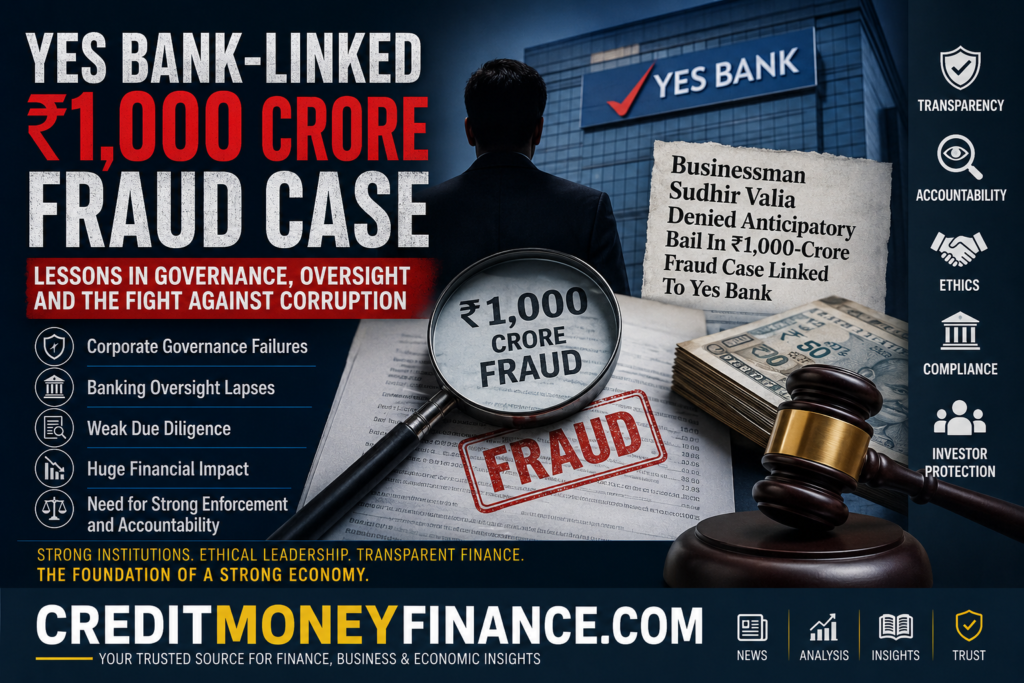
Yes Bank Linked – Suraksha Asset Reconstruction Ltd (Suraksha ARC), ₹1,000 Crore Fraud Case: Lessons in Corporate Governance, Banking Oversight, and the Fight Against Financial Corruption in India.
A detailed analysis of the alleged ₹1,000 crore fraud case linked to businessman Sudhir Valia and Yes Bank. Explore the legal developments, corporate governance concerns, banking compliance failures, and key lessons for investors, lenders, and businesses.
Yes Bank-Linked ₹1,000 Crore Fraud Case: Lessons in Corporate Governance, Banking Oversight, and the Fight Against Financial Corruption in India.
India’s banking and financial services sector has witnessed several high-profile fraud investigations over the last decade. These cases have highlighted the critical importance of transparency, ethical leadership, regulatory compliance, and robust internal controls.
One such matter currently attracting significant public attention is the alleged ₹1,000 crore fraud case linked to businessman Sudhir Valia and certain officials associated with Yes Bank. According to media reports, a court has denied anticipatory bail to the businessman, observing that the allegations involve serious financial irregularities running into hundreds of crores of rupees.
While the legal process remains ongoing and all accused persons are entitled to the presumption of innocence until proven guilty by a competent court of law, the case raises important questions about corporate governance, banking accountability, risk management, and the broader fight against financial corruption in India.
This article examines the developments, the larger implications for India’s financial ecosystem, and the lessons businesses and financial institutions must learn from such cases.
Understanding the Case
According to publicly available reports, the case relates to alleged fraudulent transactions involving substantial sums reportedly exceeding ₹1,000 crore.
The investigating agencies have alleged irregularities in financial dealings and questioned the role of multiple stakeholders involved in the transactions. The court, while considering the anticipatory bail application, reportedly observed that the allegations are serious in nature and involve substantial public and financial interests.
It is important to emphasize that the matter remains under investigation and judicial scrutiny. Any final determination regarding guilt or liability can only emerge after due legal process.
A Mumbai court has rejected the anticipatory bail plea of businessman Sudhir Valia, who is implicated in a Rs 1,000-crore financial fraud involving Yes Bank. The court ruled that the charges are serious and that Valia’s custodial interrogation is necessary.
Rana Kapoor, co-founder of Yes Bank, is also among those accused in the case.
Additional Sessions Judge Anil D. Salunkhe stated, “The seriousness of the alleged economic fraud involving the applicant (Valia) in collusion with Yes Bank officials necessitates custodial interrogation.”
The Economic Offences Wing (EOW) of the Mumbai Police has registered a new FIR targeting Kapoor, Valia, director of Suraksha Asset Reconstruction Ltd, and others, for the alleged illegal transfer of mortgaged properties worth Rs 1,000 crore.
The complaint was filed by Lakhminder Dayal Singh from Saffair Land Development, linked to Housing Development and Infrastructure Ltd (HDIL).
According to the FIR, a company from the HDIL group, Privilege Power and Infrastructure, borrowed Rs 300 crore from Yes Bank’s Worli branch in 2015. Facing financial difficulties, Saffair Land Development sought a Rs 150 crore loan approved by the bank in 2016.
Properties valued at Rs 1,000 crore owned by HDIL and its affiliates were mortgaged to secure the loan, which was due within 36 months. However, in June 2018, Singh discovered that Yes Bank had authorized Suraksha ARC to recover Rs 176.53 crore from his company prematurely.
Singh accused officials of illegally transferring the mortgaged properties while Suraksha ARC had not been declared a Non-Performing Asset (NPA), according to a 2019 audit report. He claimed the properties were sold at below-market prices.
The complainant further alleged that Yes Bank facilitated a margin money transfer of Rs 22.5 crore to Suraksha ARC by funneling it through multiple accounts, as part of a conspiracy to seize the mortgaged properties.
In his plea for pre-arrest bail, Valia denied all charges, asserting he was unjustly implicated with malicious intent.
The defense argued that the case is an attempt by a suspended director to misuse the criminal justice system over a legitimate financial transaction, emphasizing Valia’s position as one of six directors at Suraksha ARC.
Valia noted that the FIR does not specify any direct actions or gains attributed to him personally.
Additional Public Prosecutor Ashwini Rayakar, representing the EOW, contended that Valia and his company have acted in collusion with Yes Bank officials from the start of the alleged transactions.
In response to the defense’s claim regarding a delay in filing, Rayakar clarified that the fraud was uncovered only after the informant reviewed the bank’s audit report.
He argued that a thorough investigation would be impossible without the custodial interrogation of Valia, as both he and the bank officials are primary custodians of the relevant documents.
After reviewing the FIR, the court determined that the primary allegations focus on Valia and Yes Bank officials, who allegedly created forged records to claim properties worth over Rs 1,000 crore associated with the Rs 150 crore loan.
The court emphasized the severity of the allegations and reiterated that prima facie evidence does not suggest that the applicant (Valia) is falsely accused or that the allegations are an attempt to damage his reputation.
Why Large Financial Fraud Cases Matter
Financial fraud is not merely a dispute between lenders and borrowers. Large-scale fraud affects multiple stakeholders across the economy.
These include:
Banks and Financial Institutions
Fraudulent transactions can result in significant financial losses for lenders, weakening balance sheets and increasing provisioning requirements.
Depositors
Although deposits remain protected through regulatory safeguards, public confidence in banking institutions can suffer when major frauds surface.
Shareholders
Corporate scandals often lead to valuation erosion, investor losses, and reputational damage.
Employees
Investigations and financial stress can impact business operations, jobs, and employee morale.
The Economy
Large frauds divert productive capital away from genuine economic activity and can affect credit growth across sectors.
The Corporate Governance Question
One of the recurring themes in major financial fraud investigations is the failure of corporate governance mechanisms.
Good governance requires:
- Transparent financial reporting
- Independent oversight
- Strong internal controls
- Ethical leadership
- Effective board supervision
- Robust audit mechanisms
Whenever these safeguards weaken, opportunities for misconduct increase.
The Indian corporate sector has made considerable progress in governance standards over the years. However, periodic fraud cases demonstrate that governance frameworks must continuously evolve to address emerging risks.
The Banking Oversight Challenge
Banks serve as custodians of public money.
Consequently, lending decisions must be supported by:
Comprehensive Due Diligence
Banks are expected to evaluate:
- Borrower credibility
- Cash flows
- Security coverage
- Business viability
- Financial statements
- End-use of funds
Continuous Monitoring
Monitoring should not end after loan disbursement.
Financial institutions must continuously track:
- Fund utilization
- Repayment patterns
- Financial health indicators
- Related-party transactions
- Compliance obligations
Early Warning Systems
Modern banking increasingly relies on technology-driven systems capable of identifying unusual transactions and potential fraud indicators before losses escalate.
Financial Corruption: A Serious Threat to Economic Development
Financial corruption remains one of the most damaging threats to sustainable economic growth.
Its consequences include:
Loss of Investor Confidence
Investors seek transparent and predictable business environments.
Repeated instances of corruption can discourage domestic and foreign investment.
Increased Cost of Capital
Lenders often respond to elevated fraud risks by tightening credit standards and increasing borrowing costs.
Distortion of Competition
Fraudulent businesses may gain unfair advantages over law-abiding enterprises, undermining healthy competition.
Reduced Trust
Trust forms the foundation of financial markets. Corruption weakens that trust.
Regulatory Reforms and Strengthening of Financial Controls
India has introduced multiple reforms aimed at improving transparency and accountability.
These include:
Enhanced Banking Supervision
Regulators have strengthened monitoring frameworks for banks and non-banking financial companies.
Insolvency and Bankruptcy Framework
The Insolvency and Bankruptcy Code (IBC) has improved creditor rights and recovery mechanisms.
Digital Monitoring
Technology-driven surveillance systems now help identify suspicious transactions more effectively.
Corporate Disclosure Standards
Listed companies face stricter disclosure and reporting requirements.
Strengthened Audit Requirements
Independent auditing and internal audit systems continue to play a vital role in fraud prevention.
Key Lessons for Businesses
Every business owner can learn valuable lessons from high-profile fraud investigations.
Maintain Accurate Records
Proper accounting records reduce compliance risks and improve transparency.
Strengthen Internal Controls
Companies should regularly review:
- Authorization procedures
- Payment controls
- Vendor verification
- Procurement systems
Conduct Independent Audits
Periodic independent audits help identify vulnerabilities before they become major issues.
Build an Ethical Culture
The tone at the top matters.
Organizations led by ethical management teams are generally less vulnerable to misconduct.
Ensure Regulatory Compliance
Compliance should be viewed as a strategic necessity rather than a regulatory burden.
What Investors Should Learn
Investors must avoid relying solely on growth narratives.
Important factors to evaluate include:
- Governance quality
- Auditor observations
- Board independence
- Debt levels
- Related-party transactions
- Cash flow consistency
- Regulatory disclosures
Companies with strong governance standards generally deliver more sustainable long-term performance.
The Need for Strong Enforcement
India’s financial system can only remain robust when fraud investigations are pursued thoroughly and fairly.
Strong enforcement serves several purposes:
- Protecting public funds
- Maintaining market integrity
- Deterring future misconduct
- Strengthening investor confidence
- Supporting economic stability
At the same time, investigations must respect due process and legal rights.
Balancing accountability with fairness remains essential in any rule-based financial system.
Fighting Financial Fraud: A Shared Responsibility
Preventing financial corruption requires coordinated action by:
- Regulators
- Banks
- Auditors
- Corporate boards
- Investors
- Law enforcement agencies
- Employees and whistleblowers
No single institution can eliminate fraud alone.
Effective prevention depends on a culture of transparency, accountability, and ethical conduct throughout the financial ecosystem.
Conclusion
The alleged ₹1,000 crore fraud case linked to businessman Sudhir Valia and certain officials associated with Yes Bank has once again drawn attention to the challenges posed by financial misconduct and governance failures.
While the judicial process is ongoing and final conclusions must await legal determination, the broader message is clear: financial fraud and corruption impose enormous costs on businesses, investors, banks, and society.
India’s growth story depends not only on economic expansion but also on strong institutions, ethical leadership, regulatory vigilance, and uncompromising integrity in financial transactions.
The fight against financial corruption is not merely a legal necessity—it is an economic imperative.
CreditMoneyFinance.com
More Featured Articles:
ESOP Compliance in India: A Complete Guide Every Compliance Professional Must Master (2026 Edition).
RBI FLA Return 2026: Compliance Challenges for GIFT IFSC Entities Under FEMA Explained.
The Ultimate Guide to Company Registration in Dubai 2026: Benefits, Compliance, and Costs.
Ultimate Guide to Singapore Company Registration 2026: Rules, Costs, and Compliance
Expert Guidance on Compliance for Private Limited Companies and LLP in India
Expert Accounting & Taxation and Statutory Compliances Solutions across Indian Cities
BSE Main Board Listed Company without any Business Available for Strategic Acquisition.