
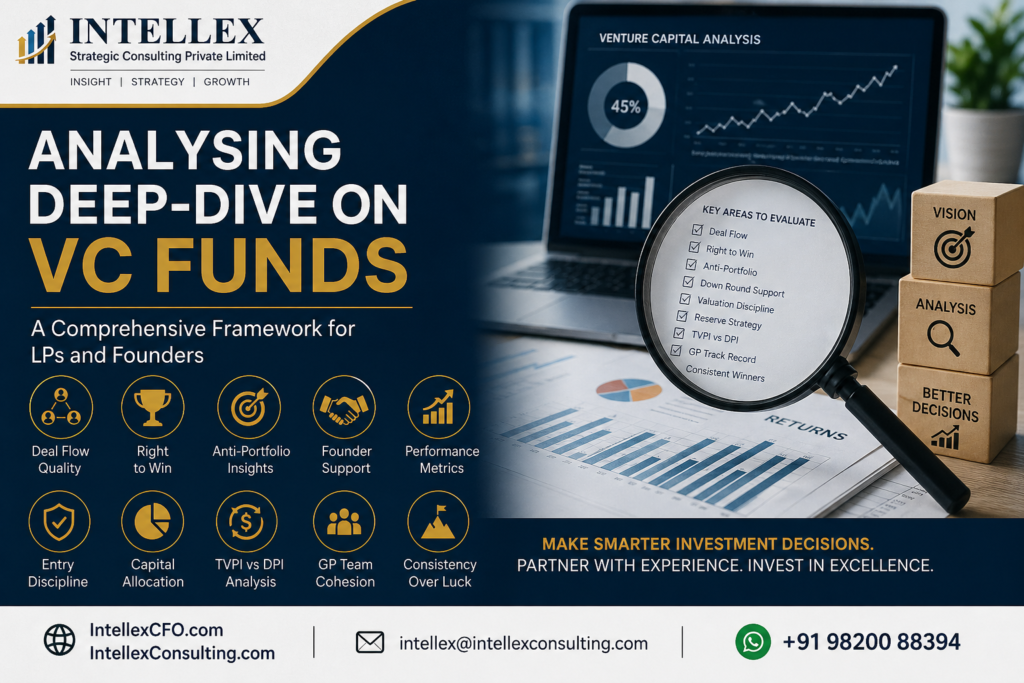
How to Analyse a Venture Capital Fund: A Deep-Dive Framework for LPs and Founders.
A comprehensive guide for LPs and founders on how to analyse venture capital funds deeply. Learn key evaluation frameworks, red flags, and decision-making insights to choose the right VC partner.
Why Deep VC Fund Analysis Matters
In today’s hyper-competitive startup ecosystem, capital is abundant, but the right capital remains scarce. For founders, choosing a venture capital (VC) partner is not merely about securing funds, it is about aligning with long-term strategic partners who can shape the trajectory of the business. For Limited Partners (LPs), investing in a VC fund requires a disciplined evaluation of risk, return potential, and the fund manager’s ability to consistently generate alpha.
Yet, most analyses of VC funds remain surface-level. Metrics like fund size, brand reputation, or headline investments often dominate discussions, leaving deeper structural and behavioural aspects under-examined.
This article presents a deep-dive analytical framework—a set of critical questions and lenses that LPs and founders should use to evaluate VC funds rigorously.
1. Proprietary vs Commoditized Deal Flow
A fundamental question: Does the fund have proprietary access to deals, or are they competing in crowded pipelines?
Proprietary deal flow indicates that a VC firm:
- Has strong founder networks
- Builds early relationships before startups become “hot”
- Gains access to opportunities before large institutional funds
On the other hand, commoditized deal flow suggests:
- The fund invests after validation by larger players
- Limited differentiation in sourcing
- Reduced ability to generate outsized returns
For LPs, proprietary access often correlates with higher alpha generation. For founders, it reflects whether the fund can discover and support non-consensus opportunities early.
2. What Is Their “Right to Win”?
Every successful VC fund has a clear competitive advantage, often referred to as its “right to win.”
This includes:
- Domain expertise (e.g., fintech, SaaS, deep tech)
- Operator experience
- Unique networks or geographic reach
- Brand equity among founders
A strong “right to win” allows funds to:
- Access better deals
- Win competitive rounds
- Add real value post-investment
If a fund lacks this clarity, it may struggle to differentiate itself, especially in competitive funding environments.
3. Analysing the Anti-Portfolio
The anti-portfolio—successful companies a fund did not invest in—offers profound insights.
Key questions:
- Which major winners did they pass on?
- Why were these opportunities rejected?
Interpretation matters:
- Passing on a company outside their thesis shows discipline
- Missing winners within their domain indicates thesis blindness
- Rejecting due to valuation concerns may signal excessive conservatism
A thoughtful anti-portfolio reflects learning ability and intellectual honesty.
4. Lead Investor vs Follower Strategy
Does the fund:
- Lead investment rounds with conviction?
- Or follow larger funds?
Leading rounds suggests:
- Strong internal conviction
- Ability to price risk independently
- Influence over company direction
Following indicates:
- Lower risk appetite
- Dependence on external validation
Neither approach is inherently wrong, but clarity is essential. LPs should assess whether the strategy aligns with return expectations, while founders should consider how much strategic support they need.
5. Behaviour in Down Rounds
A fund’s true character emerges during adversity.
Key considerations:
- Do they support founders during downturns?
- Do they participate in follow-on rounds during crises?
- Or do they withdraw support, signalling negative sentiment?
Down-round behaviour reveals:
- Long-term commitment
- Founder alignment
- Risk management philosophy
For founders, this is crucial. A supportive investor during tough times can mean survival.
6. Feedback from Failed Founders
Success stories are easy to showcase. The real test lies in how a fund behaves when things go wrong.
Ask:
- What do failed founders say about the fund?
- Were they treated with respect and fairness?
- Did the fund provide support or disengage?
This dimension reflects:
- Integrity
- Emotional intelligence
- Long-term reputation
A fund that maintains strong relationships even after failures tends to build trust-driven ecosystems.
7. Entry Discipline and Valuation Strategy
Does the fund maintain valuation discipline, or chase trending deals?
A disciplined fund:
- Understands sector fundamentals deeply
- Prices risk appropriately
- Avoids overpaying in hype cycles
However, excessive rigidity can result in missed opportunities.
The balance lies in:
- Recognizing potential early
- Paying reasonable premiums for exceptional companies
- Avoiding speculative bubbles
Funds that consistently overpay struggle to generate meaningful returns for LPs.
8. Capital Allocation and Reserve Strategy
Top-tier VC funds typically reserve 40–50% of their capital for follow-on investments.
Why this matters:
- A small number of companies generate the majority of returns
- Follow-on investments amplify exposure to winners
A weak reserve strategy suggests:
- Inability to support high-performing portfolio companies
- Dilution in later rounds
- Suboptimal capital efficiency
For LPs, this is a key determinant of portfolio construction quality.
9. Understanding TVPI vs DPI
Two critical performance metrics:
- TVPI (Total Value to Paid-In Capital): Includes unrealized gains (paper value)
- DPI (Distributed to Paid-In Capital): Actual cash returned to investors
A fund showcasing high TVPI but low DPI may:
- Rely on markups from subsequent funding rounds
- Lack real liquidity events
Strong funds demonstrate:
- Consistent DPI growth
- Ability to return capital, not just mark valuations
For LPs, cash returns matter more than paper gains.
10. GP Cohesion and Track Record
Have the General Partners (GPs):
- Worked together across a full fund lifecycle (typically 10 years)?
- Built institutional continuity?
Risks of weak cohesion:
- Dependence on a single “star partner”
- Instability if key individuals exit
- Loss of institutional knowledge
A strong team reflects:
- Stability
- Shared investment philosophy
- Long-term vision
11. Consistency vs One-Off Success
Was the fund’s performance driven by:
- One extraordinary investment (a “black swan”)?
- Or consistent mid-range winners?
A healthy portfolio typically includes:
- Multiple companies delivering 3x–5x returns
- Balanced risk distribution
Funds dependent on a single 10x outcome may struggle to replicate success.
Consistency signals:
- Strong investment processes
- Repeatable strategies
- Robust decision-making frameworks
Bringing It All Together: A Holistic Evaluation Approach
No single metric defines a great VC fund. The most effective analysis combines:
- Quantitative metrics (TVPI, DPI, IRR)
- Qualitative insights (founder feedback, investment philosophy)
- Structural factors (team cohesion, reserve strategy)
LPs should focus on risk-adjusted returns and repeatability, while founders should prioritize alignment, support, and long-term partnership value.
Why Expert Advisory Matters
Analysing venture capital funds at this depth requires:
- Access to insider insights
- Financial expertise
- Pattern recognition across funds and cycles
This is where experienced advisors play a crucial role.
Intellex Strategic Consulting Private Limited brings deep expertise in:
- VC fund evaluation and due diligence
- Startup fundraising strategy
- Investor alignment and positioning
- Financial structuring and valuation advisory
With a strong track record of advising startups, HNIs, and institutional investors, Intellex helps clients make informed, strategic investment decisions.
Connect with Expert Advisors
If you are:
- A founder evaluating the right VC partner
- An LP assessing fund investments
- A startup preparing for fundraising
You can connect with:
Intellex Strategic Consulting Private Limited
🌐 IntellexCFO.com | IntellexConsulting.com
📩 Email: intellex@intellexconsulting.com
📱 WhatsApp: +91 98200 88394
Conclusion
The venture capital ecosystem rewards those who look beyond surface-level signals. A deep, structured approach to analysing VC funds can uncover hidden risks, identify true outperformers, and enable better alignment between capital and vision.
Whether you are deploying capital or raising it, the questions outlined in this framework provide a powerful lens to evaluate venture capital funds intelligently and strategically.
In a world driven by narratives and hype, disciplined analysis remains your strongest advantage.
Intellex Strategic Consulting Pvt Ltd
More Featured Articles:
Venture Debt in India: The Complete 2026 Guide for Startups, Founders, CFOs & Growth Companies.
How Startups Can Raise Funding in Dubai: A Comprehensive Guide for Founders and Entrepreneurs.
Why Kjøller (Dubai) is an important Venture Capital Investor for Startups Globally.