
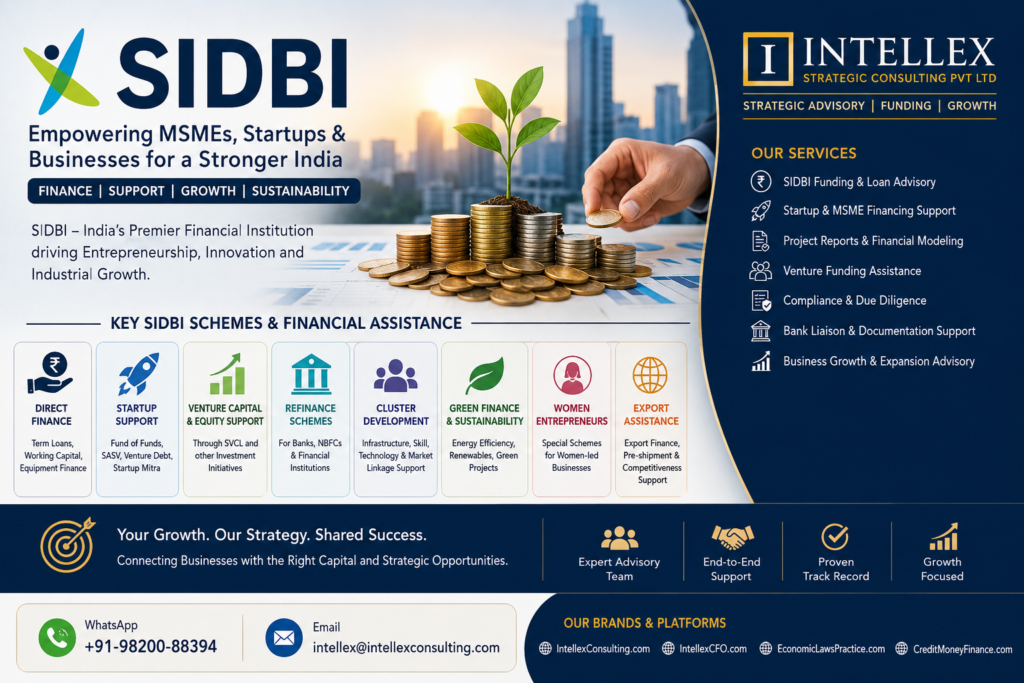
SIDBI Schemes for Indian Startups, MSMEs and Businesses: Complete Guide to Funding, Loans, Credit Support and Financial Assistance in India.
Comprehensive guide to SIDBI and its financing schemes for Indian startups, MSMEs and businesses. Learn about SIDBI loans, venture funding, MSME finance, startup support, refinance schemes, green finance, cluster development, export assistance and government-backed financial programs in India.
Introduction to SIDBI: India’s Premier Financial Institution for MSMEs and Startups
India’s economic growth story is deeply connected with the rise of Micro, Small and Medium Enterprises (MSMEs), startups, manufacturing units, technology ventures, export-oriented businesses, and innovation-led entrepreneurs. Over the past several decades, one institution has consistently played a transformational role in supporting this ecosystem — the Small Industries Development Bank of India, popularly known as SIDBI.
Established on April 2, 1990 under an Act of the Indian Parliament, SIDBI was created as the apex financial institution dedicated to the promotion, financing, and development of the MSME sector in India. SIDBI functions under the jurisdiction of the Government of India and plays a strategic role in strengthening entrepreneurship, industrial development, innovation, sustainability, and financial inclusion.
Today, SIDBI has evolved far beyond a traditional development bank. It is now a critical pillar of India’s startup ecosystem, venture capital landscape, green finance initiatives, fintech ecosystem, women entrepreneurship development, export financing, cluster development, and digital lending infrastructure.
For startups, MSMEs, manufacturers, service providers, exporters, technology companies, and emerging enterprises, SIDBI offers an extensive range of financial products, assistance schemes, venture funding opportunities, refinance support, and advisory solutions.
This comprehensive guide explains SIDBI’s structure, objectives, schemes, financing programs, startup assistance, MSME lending ecosystem, venture capital initiatives, refinance mechanisms, and opportunities available for Indian businesses.
What is SIDBI?
The Small Industries Development Bank of India was established as the principal financial institution for:
- Promotion of MSMEs
- Financing small businesses
- Development of industrial clusters
- Supporting entrepreneurship
- Technology modernization
- Employment generation
- Financial inclusion
- Startup ecosystem development
- Green and sustainable financing
SIDBI acts as:
- A direct lender
- A refinance institution
- A venture capital supporter
- A development institution
- A policy implementation agency
- A startup ecosystem enabler
The institution works closely with:
- Banks
- NBFCs
- Fintech companies
- Venture capital funds
- Government agencies
- State financial corporations
- MSMEs
- Startup incubators
- Industry associations
Importance of SIDBI in India’s Economic Development
The MSME sector contributes significantly to:
- India’s GDP
- Manufacturing output
- Exports
- Employment generation
- Rural industrialization
- Innovation and entrepreneurship
However, MSMEs and startups often face major challenges such as:
- Lack of collateral
- Limited access to credit
- High borrowing costs
- Working capital shortages
- Technology gaps
- Limited investor access
- Poor financial structuring
- Delayed receivables
SIDBI addresses these issues through structured financial assistance, credit enhancement, venture funding, refinancing, and developmental support.
Core Objectives of SIDBI
SIDBI’s primary objectives include:
1. Financing MSMEs
Providing affordable credit to small and medium enterprises across sectors.
2. Startup Ecosystem Development
Supporting startups through debt financing, venture funding, and ecosystem partnerships.
3. Employment Generation
Promoting entrepreneurship and industrial expansion to create jobs.
4. Technology Upgradation
Helping businesses modernize operations and adopt advanced technologies.
5. Green and Sustainable Development
Encouraging environmentally sustainable manufacturing and clean energy adoption.
6. Financial Inclusion
Improving access to finance in underserved and rural markets.
7. Cluster Development
Strengthening industrial clusters through infrastructure and financing support.
SIDBI’s Major Financing and Assistance Schemes
SIDBI operates numerous schemes catering to startups, MSMEs, manufacturing units, service industries, exporters, and technology businesses.
Below are the major categories of SIDBI financial assistance.
1. Direct Finance Schemes by SIDBI
SIDBI provides direct financial assistance to MSMEs and businesses through loans and credit facilities.
A. Term Loans
SIDBI offers long-term loans for:
- Plant and machinery purchase
- Factory expansion
- Technology acquisition
- Infrastructure development
- Capacity enhancement
- Modernization
Key Features
- Competitive interest rates
- Flexible repayment tenure
- Structured moratorium periods
- Support for green projects
- Assistance for new and existing units
Eligible Sectors
- Manufacturing
- Engineering
- Pharmaceuticals
- Food processing
- Textile
- Renewable energy
- IT and technology services
B. Working Capital Assistance
Businesses frequently face liquidity challenges due to:
- Delayed payments
- Inventory cycles
- Seasonal demand
- Expansion activities
SIDBI provides:
- Working capital loans
- Cash credit facilities
- Bill discounting
- Invoice financing
- Trade receivable financing
These facilities help businesses maintain operational continuity.
C. Equipment Finance Scheme
SIDBI finances:
- Industrial machinery
- Medical equipment
- Automation systems
- Technology hardware
- Commercial equipment
This scheme supports businesses seeking operational modernization.
2. SIDBI Startup Assistance Schemes
SIDBI has become one of India’s most important startup financing institutions.
A. Fund of Funds for Startups (FFS)
One of SIDBI’s flagship initiatives is the management of the Fund of Funds for Startups under the Government of India’s Startup India initiative.
Key Highlights
- Managed by SIDBI
- Supports SEBI-registered Alternative Investment Funds (AIFs)
- Indirectly finances startups through venture capital funds
- Encourages innovation and entrepreneurship
Focus Areas
- Technology startups
- SaaS companies
- Fintech
- Healthtech
- Edtech
- AI and deeptech
- Manufacturing innovation
- Agritech
This initiative has significantly expanded India’s venture capital ecosystem.
B. SIDBI Assistance to Startup Ventures (SASV)
This scheme supports:
- Early-stage startups
- Growth-stage ventures
- Innovation-led companies
Assistance Includes
- Debt funding
- Soft loans
- Venture debt
- Growth capital
Advantages
- Reduced collateral burden
- Startup-friendly assessment
- Support for scalable business models
C. Startup Mitra Platform
SIDBI launched Startup Mitra to connect startups with:
- Investors
- Banks
- Incubators
- Venture capital funds
- Government schemes
The platform acts as an integrated startup ecosystem support mechanism.
3. SIDBI Venture Capital and Equity Support
SIDBI actively supports innovation through venture capital participation.
SIDBI Venture Capital Limited (SVCL)
SIDBI Venture Capital Limited supports:
- Innovative startups
- Technology businesses
- Scalable enterprises
- High-growth ventures
Investment Focus
- Technology
- Healthcare
- Manufacturing
- Financial services
- Consumer businesses
- Green businesses
4. SIDBI Refinance Schemes
One of SIDBI’s most powerful functions is refinance support.
Under refinance programs, SIDBI provides funding support to:
- Banks
- NBFCs
- Financial institutions
- Microfinance institutions
These institutions then lend to MSMEs and businesses.
Benefits of SIDBI Refinance
Lower Interest Rates
Refinance enables lenders to provide affordable loans.
Increased Credit Flow
More businesses gain access to formal financing.
Risk Distribution
Financial institutions can improve liquidity and lending capacity.
Sectoral Growth
Targeted refinance boosts strategic sectors.
5. SIDBI Cluster Development Programs
Industrial clusters are groups of interconnected businesses operating in similar industries.
SIDBI supports clusters in:
- Textile
- Leather
- Auto components
- Handicrafts
- Engineering
- Food processing
Support Includes
- Infrastructure financing
- Common facility centers
- Technology support
- Skill development
- Market linkage assistance
Cluster development improves competitiveness and productivity.
6. Green Finance and Sustainable Development Schemes
Sustainability financing is becoming increasingly important in India.
SIDBI supports green initiatives through:
- Energy efficiency loans
- Solar financing
- Waste management projects
- Green building finance
- Renewable energy support
SIDBI Green Financing Features
Funding Support For:
- Solar rooftop systems
- Biomass projects
- Pollution control equipment
- Sustainable manufacturing
- Electric mobility ecosystem
Advantages
- Reduced operating costs
- ESG compliance support
- Improved sustainability credentials
- Lower environmental impact
Green financing is expected to become one of SIDBI’s fastest-growing segments.
7. SIDBI Assistance for Women Entrepreneurs
SIDBI actively promotes women-led businesses.
Key Features
- Concessional financing
- Lower collateral requirements
- Entrepreneurship development
- Capacity-building support
Eligible Businesses
- Manufacturing units
- Service businesses
- Startups
- Retail enterprises
- Homegrown brands
Women entrepreneurship is a major focus area under India’s inclusive growth agenda.
8. SIDBI Support for Export-Oriented Businesses
Exporters face challenges related to:
- Working capital
- Foreign market expansion
- Technology standards
- Currency risks
SIDBI provides assistance for:
- Export finance
- Pre-shipment credit
- Technology modernization
- International competitiveness
This is especially useful for MSME exporters.
9. Digital Lending and Fintech Partnerships
SIDBI has embraced digital transformation aggressively.
The institution collaborates with:
- Fintech companies
- Digital lending platforms
- Alternate credit assessment providers
Benefits
- Faster loan approvals
- Reduced paperwork
- Improved financial inclusion
- Better credit access for small enterprises
Digital financing is helping underserved businesses access institutional funding.
10. Emergency Credit and Relief Schemes
During economic disruptions such as the pandemic, SIDBI played a vital role in supporting businesses.
Support mechanisms included:
- Emergency liquidity assistance
- Moratorium support
- Special credit lines
- Revival packages
- Credit guarantee-backed lending
Such interventions helped thousands of MSMEs survive difficult economic conditions.
SIDBI’s Role in Startup India Ecosystem
India’s startup ecosystem has become one of the world’s largest.
SIDBI contributes through:
- Fund management
- Venture capital support
- Incubator partnerships
- Startup mentoring
- Debt financing
- Innovation support
The institution works alongside:
- Startup India
- DPIIT
- State startup missions
- Incubators
- Accelerators
Eligibility Criteria for SIDBI Assistance
Eligibility depends on the specific scheme, but generally includes:
Eligible Entities
- Proprietorships
- Partnerships
- LLPs
- Private Limited Companies
- MSMEs
- Startups
- Manufacturing businesses
- Service enterprises
Common Requirements
- Business registration
- Financial statements
- Project report
- GST registration
- Bank statements
- KYC compliance
- Credit profile assessment
Startups may additionally require:
- Business plans
- Pitch decks
- Founder profiles
- Revenue projections
- Investor details
How Businesses Can Apply for SIDBI Schemes
Step 1: Identify Suitable Scheme
Businesses should assess:
- Funding requirement
- Purpose of financing
- Business stage
- Eligibility criteria
Step 2: Prepare Documentation
Typical documents include:
- Financial statements
- GST returns
- Income tax returns
- Project reports
- CMA data
- Company incorporation documents
Step 3: Financial Assessment
SIDBI evaluates:
- Business viability
- Promoter credibility
- Cash flow strength
- Industry potential
- Repayment capacity
Step 4: Sanction and Disbursement
Upon approval:
- Loan terms are finalized
- Security documentation is completed
- Funds are disbursed
Common Challenges Businesses Face While Applying
Despite the availability of schemes, businesses often struggle due to:
- Poor documentation
- Weak financial structuring
- Inadequate project reports
- Compliance gaps
- Low credit scores
- Improper business planning
Professional advisory support significantly improves approval chances.
Strategic Importance of Professional Consultants in SIDBI Funding
Businesses increasingly rely on financial and legal consultants to:
- Structure transactions
- Prepare project reports
- Improve bankability
- Conduct compliance reviews
- Prepare financial projections
- Handle due diligence
- Liaise with lenders and investors
This is especially critical for:
- Startups
- High-growth MSMEs
- Manufacturing projects
- Expansion financing
- Venture debt transactions
Future of SIDBI in India’s Growth Story
SIDBI’s importance will continue to grow because:
- India’s MSME sector is expanding rapidly
- Startup investments are increasing
- Green finance is becoming mainstream
- Digital lending is accelerating
- Government support for entrepreneurship is rising
The institution is expected to play a central role in:
- Startup financing
- ESG funding
- Manufacturing growth
- Export competitiveness
- Financial inclusion
- Innovation-led industrialization
Why SIDBI Schemes are Extremely Important for Indian Businesses
SIDBI offers several advantages that traditional financing institutions may not provide effectively.
Major Advantages
Startup-Friendly Financing
Support for innovative and early-stage ventures.
Lower Cost of Borrowing
Competitive interest rates for MSMEs.
Sector-Specific Support
Tailored schemes for manufacturing, exports, green energy, and technology.
Development-Oriented Approach
Focus on long-term industrial growth rather than short-term profitability.
Ecosystem Integration
Collaboration with venture funds, fintechs, incubators, and government agencies.
Industries That Can Benefit Significantly from SIDBI
The following sectors can particularly benefit:
- Manufacturing
- Technology startups
- Fintech
- SaaS businesses
- Pharmaceuticals
- Food processing
- Renewable energy
- Electric vehicles
- Healthcare
- Textile
- Engineering
- Export businesses
- Women-led enterprises
- Rural enterprises
Key Compliance and Legal Considerations
Businesses seeking SIDBI assistance should ensure:
- Proper statutory compliance
- GST compliance
- Income tax filings
- Corporate governance
- ROC compliance
- Financial transparency
- Proper accounting systems
Non-compliance can negatively affect loan approvals and investor confidence.
Role of Financial Planning in Successful SIDBI Funding
Businesses must prepare:
- Realistic projections
- Capital expenditure planning
- Cash flow forecasts
- Debt servicing analysis
- Market feasibility reports
Professional financial structuring enhances credibility before lenders and investors.
Conclusion
The Small Industries Development Bank of India has emerged as one of the most influential financial institutions driving India’s entrepreneurial and industrial growth. Through its diverse financing schemes, startup support initiatives, venture capital ecosystem participation, refinance programs, sustainability financing, and MSME assistance mechanisms, SIDBI plays a transformative role in strengthening the Indian economy.
For startups, MSMEs, manufacturers, exporters, technology companies, and growth-stage enterprises, SIDBI offers tremendous opportunities to access affordable capital, structured financing, strategic support, and ecosystem connectivity.
However, successful access to SIDBI assistance requires strong financial planning, proper compliance management, detailed project structuring, and strategic advisory support.
Businesses that proactively prepare themselves with professional guidance, transparent documentation, scalable business models, and robust financial systems are significantly more likely to secure funding and accelerate sustainable growth.
As India moves toward becoming a global manufacturing and innovation powerhouse, SIDBI will continue to remain a cornerstone institution supporting entrepreneurship, industrialization, employment generation, and economic transformation.
Professional Advisory and Funding Assistance Support
Businesses, startups, MSMEs, manufacturers, exporters, and entrepreneurs seeking assistance with:
- SIDBI funding applications
- Startup financing
- MSME loans
- Venture funding
- Project reports
- Financial structuring
- Compliance advisory
- Due diligence
- Debt syndication
- Investor readiness
- Business expansion financing
- FEMA and regulatory advisory
- ESG and sustainability funding
- Financial documentation
- Bank liaison support
can connect with:
Intellex Strategic Consulting Pvt Ltd
WhatsApp: +91-98200-88394
Email: intellex@intellexconsulting.com
Intellex Strategic Consulting Pvt Ltd provides strategic advisory, transaction support, financial consulting, compliance structuring, startup advisory, and business funding assistance services to Indian and international businesses.
Intellex Strategic Consulting Pvt Ltd
More Finance Related Posts:
Revenue-Based Finance in India 2026: The Ultimate Founder’s Guide to Non-Dilutive Growth Capital
Strategic Finance Options for Medical and Hospital Businesses in India (2026)
Infrastructure Finance in India: Concept, Evolution, Key Players, and the Road Ahead.
Startup Funding Reset: Why Venture Debt Is Powering India’s Next Growth Wave
Breaking the Ceiling: 10 IPO Myths Holding SME Promoters Back.