
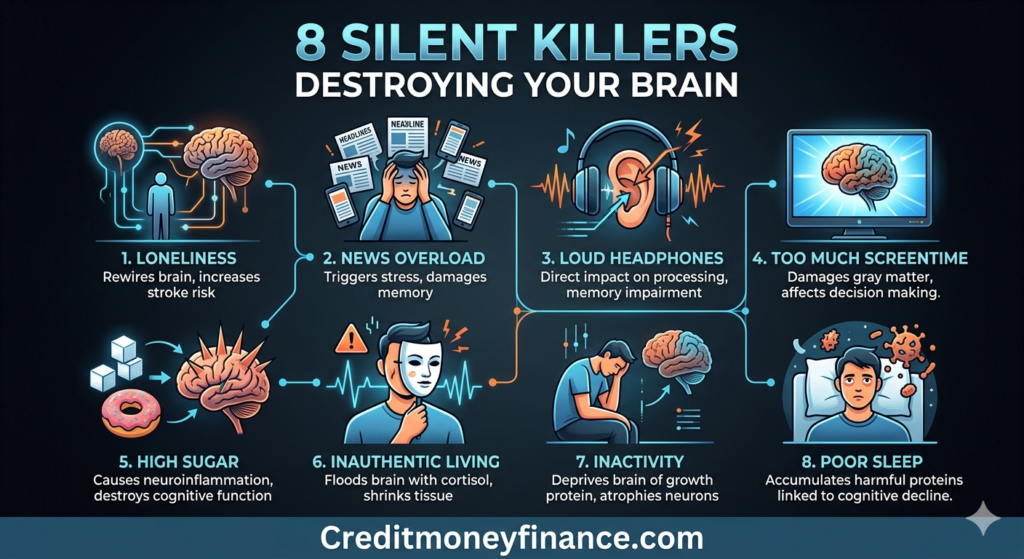
8 Silent Killers Destroying Your Brain: How to Protect Your Greatest Financial Asset.
Your brain is under attack. From hidden sugar to “doomscrolling,” learn the 8 silent killers destroying your cognitive health and how to stop them today.
In the world of finance, we talk a lot about protecting our portfolios, hedging against inflation, and diversifying our assets. But we often ignore our most important asset: the three-pound organ between our ears.
Your brain is responsible for every high-stakes decision, every creative solution, and every cent you earn. Yet, most of us are unknowingly engaging in habits that physically shrink our brain tissue and erode our cognitive edge.
If you want to maintain peak performance and avoid permanent damage, you must address these eight “silent killers.”
1. The Toxicity of Loneliness
We often view loneliness as a social inconvenience, but neurologically, it’s a emergency. Chronic loneliness increases the risk of stroke by 32%. Without regular human connection, your neurons lack the stimulation required to maintain their structure.
- The Fix: Schedule at least two “in-person” social interactions per week. Connection isn’t a luxury; it’s neurological maintenance.
2. The “Informed” Trap: News Overload
In an era of 24-hour market cycles, it’s easy to stay glued to the headlines. However, constant exposure to negative news triggers a chronic fight-or-flight response. This floods the brain with cortisol, which has been shown to shrink the hippocampus—the area responsible for memory and learning.
- The Fix: Implement a “Low Information Diet.” Check the news once a day for 15 minutes, then get out.
3. High-Volume Audio
If you spend your commute or gym sessions with headphones at max volume, you are risking more than your hearing. Hearing loss is directly correlated to cognitive decline. When the brain has to work harder to process sound, it has fewer resources for memory and executive function.
- The Fix: Follow the 60/60 Rule: Never listen at more than 60% volume for more than 60 minutes at a time.
4. Excessive Screen Time
The average professional spends 7+ hours staring at a screen. Research shows this habit can damage the brain’s gray and white matter, specifically in the frontal lobe. This is the “CEO” of your brain—the part that controls decision-making and impulse control.
- The Fix: Use the 20-20-20 rule. Every 20 minutes, look at something 20 feet away for 20 seconds. More importantly, set a “digital sunset” two hours before bed.
5. The Hidden Tax: Sugar
The average person consumes 77g of sugar daily—nearly triple the recommended limit. High sugar intake leads to neuroinflammation, which essentially “rusts” your cognitive gears. It doesn’t just impact your waistline; it slows your processing speed.
- The Fix: Cap your sugar at 25-36g. Read labels; sugar is hidden in “healthy” foods like salad dressings and protein bars.
6. The Stress of Inauthenticity
Living a life that doesn’t align with your values is a neurological nightmare. Whether it’s staying in a soul-crushing job or pretending to be someone you’re not, the “cognitive dissonance” creates chronic physiological stress.
- The Fix: Align your actions with your values. Authenticity reduces internal friction and lowers cortisol levels, preserving your brain tissue.
7. Sedentary Stagnation
Movement is the “fertilizer” for your brain. Physical activity increases BDNF (Brain-Derived Neurotrophic Factor), a protein that helps grow new neurons. If you don’t move, your brain begins to atrophy.
- The Fix: Aim for 150 minutes of moderate aerobic activity per week. Even a brisk walk during a conference call counts.
8. Poor Sleep Hygiene
Think of sleep as your brain’s “waste management” system. During deep sleep, the glymphatic system flushes out toxic proteins (like beta-amyloid) that are linked to Alzheimer’s. If you skip sleep, those toxins stay in your brain.
- The Fix: Prioritize 7–9 hours of sleep. It isn’t “time lost”; it’s the time your brain needs to clear the “trash” from the previous day.
The Bottom Line
In finance, we know that small, compound interest leads to massive wealth. The same applies to your health. By eliminating these eight silent killers, you aren’t just “staying healthy” you are protecting the engine that drives your career, your wealth, and your future.
Team: Creditmoneyfinance.com
More Featured Articles:
14 Bad Habits of Low Self-esteem that You Must Stop now and Beyond
20 Simple Habits That Make People Instantly Respect You
Personal Finance Red Flags Related To Spending Habits
Personal Loans and Business Loans and Professional Loans in India (2025):
The 6 Stages of Personal Financial Collapse and How to Spot Them Early
Why Kjøller (Dubai) is an important Venture Capital Investor for Startups Globally.
Revenue-Based Finance in India 2026: The Ultimate Founder’s Guide to Non-Dilutive Growth Capital