
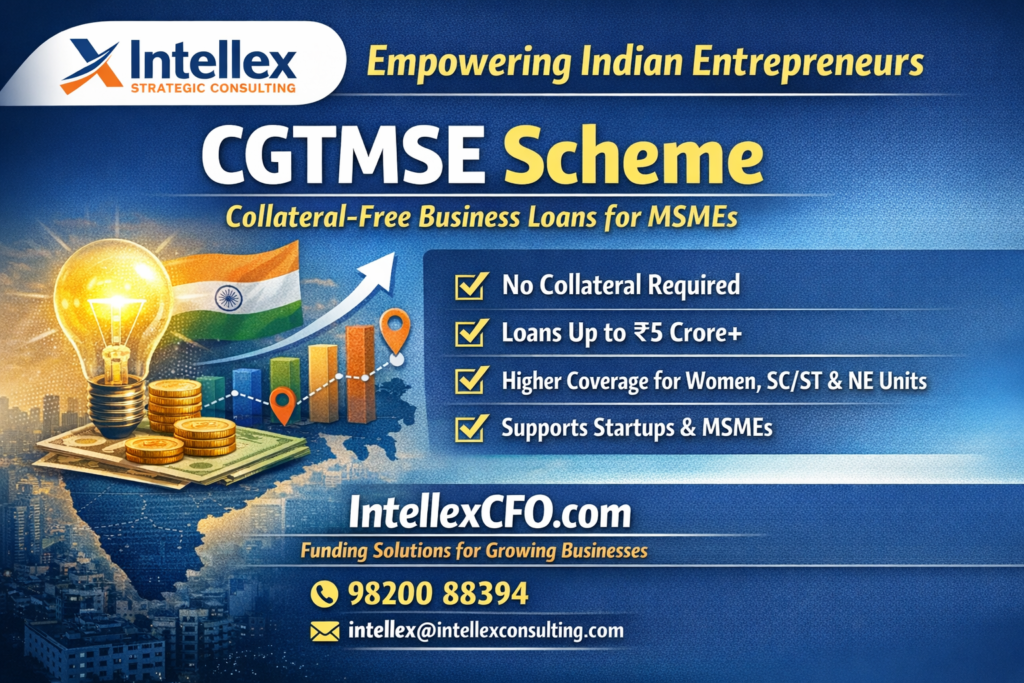
CGTMSE Scheme Explained: A Complete Guide to Collateral-Free Business Loans for MSMEs in India (2026 Edition).
Explore the CGTMSE scheme for collateral-free business loans in India. Learn eligibility, benefits, coverage up to ₹5 crore+, application process & how MSMEs can secure funding without assets.
Empowering Indian Entrepreneurs: A Complete Guide to the CGTMSE Scheme for Collateral-Free Business Loans
Introduction: Solving the Biggest MSME Challenge – Access to Credit
Micro, Small, and Medium Enterprises (MSMEs) are widely recognized as the backbone of the Indian economy. They contribute significantly to employment generation, exports, and GDP growth. However, despite their importance, one persistent challenge continues to hinder their growth — access to formal credit without collateral.
Many promising entrepreneurs and startups lack tangible assets to pledge as security, making it difficult to secure loans from traditional financial institutions. To address this structural gap, the Government of India introduced the Credit Guarantee Fund Trust for Micro and Small Enterprises (CGTMSE) , a transformative initiative designed to enable collateral-free business financing.
What is the CGTMSE Scheme?
The CGTMSE (Credit Guarantee Fund Trust for Micro and Small Enterprises) scheme was launched in 2000 by the Government of India in collaboration with the Small Industries Development Bank of India (SIDBI).
This scheme acts as a credit guarantee mechanism, where the government provides assurance to banks and financial institutions against potential borrower defaults.
Key Highlight:
- Businesses can avail collateral-free loans up to ₹5 crore (and higher in revised frameworks).
- In case of default, CGTMSE covers a significant portion of the loss (up to 85%), thereby reducing lender risk.
This encourages banks to lend more confidently to first-time entrepreneurs, startups, and small businesses.
Objectives of the CGTMSE Scheme
The scheme plays a vital role in strengthening India’s entrepreneurial ecosystem by:
- Promoting self-employment and entrepreneurship
- Enabling first-generation entrepreneurs to access credit
- Bridging the MSME credit gap
- Reducing dependence on informal lending channels
- Supporting national initiatives like Make in India and Atmanirbhar Bharat
- Encouraging financial inclusion and formalization of businesses
Eligibility Criteria for CGTMSE Loans
The scheme is applicable to both new and existing Micro and Small Enterprises (MSEs) engaged in:
Eligible Sectors:
- Manufacturing businesses
- Service enterprises
- Select retail and trading activities
- Startups recognized under Startup India (subject to lender assessment)
Generally Not Eligible:
- Agricultural activities (primary farming)
- Educational and training institutions
- Self-help groups (SHGs)
- Certain speculative or non-productive activities
Loan Coverage & Guarantee Structure
The extent of guarantee coverage depends on the loan amount and borrower category:
| Loan Amount | Guarantee Coverage |
|---|---|
| Up to ₹5 lakh | Up to 85% |
| ₹5 lakh – ₹50 lakh | Up to 75% |
| ₹50 lakh – ₹5 crore | 50% – 75% |
| Women / SC-ST / NE Region | Up to 85% |
Recent Updates & Enhancements
- Guarantee limits enhanced in select cases (policy revisions up to ₹10 crore in expanded frameworks)
- Reduced guarantee fees for MSMEs
- Faster digital processing and claim settlement
- Inclusion of NBFCs to improve credit access in Tier 2 & Tier 3 cities
Types of Loans Covered Under CGTMSE
The scheme supports multiple types of business financing needs:
1. Term Loans
Used for:
- Machinery purchase
- Infrastructure development
- Expansion and modernization
2. Working Capital Loans
Used for:
- Day-to-day operational expenses
- Inventory management
- Cash flow requirements
3. Composite Loans
A combination of:
- Term loan + Working capital
Participating Banks & Financial Institutions
CGTMSE loans are offered through a wide network of financial institutions, including:
- State Bank of India
- HDFC Bank
- ICICI Bank
- Bank of Baroda
- Union Bank of India
- SIDBI
- Approved NBFCs
This broad participation ensures accessibility across urban and semi-urban India.
Key Benefits of the CGTMSE Scheme
✅ No Collateral Required
Entrepreneurs can raise funds without pledging property or assets.
✅ Encourages First-Time Entrepreneurs
Ideal for startups and new business owners with limited financial history.
✅ Reduced Risk for Lenders
Government-backed guarantee increases loan approvals.
✅ Inclusive Financing
Higher coverage for:
- Women entrepreneurs
- SC/ST businesses
- North Eastern region enterprises
✅ Supports Business Growth
Funds can be used for expansion, modernization, and scaling operations.
✅ Promotes Formalization
Encourages businesses to register under Udyam and maintain compliance.
Step-by-Step Process to Apply for a CGTMSE Loan
Step 1: Udyam Registration
Register your business as an MSME.
Step 2: Choose the Right Lender
Approach a bank/NBFC offering CGTMSE-backed loans.
Step 3: Prepare Documentation
Ensure all financial and business documents are ready.
Step 4: Loan Application & Appraisal
The lender evaluates:
- Business viability
- Repayment capacity
- Financial projections
Step 5: CGTMSE Coverage Approval
After sanction, the lender applies for guarantee cover.
Step 6: Loan Disbursement
Funds are released under CGTMSE protection.
Documents Required for CGTMSE Loans
- Udyam Registration Certificate
- PAN & Aadhaar of promoters
- Business plan & financial projections
- KYC documents of company & directors
- GST registration (if applicable)
- Bank statements
- Income tax returns
- Project report / machinery quotations
Common Challenges & How to Overcome Them
While CGTMSE simplifies access to credit, borrowers may face:
1. Loan Rejections Due to Weak Financials
✔ Solution: Prepare a strong project report and realistic projections
2. Lack of Awareness
✔ Solution: Work with professional advisors
3. Delays in Processing
✔ Solution: Ensure complete documentation and compliance
Why Professional Advisory Matters
Navigating CGTMSE applications requires:
- Strong financial structuring
- Bank liaison
- Documentation expertise
This is where expert advisors play a crucial role in improving approval chances and optimizing loan structures.
Conclusion: A Game-Changer for Indian MSMEs
The CGTMSE scheme stands as one of India’s most powerful financial inclusion tools. By eliminating collateral barriers and sharing credit risk, it enables thousands of entrepreneurs to transform ideas into scalable businesses.
Whether you are a startup founder, small business owner, or expanding enterprise, CGTMSE can unlock access to institutional funding — helping you grow sustainably and contribute to India’s economic progress.
Get Expert Assistance for CGTMSE Loans
This article is published in association with IntellexCFO.com, your trusted partner for:
- CGTMSE Loan Advisory
- MSME Funding & Debt Syndication
- Project Finance & Business Planning
- End-to-End Loan Processing Support
Contact Us
📞 WhatsApp: 98200 88394
✉️ Email: intellex@intellexconsulting.com
Team – Intellex Strategic Consulting Private Limited
More Featured Articles:
Revenue-Based Finance in India 2026: The Ultimate Founder’s Guide to Non-Dilutive Growth Capital
Strategic Finance Options for Medical and Hospital Businesses in India (2026)
Infrastructure Finance in India: Concept, Evolution, Key Players, and the Road Ahead.
SEBI Reclassifies REITs as Equity from Jan 2026: InvITs to Remain Hybrid Under New Investment Rules
THE 20 MAIN DIFFERENCES BETWEEN WINNERS AND LOSERS. Which side are you on?
Breaking the Ceiling: 10 IPO Myths Holding SME Promoters Back.