
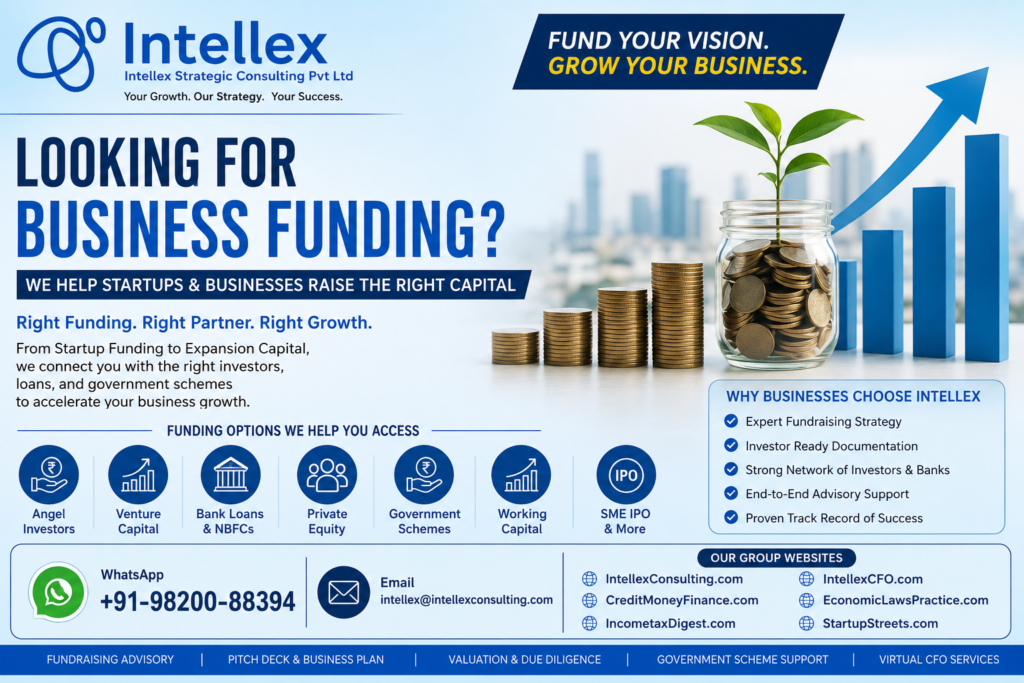
Looking for Business Funding in India? The Complete 2026 Guide for Startups, MSMEs and Growth Companies to Raise Capital Successfully.
Discover the complete guide to business funding in India. Learn about startup funding, angel investors, venture capital, bank loans, government schemes, private equity, debt funding, SME IPOs, investor expectations, due diligence, and fundraising strategies to secure capital for your business.
Looking for Business Funding? Here’s Everything Every Indian Entrepreneur Should Know
One of the biggest challenges faced by entrepreneurs is not starting a business—it is raising the right amount of capital at the right time from the right investors.
India has emerged as one of the world’s largest startup ecosystems with more than 1.6 lakh DPIIT-recognised startups, thousands of active angel investors, hundreds of venture capital funds, family offices, banks, NBFCs, government funding programs and corporate venture capital funds.
However, despite abundant capital available in the ecosystem, only a small percentage of businesses successfully raise funding. Investors today are far more selective than ever before. They look beyond innovative ideas and carefully evaluate execution capability, financial discipline, governance standards and long-term scalability.
This comprehensive guide explains everything Indian entrepreneurs need to know before approaching investors.
Why Businesses Need Funding
Funding is not merely about survival. It is about accelerating growth.
Businesses seek capital for:
- Product development
- Technology creation
- Research & Development
- Market expansion
- Sales and marketing
- Hiring skilled manpower
- Manufacturing capacity
- Working capital
- International expansion
- Business acquisitions
- Equipment purchase
- Regulatory compliance
The right funding allows entrepreneurs to scale much faster than relying solely on internal profits.
Different Stages of Startup Funding
1. Bootstrapping
The entrepreneur funds the business through personal savings or family support.
Ideal for:
- Idea stage
- Prototype development
- Early validation
Advantages:
- Complete ownership
- No investor pressure
Disadvantages:
- Limited capital
- Slower growth
2. Friends & Family Funding
Often the first external funding source.
Investment Size:
₹5 lakh to ₹1 crore
Suitable for validating the business model before approaching institutional investors.
3. Angel Investment
Angel investors are successful entrepreneurs or high-net-worth individuals investing in early-stage companies.
Typical Investment:
- ₹25 lakh
- ₹50 lakh
- ₹1 crore
- ₹5 crore
What Angels Look For
- Strong founder
- Large market opportunity
- Innovative idea
- Scalable business
- Early traction
- Committed management
4. Seed Funding
Seed funding helps startups commercialize products.
Used for:
- Team building
- Marketing
- Product launch
- Customer acquisition
Funding Sources
- Angel Networks
- Seed Funds
- Incubators
- Accelerators
- Family Offices
5. Venture Capital (VC)
VC funding is meant for companies demonstrating rapid growth potential.
Investment Range
₹5 crore to ₹250 crore+
VC firms expect:
- High revenue growth
- Technology advantage
- Large addressable market
- Strong unit economics
- Exit potential
6. Growth Capital
Businesses generating significant revenues require larger investments for expansion.
Funding is used for:
- New factories
- Global expansion
- New product lines
- Acquisitions
Investors include:
- Private Equity Funds
- Sovereign Wealth Funds
- Strategic Investors
7. Private Equity (PE)
PE investors generally invest in mature businesses.
Investment Size
₹50 crore to several thousand crores.
Focus Areas
- EBITDA growth
- Corporate governance
- Profitability
- Market leadership
Debt Funding Options
Not every business needs equity funding.
Many profitable businesses prefer debt financing.
Options include:
- Bank Loans
- NBFC Loans
- Working Capital Limits
- Cash Credit
- Overdraft
- Equipment Finance
- Invoice Discounting
- Supply Chain Finance
- Venture Debt
Debt allows founders to retain ownership while funding growth.
Government Funding Opportunities in India
The Government of India has significantly strengthened the startup ecosystem through various initiatives.
Popular schemes include:
- Startup India Seed Fund Scheme (SISFS)
- SIDBI initiatives
- Credit Guarantee Fund Trust for Micro and Small Enterprises (CGTMSE)
- PMEGP
- MUDRA Loans
- Stand-Up India
- Technology Development Board support
- Biotechnology Industry Research Assistance Council (BIRAC) grants
- MSME Champions Scheme
- State Startup Missions and Innovation Funds
Many of these schemes provide grants, collateral-free loans, interest subsidies or equity support.
Funding Sources Available in India
Entrepreneurs can raise capital from:
- Angel Investors
- Venture Capital Funds
- Family Offices
- Corporate Venture Capital
- Incubators
- Accelerators
- Banks
- NBFCs
- Government Funds
- International Investors
- Private Equity Funds
- Strategic Corporate Investors
- SME IPO Markets
- Crowdfunding Platforms (where permitted)
Documents Required Before Raising Funds
Professional documentation significantly improves investor confidence.
Prepare:
- Pitch Deck
- Executive Summary
- Business Plan
- Financial Model (3–5 years)
- Cap Table
- Founder Profiles
- Market Research
- Customer Validation
- Revenue Projections
- Product Roadmap
- Legal Documents
- IP/Trademark Details
- Company Registrations
- GST & Tax Filings
- Shareholding Pattern
- Due Diligence Data Room
What Investors Evaluate
Investors assess several parameters before investing.
Founders
- Industry expertise
- Leadership
- Integrity
- Commitment
- Vision
Market
- Large addressable market
- Growing demand
- Competitive landscape
Product
- Differentiation
- Technology
- Intellectual property
- Customer problem solved
Business Model
- Revenue visibility
- Scalability
- Margins
- Unit economics
Financial Performance
- Revenue growth
- Burn rate
- Gross margins
- Customer Acquisition Cost (CAC)
- Customer Lifetime Value (LTV)
- Cash runway
Governance
- Compliance
- Accounting standards
- Board oversight
- Legal hygiene
Common Reasons Startups Fail to Raise Funding
Many promising businesses fail because of avoidable mistakes.
Common reasons include:
- Unrealistic valuations
- Weak business model
- Poor financial planning
- No product-market fit
- Lack of customer traction
- Weak founder team
- Poor investor presentation
- Compliance gaps
- Incomplete documentation
- Unclear use of funds
- Weak governance
- Inadequate due diligence preparation
Importance of Due Diligence
Before investing, investors conduct extensive due diligence covering:
- Legal
- Financial
- Tax
- Secretarial
- Technology
- Intellectual Property
- HR
- Commercial
- Operational
- ESG compliance
Businesses should proactively identify and rectify issues before approaching investors.
How Long Does Fundraising Take?
Typical timelines are:
- Angel Funding: 2–4 months
- Seed Funding: 3–6 months
- VC Funding: 4–8 months
- Private Equity: 6–12 months
- Bank Loans: 1–3 months (depending on documentation)
Planning cash flow accordingly is essential.
Tips to Increase Funding Success
- Build a strong founding team.
- Validate the market before seeking investment.
- Develop a compelling investor pitch.
- Maintain transparent financial records.
- Keep statutory compliances up to date.
- Demonstrate customer traction and repeat business.
- Focus on sustainable unit economics.
- Be realistic about valuation.
- Build relationships with investors well before fundraising.
- Seek professional advisors for fundraising strategy and due diligence.
Emerging Funding Trends in India (2026)
The investment landscape continues to evolve, with growing interest in sectors such as:
- Artificial Intelligence (AI)
- Climate Technology
- DeepTech
- Defence Technology
- Space Technology
- EV & Battery Technology
- HealthTech
- FinTech
- Agritech
- SaaS
- Manufacturing
- Semiconductor Ecosystem
- Cybersecurity
- Clean Energy
- Circular Economy
Startups operating in these sectors with scalable business models are attracting strong investor interest.
Final Thoughts
Securing business funding is not just about finding an investor—it is about building a business that investors want to back. Entrepreneurs who focus on governance, compliance, customer validation, financial discipline and long-term value creation significantly improve their chances of raising capital.
Whether you are at the idea stage, scaling rapidly, or preparing for institutional investment, careful planning and professional execution can make the difference between a successful fundraise and a missed opportunity.
Need Professional Assistance for Raising Business Funding?
Intellex Strategic Consulting Pvt Ltd provides end-to-end fundraising advisory and strategic consulting services for startups, MSMEs and growth-stage businesses across India.
Our Services
- Startup Funding Advisory
- Investor Readiness Assessment
- Pitch Deck Preparation
- Business Plan Development
- Financial Modelling
- Valuation Advisory
- Due Diligence Support
- Angel & Venture Capital Connect
- Debt Funding & Working Capital Assistance
- Private Equity Advisory
- Government Grant & Scheme Advisory
- Transaction Structuring
- Compliance & Corporate Advisory
- Virtual CFO Services
Contact Us
Intellex Strategic Consulting Pvt Ltd
📱 WhatsApp: +91-98200-88394
📧 Email: intellex@intellexconsulting.com
🌐 Websites:
- IntellexConsulting.com
- CreditMoneyFinance.com
- IncometaxDigest.com
- IntellexCFO.com
- EconomicLawsPractice.com
- StartupStreets.com
Partner with Intellex Strategic Consulting Pvt Ltd to prepare your business for successful fundraising and long-term growth.
More Featured Articles:
Strategic Growth Capital for Manufacturing Businesses in India.