
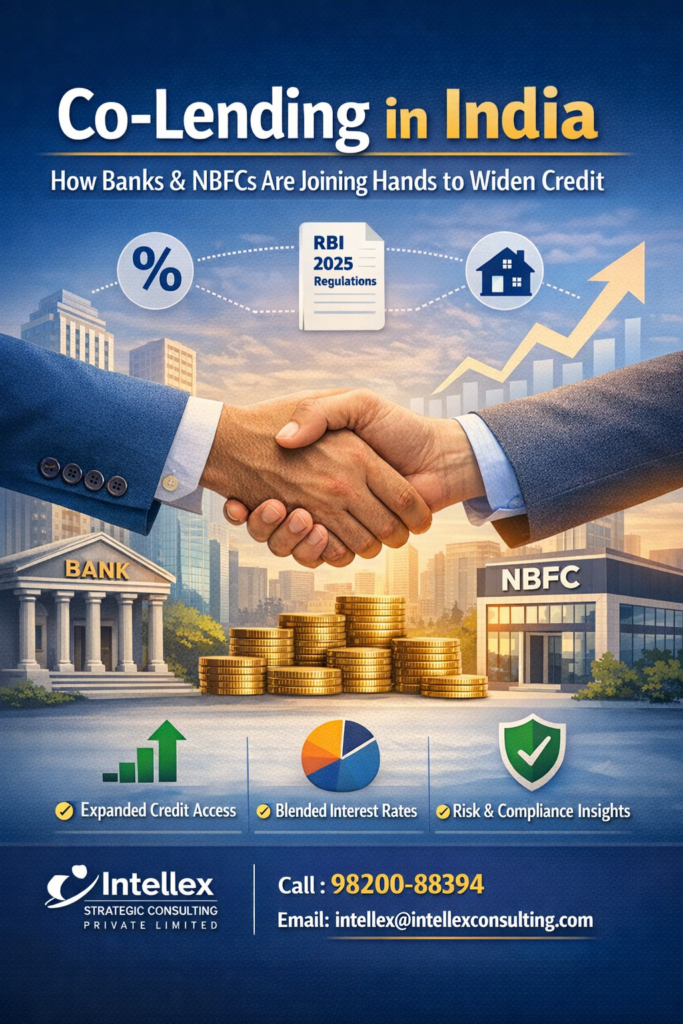
The Evolution of Co-Lending in India: Navigating the 2025 Regulatory Landscape
RBI Co-Lending Directions 2025, Bank-NBFC partnership, Priority Sector Lending (PSL), MSME credit, Blended Interest Rate.
Explore how the co-lending model between Banks and NBFCs is transforming India’s credit market.
Learn about the RBI’s 2025 directions, the impact on MSME lending, and benefits for borrowers.
The Evolution of Co-Lending in India: A Strategic Synergy for Financial Inclusion
The Indian credit landscape is undergoing a structural shift. The Co-Lending Model (CLM) a strategic contractual arrangement where Banks and Non-Banking Financial Companies (NBFCs) jointly fund loans has moved from a niche experiment to a mainstream distribution powerhouse.
By marrying the low-cost liquidity of banks with the agile distribution and specialized underwriting of NBFCs, this model is effectively bridging the credit gap for MSMEs, affordable housing, and the “last-mile” retail segment.
The Regulatory Shift: From 2020 to the 2025 Directions
Since the RBI’s 2020 circular, co-lending has matured significantly. The 2025 Co-Lending Directions (Draft/Final) represent a pivotal milestone, harmonizing the framework to include non-priority sectors and introducing rigorous standards for:
- Standardized Disclosures: Mandating a Key Facts Statement (KFS) for total transparency.
- Operational Integrity: Strict use of escrow accounts and pre-defined appropriation rules.
- Risk Mitigation: Prohibiting implicit loss guarantees to prevent regulatory arbitrage.
How the Co-Lending Mechanism Operates
At its core, a Co-Lending Arrangement (CLA) is a “win-win-win” structure. Here is the typical operational flow:
- The Master Agreement: A board-approved contract defining the product scope, risk-sharing ratios, and exit triggers.
- Origination & Underwriting: The NBFC (the sourcing partner) leverages its local presence to acquire and vet customers. The Bank (the funding partner) maintains oversight through ex-ante due diligence.
- The Funding Split: Loans are funded in a pre-agreed proportion (historically 80:20). Each lender maintains the respective exposure on their own balance sheet.
- The Blended Rate: Borrowers benefit from a single, competitive interest rate derived from the weighted average of both partners’ cost of funds.
Strategic Advantages for Stakeholders
1. For Borrowers
- Enhanced Accessibility: Reaches underserved geographies where traditional banks lack a physical footprint.
- Lower Borrowing Costs: The inclusion of bank capital often drives down the overall APR compared to pure NBFC loans.
- Seamless Experience: Borrowers interact with a single entity (the NBFC) while enjoying the security of a large bank’s backing.
2. For Financial Institutions
- Banks: Gain access to granular, high-yield portfolios and fulfill Priority Sector Lending (PSL) targets without the high overhead of building new distribution branches.
- NBFCs & Fintechs: Unlock massive scalability. By offloading 80% of the loan volume to a bank’s balance sheet, NBFCs can manage capital more efficiently while retaining customer relationships.
Navigating Risks and Compliance
While the model is robust, the RBI’s 2025 directions highlight several areas that require institutional vigilance:
Risk Factor | Regulatory Expectation |
|---|---|
Moral Hazard | Sourcing fees must be arm’s-length and cannot act as a “first loss” guarantee. |
Operational Complexity | Systems must ensure real-time reconciliation of escrow flows and split accounting. |
Cherry-Picking | Banks are discouraged from “discretionary purchase” to ensure the partnership remains a true joint-origination model. |
Grievance Redressal | A clear escalation path to the Banking Ombudsman must be provided to the borrower. |
Looking Ahead: The Future of Collaborative Lending
The RBI’s move toward a consolidated framework signals that co-lending is here to stay. We expect to see a surge in Fintech-Bank partnerships, where AI-driven underwriting allows for near-instant credit decisions. For institutions, the focus must now shift toward tech-stack integration and transparent borrower communication to scale responsibly.
Co-lending is more than just a financial product; it is a pragmatic response to India’s credit needs, ensuring that capital reaches the roots of the economy.
Partner with the Experts
Are you looking to establish or optimize your Co-lending Partnerships? Intellex Strategic Consulting provides end-to-end advisory on regulatory compliance, master agreements, and partner matchmaking.
- WhatsApp: +91 98200-88394
- Email: intellex@intellexconsulting.com
Team : Intellex Strategic Consulting Pvt Ltd
More Featured Articles:
Kotak Mahindra Bank – SME & Wholesale Lending Solutions (₹7–200 Cr)
SIDBI – Powering India’s MSME Growth: Funding, Schemes & Business Support
Revenue-Based Finance in India 2026: The Ultimate Founder’s Guide to Non-Dilutive Growth Capital
Strategic Finance Options for Medical and Hospital Businesses in India (2026)
Infrastructure Finance in India: Concept, Evolution, Key Players, and the Road Ahead.
Personal Finance Red Flags Related To Savings & Emergency Planning