
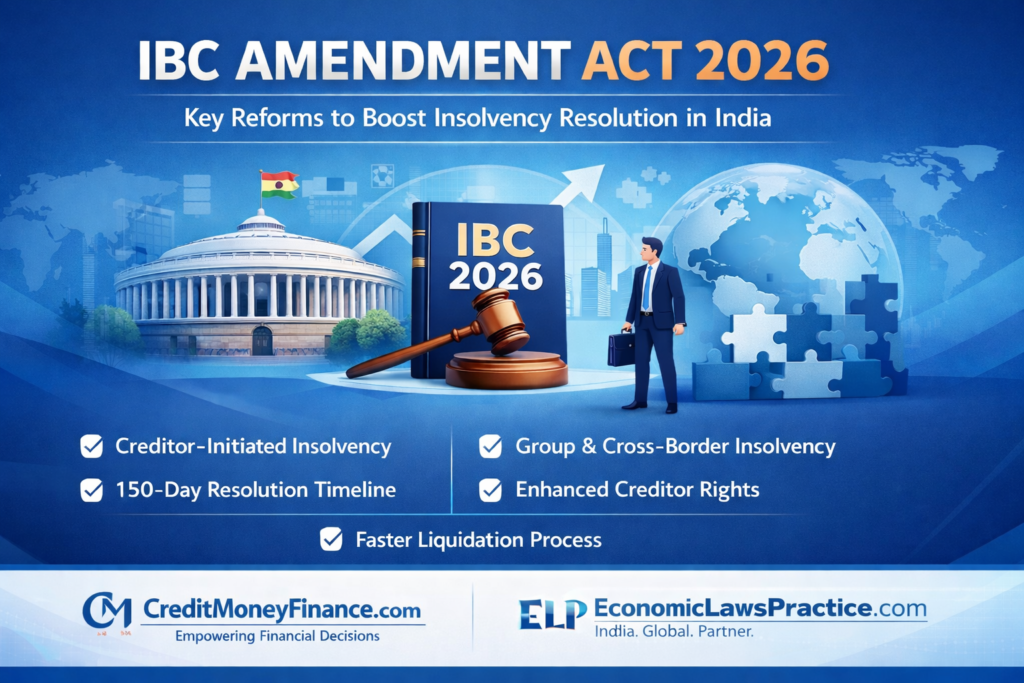
IBC Amendment Act 2026: Transforming India’s Insolvency Framework for Faster Resolution and Stronger Creditor Rights.
A comprehensive guide to the IBC Amendment Act 2026 covering key reforms, timelines, creditor rights, cross-border insolvency, and impact on businesses in India.
India’s insolvency landscape has undergone a significant transformation with the introduction of the Insolvency and Bankruptcy Code (Amendment) Act, 2026. Since its original enactment in 2016, the Insolvency and Bankruptcy Code (IBC) has been a cornerstone reform aimed at resolving stressed assets and improving credit discipline. However, practical challenges such as delays, litigation bottlenecks, and value erosion necessitated further refinement.
The 2026 amendment marks a decisive shift toward speed, efficiency, and creditor empowerment, aligning India’s insolvency regime more closely with global best practices. This article provides a detailed breakdown of the key reforms, their implications, and what businesses, professionals, and creditors need to understand.
Evolution of the Insolvency Framework in India
Before IBC, India’s insolvency resolution was governed by fragmented laws such as SICA, SARFAESI, and the Companies Act. These frameworks often led to:
- Prolonged litigation
- Low recovery rates
- Significant erosion of asset value
The introduction of IBC in 2016 consolidated these laws and established a time-bound resolution process under the supervision of the National Company Law Tribunal (NCLT). While it improved recovery rates and ease of doing business rankings, implementation challenges persisted.
The 2026 amendment is therefore a course correction, addressing systemic inefficiencies.
Key Highlights of the IBC Amendment Act 2026
1. Creditor-Initiated Insolvency Resolution Process (CIIRP)
One of the most transformative reforms is the introduction of the Creditor-Initiated Insolvency Resolution Process (CIIRP).
Traditionally, initiating insolvency required procedural delays and judicial scrutiny. Under CIIRP:
- Financial creditors can initiate insolvency directly with prior approvals
- Reduced dependency on lengthy admission processes
- Faster response to early signs of financial distress
This change strengthens the position of lenders and promotes proactive resolution.
2. Faster Resolution Timeline – 150 Days
The amendment reduces the overall resolution timeline from 330 days to 150 days, including litigation.
This is a major step toward:
- Minimizing value erosion of distressed assets
- Improving recovery rates
- Enhancing investor confidence
Time-bound resolution is critical in insolvency cases, as delays often diminish enterprise value.
3. Mandatory Admission Timeline – 14 Days
The amendment mandates that the National Company Law Tribunal (NCLT) must admit or reject insolvency applications within 14 days of default confirmation.
This addresses a long-standing bottleneck where admission delays stretched for months.
Impact:
- Faster commencement of CIRP
- Reduced uncertainty for creditors and debtors
- Improved judicial efficiency
4. Enhanced Role of Committee of Creditors (CoC)
The Committee of Creditors (CoC) now plays a more active and supervisory role, especially during liquidation.
Key enhancements include:
- Oversight of liquidation proceedings
- Voting rights in key decisions
- Greater control over asset realization
This ensures that stakeholders with financial exposure retain control over outcomes.
5. Group Insolvency Framework
A landmark introduction is the Group Insolvency Framework, which allows coordinated resolution of related entities within a corporate group.
Why this matters:
- Many large businesses operate through multiple interconnected entities
- Separate proceedings often lead to fragmented resolution and lower recoveries
With group insolvency:
- Proceedings can be consolidated
- Value maximization becomes more feasible
- Interdependent assets can be resolved holistically
6. Cross-Border Insolvency Provisions
The amendment introduces a structured framework for cross-border insolvency, enabling cooperation with foreign jurisdictions.
This is broadly aligned with global standards such as the UNCITRAL Model Law.
Key features:
- Recognition of foreign insolvency proceedings
- Coordination between Indian and foreign courts
- Protection of assets across jurisdictions
This reform is crucial in a globalized economy where companies have international operations.
Strengthened Creditor Rights
Minimum Payout to Dissenting Creditors
Dissenting financial creditors are now entitled to receive at least:
- The liquidation value, or
- The amount payable under the resolution plan
This ensures fairness and protects minority creditors.
Power to Replace Liquidators
The CoC can now replace a liquidator with 66% voting share, enhancing accountability in liquidation proceedings.
Transfer of Guarantor Assets
With CoC approval, the framework allows:
- Transfer or resolution of personal guarantor assets
- Better recovery prospects for lenders
This closes a key gap in earlier provisions where guarantor enforcement was complex.
Efficiency and Process Improvements
Time-Bound Mechanisms
Strict timelines have been introduced across all stages:
- Admission
- Resolution
- Liquidation
This ensures discipline and predictability in insolvency proceedings.
Restrictions on Withdrawal of CIRP
The amendment introduces tighter controls on withdrawal of insolvency applications to prevent misuse or strategic delays.
Clarification on Government Dues
The law clarifies the treatment of statutory dues, reducing ambiguity and litigation involving government authorities.
Resolution Professional as Liquidator
The amendment provides clarity on the appointment of the Resolution Professional (RP) as the liquidator, ensuring continuity and efficiency.
Impact on Key Stakeholders
For Financial Institutions
- Greater control over insolvency proceedings
- Improved recovery rates
- Reduced timelines and legal uncertainty
For Corporates
- Faster resolution of distress
- Increased pressure for timely debt servicing
- More structured exit mechanisms
For Investors
- Enhanced confidence in India’s insolvency regime
- Better valuation of distressed assets
- Increased participation in stressed asset markets
For Professionals
- Greater responsibility and accountability
- Increased demand for insolvency professionals, legal advisors, and restructuring experts
Challenges and Considerations
While the amendment is progressive, certain challenges may arise:
- Capacity constraints at NCLT benches
- Implementation of cross-border insolvency mechanisms
- Coordination complexities in group insolvency cases
- Need for robust regulatory oversight
Effective execution will determine the success of these reforms.
Conclusion
The IBC Amendment Act 2026 represents a pivotal evolution in India’s insolvency ecosystem. By focusing on speed, transparency, and creditor empowerment, the reform aims to address long-standing inefficiencies and align India with global insolvency standards.
The introduction of CIIRP, reduced timelines, group insolvency, and cross-border provisions signals a mature and forward-looking legal framework. For businesses, lenders, and professionals, adapting to these changes will be essential in navigating the evolving financial landscape.
As India continues its journey toward becoming a global economic powerhouse, a robust and efficient insolvency regime will play a critical role in sustaining investor confidence and financial stability.
Team : Credit Money Finance
More Featured Articles:
Revenue-Based Finance in India 2026: The Ultimate Founder’s Guide to Non-Dilutive Growth Capital
Strategic Finance Options for Medical and Hospital Businesses in India (2026)
Top 10 Angel Networks in India Driving the Startup Boom
How Do VCs & Angel Funds Analyze Startups?
The Most Powerful Wealth-Building Skill: A Proven 5-Step Framework to Make Money Faster.