
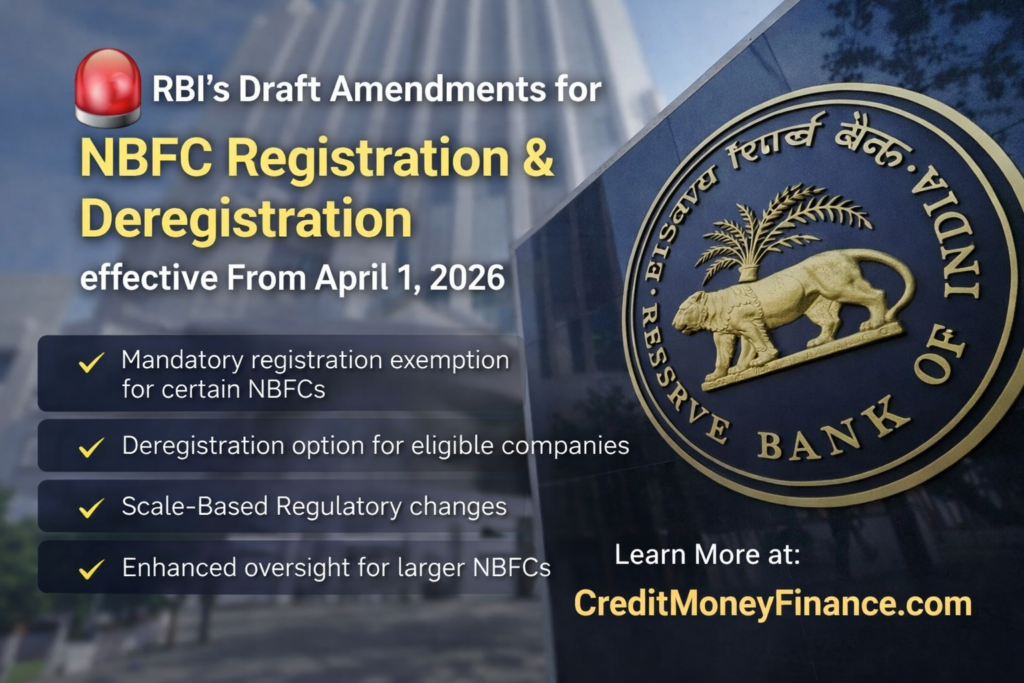
RBI’s Groundbreaking Draft Amendments for NBFC Registration & Deregistration (2026): What India’s Financial Sector Must Know
Explore the RBI’s latest draft amendments that propose exempting small NBFCs from mandatory registration, introduce deregistration pathways, and reshape the regulatory framework under the Scale-Based Approach.
Introduction:
The Reserve Bank of India (RBI) has taken a significant step toward reforming the regulatory landscape for Non-Banking Financial Companies (NBFCs). Through the recently issued draft Reserve Bank of India (Non-Banking Financial Companies – Registration, Exemptions and Framework for Scale-Based Regulation) Amendment Directions, 2026, the central bank aims to ease regulatory burdens for smaller, low-risk NBFCs while ensuring continued financial oversight and stability.
These draft amendments effective from April 1, 2026 have already sparked broad interest across the NBFC sector.
We break down what these RBI draft changes mean, the context behind them, and why it matters for NBFCs, investors, regulators, and financial stakeholders.
1. Background: NBFC Regulation Under RBI.
NBFCs are key players in India’s financial ecosystem offering credit, investment, leasing, and other services outside the formal banking sector.
Unlike banks, NBFCs cannot accept demand deposits but are otherwise governed by the Reserve Bank of India Act, 1934, especially Section 45-IA, which mandates NBFCs to register with the RBI before commencing business.
In 2021, RBI introduced the Scale-Based Regulatory (SBR) Framework to classify NBFCs by size, risk profile, and systemic importance. Under SBR:
NBFCs with larger assets or public engagement face stricter regulation.
Smaller, lower-risk NBFCs fall into the Base Layer with lighter compliance.
Until now, however, registration was mandatory regardless of business model creating compliance costs for entities that neither raise public funds nor interact with retail customers.
2. The 2026 Draft Amendment: Key Highlights:
A. Exemption from Mandatory Registration:
Perhaps the most consequential change proposed is the exemption from mandatory RBI registration for a specific class of NBFCs those that:
✔️ Do not avail public funds
✔️ Have no customer interface
✔️ Operate with an asset base of less than ₹1,000 crore.
According to the draft, such NBFCs will be classified as “Unregistered Type I NBFCs” and will be exempt from registration requirements.
This change aims to reduce regulatory friction for smaller and low-risk financial firms, allowing them to focus on credit delivery and business growth rather than compliance overheads.
B. Deregistration Window for Existing NBFCs:
Existing NBFCs that currently hold a registration and meet the exemption criteria as of April 1, 2026 can apply for deregistration under the draft rules.
The deregistration must be applied via the PRAVAAH portal, with supporting documents like certificates of registration, audited financials, board resolutions, and undertakings.
The deadline to apply is 30th September 2026, offering a six-month transition window for compliant entities.
This provides a clear roadmap for NBFCs looking to adjust to the new regime.
C. Registration Maintained for Certain NBFCs:
Not all NBFCs benefit from deregistration. The draft states:
NBFCs with assets more than ₹1,000 crores even if they don’t take public funds or have customer interfaces must register as Type I NBFCs.
Any NBFC that subsequently decides to accept public funds or have customer interaction must register with RBI as a Type II NBFC before doing so.
This ensures that larger or more systemic NBFCs remain under appropriate regulatory supervision.
D. Continued Regulatory Oversight:
Importantly, the exemption from registration does not mean deregulation in full. Even unregistered, low-risk NBFCs remain subject to:
RBI’s authority under the RBI Act
Supervisory actions, including penal measures, if risks emerge
Other applicable RBI directions and financial sector laws.
This balances ease of doing business with financial stability safeguards.
- Please Read: Funding Solutions for NBFCs & HFCs
3. Rationale Behind the Change:
The RBI’s proposals are rooted in the idea that not all NBFCs pose equal systemic risk. Smaller entities without public exposure, customer dealings, or significant assets often have:
Lower risk profiles,
Limited impact on financial stability and Unique business models that don’t justify full RBI compliance overhead.
By exempting such NBFCs from costly registration requirements, RBI seeks to:
Reduce compliance burden,
Promote credit flow and formalization
Allocate supervisory resources where they matter most (larger and systemic NBFCs)
Essentially, this reflects a more risk-sensitive regulatory approach.
4. Practical Implications for NBFCs.
For Small & Low-Risk NBFCs.
Less compliance cost and paperwork,
Potential reclassification without losing legitimacy,
Strategic flexibility to focus on business operations, etc
For Medium & Large NBFCs:
Continued requirement for registration and oversight,
Clearer regulatory thresholds for when registration is needed,
Enhanced accountability if plans change (e.g., start public fundraising).
For Investors & Stakeholders:
Simplified due diligence for low-risk, NBFC opportunities, and
Greater transparency on regulatory expectations.
5. RBI’s Broader Regulatory Vision.
The draft amendments align with RBI’s larger goals to:
Create differential regulation under SBR,
Encourage responsible growth of the NBFC sector,
Avoid one-size-fits-all regulation, and
Maintain financial stability while supporting credit access.
The RBI also continues consultations on other draft frameworks including customer protection, mis-selling norms, and loan recovery standards showing a broad commitment to updated financial regulation.
6. Next Steps & Consultations:
The draft is open for public comments until early March 2026, indicating RBI’s commitment to stakeholder feedback before final implementation. Entities planning to take advantage of deregistration or exemption criteria should watch deadlines closely.
Conclusion:
RBI’s 2026 draft amendments signal a major shift in NBFC regulation one that recognizes diversity in size, risk, and business models. By exempting certain NBFCs from registration requirements, providing a deregistration window, and maintaining prudent oversight where necessary, the regulator balances ease of doing business with financial system safety.
For NBFC practitioners, investors, and financial professionals, understanding these changes isn’t just compliance , it’s strategic planning for the future of India’s dynamic non-bank finance landscape.
Team: Creditmoneyfinance.com
More Featured Articles :
Working Capital Solutions for Growing Businesses across India from Banks and NBFC
How to Secure Unsecured Business Loans & Working Capital Without Collateral.
The Ultimate Guide to Working Capital Solutions for Growing Businesses in India (2026)
The Ultimate Guide to Company Registration in Dubai 2026: Benefits, Compliance, and Costs